Thursday, 29 March 2018

Red Desert, Part 2


1. An important point about Antonioni’s ‘Red Desert’ is that we should not jump to conclusions about the film’s central message. Antonioni himself has been troubled by the unintentional (or intentional) misunderstanding of the film, and he has stressed repetitively in interviews about what he was trying to say in ‘Red Desert’. Especially for the detractors, they would easy engage in cherry picking and said the film’s stance was anti-technology, anti-nature or even anti-progress, which were all rebutted by the director. The detractors simply have failed to see the big picture.


2. I feel that the stance posed by ‘Red Desert’ is remarkably similar to that of ‘2001: A Space Odyssey’, because the above labels could also be used by its detractors to attack the sci-fi classic. Both Antonioni and Kubrick were never against technology from the beginning. What they have delivered in common was a balanced point-of-view about technology and progress and how that might impact humanity and inspire changes. For both filmmakers, if you want to understand more about the human condition, you should not turn away from the problematic issues, even if they originate from well-intended motivations.


3. Though Antonioni did celebrate that humanity has the power to master and control nature, he was not at all oblivious to the consequences of that. He was indeed viewing the issue in a very realistic stance. As he stated in another interview, each era has demanded sacrifices upon which other things were built. There is no evolution without crisis. Antonioni appreciated the problem that arose from any form of progress, and demanded the audience not to retreat or run away from them. Before we think about the big questions, let’s deal with a bit of psychology first.


4. Giuliana seemed to have the ability to see things in a unique way. Yet, the heightened sensation might just be subjective (and probably delusional) point of view from Giuliana, suggesting she might have some form of mental illness. Antonioni, on the other hand, did not provide any clue about an impartial perspective, therefore the audience has no clue whose (or which) point of view was the correct one that points to reality? Certainly, this was the style that Antonioni employed in many of his films, as an allusion to Nietzsche’s philosophy.


5. And, I believe there is a vision that Antonioni has been always delivering, much like that of Dreyer and Bergman as I will discuss in later articles – that in real life there is only a thin line because vivid imaginations and potential psychosis. When you see something so different from other people, as Orson Welles would have put it, ‘he / she is either a genius or a complete idiot’. Moreover, it is rather ironic that Giuliani’s idealistic thought - the island she was mentioning in her story was the only one that seemed to reconcile with any attributes grounded in reality, as least the way the audience would find comfortable with. The colors in the sequence were natural, not deliberately deformed or heightened in any way.


6. Objectively, Ugo, Giuliana’s husband, was quite concerned that she has probably contacted some sort of mental illness and therefore she was not acting quite right. Worse still, Giuliana was distressed by a nightmare involving herself sinking in quicksand. This aspect is interesting because it reminds me of another 1964 film from the East, Hiroshi Teshigahara’s ‘Woman in the Dunes’, which I have talked about before. That film was also surrealistic and dealt with existential issues, and I am not sure that is a mere coincidence or maybe there is some inspiration between the two. The content of the dream was not random, it was quite deliberate. When Giuliana was hospitalized before that, she heard an anecdote from a woman that she was afraid of drowning because she felt that was no ground beneath her, as if she was sliding down a slope. Later on, when courting with Corrado, she expressed that she couldn’t look at the sea – though she liked the feeling of it – because she would lose interest on the land - which was what her issue seemed to originate. This is a very nice analogy because the very act of ‘drowning’ was like the unquestioning and conformity to the situations people found themselves in. Giuliana seemed to be aware of the existential ennui, no matter how sick she might be judged by psychiatry, that she had to get away from this turmoil.


7. What is quite obvious, though, was that Giuliana’s real issue originated from her isolation and alienation from the world around her. Not only the modernizing environment has led to her distress, she found it hard to find a true and lasting relationship from others, including her family. The people around her might have offered some possible distractions – sex, politics, material possessions, or mindless RPGs – but any of them would not lead to a better status for her. She had the responsibility to figure it out for herself.


8. The memorable fog scene signifies the existential angst of many characters of Antionioni’s films in general. In the scene, characters appear and disappear amidst the fog, as if not certain of who they are, and what their individual identities lead them to. The very fact that the characters are widely separated in the scene separated the inevitable loneliness inside every one of us, the isolation inherent in the individualism of humanity. This memorable scene was Antonioni’s poetic portrayal of the human condition we must all confront at some point.


9. Corrado, who was Ugo (Giuliana’s husband)’s business partner, was an interesting character. While he was not a model character – there were no model characters in an Antonioni film – he was at least concerned with Giuliana’s plight and was willing to connect with her. Like everybody else, he was also in a state of alienation, but he was a bit more open to interact with his surroundings and has always attempted to look for a solution. He told Giuliana "You wonder what to look at; I wonder how to live." So, he was exploring the attitude to live for a meaningful life. His voyage to Argentina symbolized a possible solution to counteract the existential crisis – to simply run away / escape from the situation. But is it the right way to go?


10. Antonioni disagreed. He felt that the right attitude was not to long for the more primitive times, with the belief that it was a more natural landscape for man. Nor was it to escape from the painful condition. This is best illustrated in the final minutes of the film. When Giuliana and Valerio were walking near his husband’s industrial plant, a stream of exotic yellow smoke was shooting out. And while Valerio wondered whether the birds would be harmed by the poisonous smoke, Giuliana gave an answer that showed she was enlightened regarding her situation. The birds did not just escape or never came back, rather, they figured out a way to get around the poisonous smoke, so that they could be suited to the ever-changing environment. Antonioni believed this flexible attitude was something that we had to develop to meet the changes we encounter in the modern age.


11. Antonioni also believed in hope from the younger generations, like Bergman in ‘The Silence’. Giuliana’s son, Valerio, had a fascination with the robot toy, and his attitude was more open to changes than the other characters. Regarding the robot, that’s a scene where the ambiguity has led to contradictory interpretations from the viewers. The robot accidentally switched his direction and repeatedly crashed into a wall, without the people noticing it. After the light of the room was switched off, the only visible aspect was the robot’s shining eyes. Antonioni appreciated that this scene was meant to be open to interpretation, though he did not want the viewers to feel that the scene had a negative outlook suggesting the technological direction was leading humanity to a dead end. Rather, he pointed out that because in the dark the shining eyes of the robot was the only source of illumination, it could be the thing that could assist humanity to a better outcome. Because Valerio could easily accept this new toy, he would be more equipped to face the many changes that he would eventually encounter in his adulthood.


12. With ‘Red Desert’, Antonioni asked his audience to have a change in perspective – should things be always perceived in the same way? Anything, no matter natural and man-made, can have the potential to show a beauty of its own. That only depends on how you look at it.


(2/2)


Film Analysis


Friday, 9 March 2018

A Few Words on Oscar


The Academy Awards ceremony has taken place on 5th March, 2018. While there were not many surprises for the winners, it is a great idea here to review a few of these wonderful films from 2017.
 
The Shape of Water’ has won the Best Picture Oscar, and Guillermo del Toro has won his first Oscar for his stunning directorial effort. Del Toro has been acclaimed as a visual and imaginative director over the years, and while ‘The Shape of Water’ has similarities with another of his masterpiece, ‘Pan’s Labyrinth’, these films are about the potential of imagination and fantasy within a harsh reality. The two protagonists of ‘The Shape of Water’ were both underdogs – who were the victims in a paranoid and prejudiced world. There should be no surprise that the story took place in a setting of the Cold War because that was exactly the time when people did not put much consideration on the well-being and dignity of individuals – even if it was a blue, fish-like creature – and subject to bouts of electric shocks and vivisections. Yet, del Toro is willing to offer us hope – the setting was exactly where fantasy and love could become possible, when the mute protagonist and the creature could fathom a compassion beyond human. The scenario is very similar to ‘Pan’s Labyrinth’, when the little girl has to imagine a fantasy world with the creature with horns to ‘detox’ her really stressful situations. The evil clutches may prevail sometimes in the real world through the brute force, yet those with golden hearts deserve more than just the world. Just like the 2 protagonists in the film, they can reach a realm where they can be happy together, and this is what a visionary filmmaker like del Toro can offer. After all, the analogy of water (which somewhat recalls Bruce Lee’s philosophical statement – ‘Be water, my friend) is related to humanity. Water is free-flowing, can come in all sort of forms and shapes. It only depends on the context, and gives meaning to itself. And, what you can make meanings out of your existence depends on you. 

Gary Oldman and Frances McDormand won the Best Actor and Best Actress respectively for their brilliant performances in ‘Darkest Hour’ and ‘Three Billboards Outside Ebbing, Missouri’. All the nominees in the Best Actor category are wonderful, and it really is a bit of a Mexican Standoff there. Gary Oldman has steadily proved to us that he is a spectacular actor who deserves to be loved throughout the years. One can never forget his killer performance in ‘Leon: The Professional’, when he played the Beethoven loving bad cop. Just like when he was portraying Winston Churchill, he put all his feelings and efforts into the character, and with the stunning makeup effects he literally became Churchill. I suppose many of the film lovers would feel great about Oldman finally winning the Oscar. Frances McDormand, who has already won the Best Actress Oscar years ago in ‘Fargo’, completely nailed it as the obsessive, foul-mouthed, and determined mother in ‘Three Billboards’. Her intense look only showed her determination of getting things right, and she would drop F-bombs and go NBK (interesting that Woody Harrelson was also in the film – a bit sad he did not get the Oscar, but then Sam Rockwell is also great) on the injustice that befell around her. The three billboards represented her modus operandi when facing with the disjointed time, direct and to the point. McDormand is channeling Klaus Kinski here – her character is obsessive about her aim, and she can easily go a bit too far – at a certain point throwing Molotov cocktails (and F-bombs and racial slurs) to the police station. I do not feel the director was asking the audience to judge his characters. There is no point to ask whether McDormand’s character is good or evil, so are Harrelson’s and Rockwell’s, because the flaws are what make them so human and realistic. The dark sides portrayed in the film – the prejudice, obsession, anger – are something present in our world, and we have to be courageous and confront them often. Ms. McDormand’s talent should be lauded because, as a leading lady often in Coen Brothers’ films, ‘Blood Simple’, ‘Fargo’ etc., she always delivered the first rate performance of surviving and fighting in an absurd, bigoted, and to be plain, effed-up universe. The intensity of her performance testified the fighting back of the individual, something that humanity should really cherish and celebrate.

Dunkirk’ won 3 technical awards, and Christopher Nolan was nominated for both director and picture. The film is special because Nolan has painstakingly turned away the narrative structure common in many American movies. The idea of the film is very simple, very different from his past work like Memento or Inception. The plot is sort of similar to The Wages of Fear, where basically the soldiers were fighting for their lives through round after round of obstacles, asking themselves when they will hit the wall. What Nolan has achieved is to present the story through a very visual and aural way, and the scenarios here would give the audience snapshots and experience of war. Nolan did not try to give us a coherent story of the evacuation, and this should not be seen as a shortcoming of the film, as some critics may have assumed. He deliberately downplayed the importance of the use of dialogue to explain the story and feelings of the characters, so in a Kubrickian sense - the film is possibly the closest in terms of his influence from Kubrick - Nolan ‘banalized’ the dialogues and made the characters opaque. Because, like Mildred's case in ‘Three Billboards’, there was no room for polite society, everyone was just reacting to survive and passing the round. I really love the fact that since the first meeting of the 2 main characters on the beach, they have not really said anything to each other, but no one would deny that they were friends. I believe this is a testament to Nolan's caliber, where you do not need any sentimental dialogues to convince the audience they are comrades - all you need is a creative vision.

How did Nolan achieve this visual experience? It is instructive that he has taken inspiration from silent films, an era that dialogues were only presented as title cards, and the filmmaker had to exert the power 100% by the cinematic images. That is the reason why some of the most memorable cinematic images come from the silent era, because the filmmaker had to fully rely on the visual aspects to make the point. Nolan used purely visual means to portray the stress and excitement when one was locked in battle, and the spectacular sound effects lead to a cinematic poiesis of action. The effect is further enhanced because Nolan played in parallel 3 sets of action of various durations, and the relativity of the time difference clearly heightened and alienated the effect of viewing the film. The stylized score evoked stress for the audience, and completely matched the theme of escalation as shown in the film. When watching the film, I could only think of the famous quote from Churchill, ‘If you're going through hell, keep going!’

Finally, how can we miss 'Blade Runner 2049', a genuinely fantastic film from 2017? Though I was a bit disappointed the film was not recognized by any major category nominations of Oscar - I would be surprised if the film was not a top 10 film of 2017 - it did finally get the respect from the great reviews from critics this time, and got 5 nominations in Oscar, eventually winning 2 well deserved ones - Visual Effects and Cinematography. Though I will always see BR as a Ridley Scott masterpiece, Denis Villeneuve has given new life to the story, and he has made significant contributions in terms of the interpretations of BR.

Roger Deakins, a first-rate director of photography who has worked with the Coen Brothers, Scorsese and Villeneuve, finally won his first Oscar for BR2049. Deakins is the rare sort of  cinematographer who has a style as distinct as a  filmmaker, some other examples are Vittorio Storaro, Gordon Willis and Emmanuel Lubezki. Say, in Storaro’s case, no matter it is a Bertulocci, Coppola, or Beatty film, Storaro always provides his signature fluid camera movement, and complements with the approach of the director in question. When we look at Deakins’s style, one can usually identify with a gritty atmosphere, and that is why he has such fruitful collaborations with the Coen Brothers and also Villeneuve, as it will be very different if Deakins’s signature style is absent in films like ‘Prisoners’ and ‘Sicario’. Deakins’s style perfectly fits the future noir of Blade Runner, and affords a sense of edginess to the not-that-black-and-white film. Speaking of style, we should also acknowledge and appreciate the original effort of Jordan Cronenweth, the cinematographer for the original Blade Runner film in 1982. It was him who gave us the atmospheric feel of the original masterpiece, and literally influenced every sci-fi or cyberpunk films since then. Scott has always maintained that Blade Runner was intended to contain elements of Film Noir, and it should be of no surprise that Cronenweth’s approach to cinematography was also inspired by the aesthetics of Film Noir. The low key, expressionistic feel that penetrate both Blade Runner films is exactly what make them visually stunning and that achievement deserves the recognition from Oscar.

Really look forward to more wonderful films in 2018!


Friday, 23 February 2018

Red Desert, Part 1

Monica Vitti in 'Red Desert'

This time, I would like to talk about Michelangelo Antonioni’s ‘Red Desert’. Though it was a film more than 50 years ago, it is still a recommendable film for today’s audience. While I first became fascinated in Antonioni’s work after working ‘Blow Up’ many years ago, it has turned out that ‘Red Desert’ would become my favorite Antonioni film of all. I am impressed by the thoughtfulness and philosophical outlook of the film, and I think the central theme of the film is relevant for people from any era – what sort of attitude and action should one take in an ever-changing world? Just merely try to fit in and get every gadgets that are just on the web 5 seconds ago? Or to retreat and celebrate the good old times and a simpler life? As we will see, Antonioni recommended a more positive plan of action for the audience.     


The visual style of ‘Red Desert’ has influenced many subsequent films. Alfred Hitchcock, who admired Antonioni, has been impressed by the color use in ‘Red Desert’ and ‘Blow Up’. He tried to adapt a similar visual style in his unrealized film ‘Kaleidoscope’, and what a shame this film could never be made. On the other hand, John Boorman has also cited his influence from Antonioni and other European filmmakers when he made the Lee Marvin classic ‘Point Blank’ in 1967, which was also about the question of subjectivity and alienation. 


The story concerned the experience of Giuliana, the mother of a single child, in a modernizing and industrial town. She struggled to come to terms in the technological progress around her, and a subtle suggestion stated that she might be suffering from some form of neurosis – and certainly existential crisis. Through her interaction with the people, and also landscape and environment around, would she be able to find her own place, and also have the wisdom to figure out a meaning of her life? 


Once in an interview, Antonioni has expressed a lot about his view on ‘Red Desert’. He noted that this film represented a shift of focus for his filmography, because for his 3 films before that – the trilogy that started with ‘L’ – they were more concerned with relationships between people. In ‘Red Desert’, a more cosmological and outward perspective was taken – he wanted to explore more about how individuals interacted with their surroundings – the ‘human in universe’ theme, which I have mentioned quite a lot before in other films. While this approach would likely require an impartial perspective, Antonioni’s style turned out to be far more imaginative than that.  


The style could be considered artificial or even abstract at points, very much like a high-end modernist artwork. While color may at the surface seem to enhance the realism of the scenes – human beings see in color, right? – Antonioni’s evocative use of color seemed to lead to the very opposite paradoxically. His use of color led to a ‘formalist abstraction’, which served his anti-realist motivation. Thus, the color was seen as very ‘heightened’ for the audience, and to be honest, it has a weird sort of pleasure when one looks at it. Antonioni has also explained that the artificiality of his color would enhance the expressivity of his images, I guess much like the edginess seen in German Expressionism. It is notable that Antonioni used a telephoto lens when he shot ‘Red Desert’, because in order to achieve an anti-realist effect, he was committed to reduce the depth of field often evident in Bazinian Realism, and his use of the lens led to a flattening effect of his images, where the distance between foreground and background was reduced. 


As noted by many critics, the motif of landscape is very important for Antonioni's films. Antonioni has succinctly stated that all his works were born of a landscape, and his desire to explore the landscape. Thus, one can start by saying that Antonioni has provided an impersonal view of humanity, as there is a delicate balance between the emphasis of humans and environment.  


Antonioni employed some nice editing strategies to illustrate an abrupt shift of focus and to illustrate to the audience how his characters were trapped by their surroundings. He deliberately did sudden cut from a conversation between 2 characters to a background shot, to state that the characters were locked in a larger surrounding they might or might not be appreciating. Interestingly, this strategy has been used by a lot of great directors, where they attempted to show an alienation and entrapment of the characters. Stanley Kubrick’s ‘Barry Lyndon’, Joseph L. Mankiewicz’s ‘Sleuth’, Martin Scorsese’s ‘Taxi Driver’ contained nice examples of this great approach. The placement of the characters were also quite unusual in many cases, as if Antonioni was attempted to undermine them, suggesting a loss of agency of these characters towards their environment or the context they found themselves in. 


The poiesis from Antonioni meant that he was not only determined to confront his audience visually, but also aurally. He portrayed the irony that, in some senses, the industrial noises were even louder than the character’s dialogue – which would NOT be the case for the traditional approach of Western cinema – symbolizing that these characters were entrapped and alienated, and could not deliver clearly their thoughts and feelings to each other.

(1/2)

by Ed Law
24/2/2018

Film Analysis


Friday, 2 February 2018

La Notte


1. In January and February this year, a number of films by the Italian filmmaker Michelangelo Antonioni are re-released in Hong Kong. This time, I am going to talk about ‘La Notte’, which is part of a trilogy with ‘L’Avventura’ and ‘L’Eclisse’.  I will present my viewpoints in an episodic manner, as if they are some random thoughts from my mind.

2. ‘La Notte’ is fascinating in the sense that it can be qualified for the guideline for classical unities in Aristotle's ‘Poetics’ - the unity of time. In terms of theme, ‘La Notte’ shares similarity with another film of the same era, John Cassevetes’s ‘Faces’, though the approaches to the issue were quite different between the 2 filmmakers. It has also been compared to Stanley Kubrick's 'Eyes Wide Shut'.

3. The story concerned Giovanni and Lidia, a couple from Milan, and how the experience in an evening would push them to examine their relationship.  While the activities might sound a bit random and episodic, Antonioni’s intention was probably deliberate and these activities will lead to meanings if one is willing to look beyond the banality of the surface.

4. The relationship between the couple was detached, and soon Lidia felt that she needed some solitude and thus wandered into the evening lights. When she strolled through the place she once lived, some solutions seemed to offer to her in the form of her perceptions – aggression (a fight) or running away (the setting off of some homemade rockets). As one would see also in the later Antonioni’s films, these are often not the best way to deal with one’s existential terror, though they might have provided some form of short-term solace.

5. Memories have been confronting the characters, especially our 2 protagonists. Antonioni the filmmaker seemed to provide his characters a lot of things to think back on, say, where they lived in the past, and the love poem Giovanni has written a long time ago. Giovanni went as far to claim that all he was left with were recollections of the past, though, ironically, Lidia caught him off by noting that he even forgot his own poem, where he has written for Lidia to show his love.

6. It is also worthwhile to see that the mise-en-scene has also emphasized the detached relationships for the characters. Antonioni deliberately installed barriers like gates and doors to symbolize the distance between characters, and the limits that impeded them to get closer to each other in an emotional way. One of the scenes involved a floor which resembled a chessboard, as if the characters were players in a game, always keeping safe distance from what others could offer.

7. Giovanni succinctly stated to Lidia regarding his existential angst, "I no longer have inspirations, only recollections". Inspirations are what we need to move on with our lives, to find out our own meanings throughout the journey of our existence. Giovanni pinpointed the stalemate in his own life, and probably his relationship with Lidia. All Lidia could recommend, which was understandable at first glance, was that "One must do something", and they just dropped in to a lavish party, to explore any new opportunities for gratifications.

8. The party by the millionaire was fascinating, because although the activities might appear banal, Giovanni and Lidia were forced to confront a number of issues – fidelity (in the form of Monica Vitti and her invented game), fame and wealth, mortality and nature (the sudden shower). What I have often wondered is to what extent Kubrick has been influenced by this double-flirting sequence and put it into ‘Eyes Wide Shut’ (he did mention ‘La Notte’ was one of his favorite films). The force of nature also exposed the carnality of some of these ‘civilized’ guests – they literally jumped into the pool like kids when rain started to pour.

9. The millionaire, Gherardini, was portrayed rather neutrally in the film, given the belief Antonioni would likely have regarding this sort of people. Gherardini indeed gave a few insightful observations about modern life. Not only he saw through the decadence and wealth-oriented nature of the modern ago, he also felt that the meaning of life has to be figured out by the individual himself. Gherardini cared less about his position on the billionaire list, yet he wanted to create something ‘solid’ – which was a legacy of himself to be remembered. He also pointed out a nice point regarding writer and or form of artist – one should create an art work because of necessity, because the artist had a will to do it – they just wanna do it, period. It could not just be reward or recognition that one wanted to involve in art work. Gherardini’s vision also coincided with some key ideas of existentialism, for example his affirmative insistence that ‘Life is what we make of it through our own efforts.’, and his concentration on the present rather than the inaccessible future. 

10. After all that happened throughout the evening, they reflected one last time on their relationship. Lidia was sad because she felt that she no longer loved Giovanni, and she felt like dying because there was clearly a relationship she has cherished all the time, and she saw it as an intense loss. Giovanni could appreciate the seriousness of the issue and he kept on reassuring her that he definitely loved her.

11. It should be fair to state that both of them were experiencing some form of crisis, so we cannot say who should be more responsible for the marriage failure. Lidia, by noting that Giovanni has forgotten his own love letter, allowed him to confront his own memories, his vision of the affair. In a sense, Giovanni would be able to discover new meanings in these lost memories, and see how they might be inspiring him to regard his relationship with Lidia, just like he has once written for Lidia, "Beyond your face I saw a pure, beautiful vision showing us in the perspective of my whole life...all the year to come, even all the years past.".

12. Antonioni concluded La Notte with an open ending, by not giving the answer of whether Giovanni and Lidia reconciled at the end. I would be optimistic and speculate that they would have a greater chance to be back with each other. Because throughout the night, they had so many chances to rediscover themselves and realize where the problems were. Both of them still treasured the relationship they have sustained, and would feel depressed if that ended with a nasty note. When Giovanni was forcing himself on Lidia (sort of), it was almost the dawn, suggesting the beginning of a new day, and a new chapter of their relationship. That is the idea of ‘lost and found’ – through the recognition of the the value of what that has been lost, it will then orient for a new start. After all, that is what I think Antonioni has always wanted us to be able to do.

by Ed Law
3/2/2018

Film Analysis


Friday, 26 January 2018

La Ronde


This time, I will talk about a film by Max Ophüls, known as ‘La Ronde’.


The story of ‘La Ronde’ was adapted from a play written by Arthur Schnitzler, who also wrote ‘Dream Story’, the novel that inspired Kubrick's ‘Eyes Wide Shut’. Schnitzler's visionary look at the sexual relationships and psychological aspects of the human condition was inspiring even for today's readers, as he seemed to see through the universal and anthropological traits that have governed human's behaviors all the way - our desires, our imaginations, and our needs for love and recognition from others. Freud, a contemporary of Schnitzler, was very impressed by the writer's ideas and was also amazed by how close their outlooks resembled each other, going as far to call Schnitzler his ‘double’.


The story were formalized in a sense, because it involved ten love stories, where they were interconnected and consecutive. To put it plainly: let’s say the ladies were represented by [A, C, E, G…]; and the gents were represented by [B, D, F, H…]. So A flirted with B, then when the relationship ended; B hanged around with C; then C with D; and D with E… and all the way back to A, rather ironically. Very stylized from a 19th century writer, isn't it? It can be considered as a round dance of love. What is more interesting, not only the sexual relations appeared random, they also transcended all form of class relations, which was really a core value back in the 19th century. Hence, the blue-blooded and aristocrats got a bang on with the low lives. If there existed a reason why the firewall of ideology could be crashed, then it would be that the clockwork of lust (I cannot find a word more appropriate than ‘clockwork’) here were driven by the desire and impulse to feel love and pleasure. The encounters in ‘La Ronde’ may sound amoral, if you really take it seriously within the framework of monogamy or ‘respect’ for someone you love. Yet, I do not feel Schnitzler and Ophüls were passing any moral judgments here. They were just merely reporting the truths of human nature.


While the play itself is a fascinating story on its own right, Ophüls’ creative approach

In his treatment of the story was also noteworthy. Not only it stood as a testament for his unique style, the theme was also addressed nicely through Ophüls’ style. For the design, the story was told by an operator of a carousel, and it was evident that the analogy of a carousel fitted well with the structure of the story because of their circular forms. It also signified the filmmaker’s fluid and mobile camera style, and reinforced the interaction between style and content. All the love stories were locked in as if they were separate components of the carousel, yet it was important to appreciate that they are all connected at the same time. It can be ironic to realize that, while the stories belonged to the ten or so characters, it was the operator which was orchestrating all the stories, and telling the stories with a full control, as if he was a conductor of a symphony. The complexity of the plot also stemmed from the fact that the stories itself were not all objective, they resembled layers and layers of memories and opinions, which might be subjective or even considered as rumors. Deleuze, who has admired Ophüls and cited the filmmaker’s work as examples in his philosophy of cinema, has put it nicely that the structure of ‘La Ronde’ resembled a crystal of memories – which was a form of time-image for his categorization. He pointed out that the reason why it was categorized as time-image was due to the fact that the stories were not merely objective recollections, meaning that the audience had to actively engage with these memories and discovered any (subjective) meanings for themselves. This active participation often distinguishes the ‘time-image’, often served as an ideal of film art, from the films with a more conventional narrative. All in all, Ophüls’ version of ‘La Ronde’ illustrated a formal beauty that signified the filmmaker’s achievement as a cinematic artist.

by Ed Law
27/1/2018

Film Analysis


Saturday, 13 January 2018

Cinematic Poiesis

For some filmmakers, the approach to cinema is not very different from the approach to poetry. The approach is to look for a 'poetic' in cinema, which is advocated by many film theorists. The word has a history as far as the dramatic theory from Aristotle, and this approach of art has been embraced by various thinkers throughout history.

The word 'poetics' was derived from the Greek word 'poiesis', which meant active making. David Bordwell believes that film should be studied as a process of construction. To him and those who support the approach, an appreciation of cinema should in no way be limited to a mere analysis of plot or narrative itself. That means ‘story’ is not the only metric to assess a film, as for those who thinks ‘If you have a great story, you have a great film’ may insist. Even if one has a dull story it may still be metamorphosed to a brilliant film, and the greatest plot can appear like a high school video project if that falls onto the wrong hands. What is the magic behind that? If is the other side of the coin – form (or style).

A poetic of cinema is a delicate entanglement of three elements of films: image, sound and word. It is the combination of the aural dialogue, music, sound and also the visual composition, lighting, editing, and narrative aspect that leads to an organic unity. Often, if it is done satisfactorily, the effect is not merely additive, and the sum can be greater than the parts. While Poetics concerns film form or the formal aspects of cinema, it is not necessarily the same as the movement of Formalism, popularized by the Russians in the early 20th century - though there may be certain common aspects between them.

Filmmakers like Kubrick, Ozu, Welles, Antonioni and Tarkovsky, and many other great ones, have put together the various aspect of cinematic techniques, leading to an active construction of cinematic experience for the audience. The great thing about poiesis is that it demands an active participation from the members of the audience, not just passively receiving filmic images under the power of the so called ‘plot’ or ‘narrative’.

Bordwell contributed intensely to this field by studying in depth the style of Yasujiro Ozu, who I will talk about in later articles. What is quite ironic about the analysis of Ozu is that he has been labelled as traditional and the most Japanese by some critics, who seems to have only observed the surface of the issue. It turns out that Ozu has put up more Western and American references that one can expect, even in his earliest films. As Bordwell has pointed out and elaborated in detail, Ozu's style was among the most original and innovative towards the Western audience, because he defied many rules and techniques what most American filmmakers would see as the norm and were comfortable with.

Bordwell presented his ideas in 'Ozu and the Poetics of Cinema', and then he also published ‘Poetics of Cinema’, in which he developed his central thesis and provided more examples throughout the history of cinema. I recommend these books to anyone who is interested in cinema and want to understand more how cinematic style can lead to an impact on its audience. You will see cinema in a completely new light! 

by Ed Law 
Film Analysis


Friday, 5 January 2018

2001: A Space Odyssey - The Quantum Leap


The year 2018 marks the 50th anniversary of Stanley Kubrick's ‘2001: A Space Odyssey’, and that makes total sense for us to continue our exploration of this modern classic. This time, we will do something special. I will concentrate on only a single scene in 2001. While that may seem a bit of an excess, it is justified because that scene in question is widely considered at one of the most iconic moments in all of cinema, and serves as a testament to Kubrick's genius. It is a scene signified by both simplicity and complexity, and thousands of words can be devoted to one’s interpretations of what that cinematic image means to him. Indeed, the reason why Kubrick's masterpiece was termed an ‘Odyssey’ was because he intended this cinematic experience as an exploration, one that even every member of the audience had a place in.
To remind ourselves where we are coming from, Moon Watcher, an ape-man from the ancient times, was inspired by the presence of a black monolith, and he developed the idea of using a bone as a tool. This new found technology was put to good use when he used it to kill, or bash the brains in, the leader of a rival tribe of ape-men. The success of this encounter meant that Moon Watcher and his friends could claim authority to a property - a water hole, and it was the very first time they felt they were in control of their lives. As Moon Watcher was finally alone, he gave a gratifying roar and threw the bone up into the air. Then, cinematic magic emerged. A match cut led the audience to an image of a space ship of a similar shape. This represents a leap of millions of years in only 1/24 of a second, which is the duration of a single frame in cinema.
This memorable scene is one of the most ambiguous images in Kubrick’s cinema, or probably in all of cinema. The reason why Kubrick adopted ambiguity rather than a clear explanation for his masterpiece was because he was trying to illustrate the complex nature of the many issues regarding humanity. Certain viewers prefer ‘Yes-or-No’ type of answers all the time, where a binary opposition has to be established for whatever issue they are concerned with, be it morality, social structure, or preferences. In reality, most issues we encounter in real life can be made sense of with multiple perspectives. In fact, contradicting sides often emerge from the very same issue. Is technology good or bad for us? Does culture lead us to a better taste? Can we use morality as a metric for everything? Kubrick wanted contribution from the audience, and demanded them to give their own answers to these issues.
Kubrick encouraged the audience to discover self-knowledge through the confrontation of his many great films. Self-knowledge does not necessarily guarantee reassurance - we have to face the positive but also the negative sides of our own nature, even if we often attempt to avoid or deny the latter. It is through the sincere appreciation of ourselves that would lead to hope for the improvement of our well-being and the discovery for the meaning of our existences.
It is significant to note that the editing style of this scene is a match-cut. Since the development of montage from the American and Soviet filmmakers at the start of 20th century, many innovative uses of editing have been employed to generate visual impacts for the audience. The preference of Kubrick to use a match cut in his most famous cinematic usage served a purpose far more important than a mere shocking effect. The match cut emphasized the similarity between the image of the bone and the space craft, not only in terms of physical appearance but also the underlying concept behind that. The two images, when placed side-by-side, led to a continuity. That suggested we could not detach ourselves from our origin. The connection between the bone and the spacecraft could be seen as a manifestation of the will, an aggressive energy and drive that motivated humanity throughout history.  
On the surface, this scene shed a positive light, because one should be in awe how much humanity has done in terms of progress. The bone is visually a homogenous material, and the spacecraft is composed of numerous components. Through a first concept and the application of our intellectual faculties, we have been able to instill complexity to our creations, and the voyage to the outer space is a testament to humanity’s achievement. This scene can be easily seen as the most optimistic moment in cinema.
Yet, the flip side is, it can just be the most pessimistic outlook from Kubrick, where a demand for contemplation from the audience is evident. He might be suggesting that we have not made any fundamental changes at all – no matter how much we have appeared to be evolved or developed throughout such a long span of time. The pessimism originated indeed from the continuous nature of the match cut, which, in a symbolic point of view, not only nothing apparent has been changed, but it also signified that the only thing that has been passing through time is our nature to survive at all costs, including the use of violence and aggression to achieve this end. Humanity’s dark side may just be so intense that it cannot be eliminated. It can only be transformed, from primitive violence to institutionalized violence. Kubrick was not trying to pass any moral or misanthropic judgment in this possible interpretation, he was merely telling the truth about our nature.


As I have already pointed out, many things can be seen in contrasting perspectives. The duality of issues in life often reflects the duality of Man. Violence and aggression are not a side effect of technology and innovation, but the other way round.  Kubrick's antihumanist vision showed that violence has always been part of us, the representation of our animalistic origin. Humanity is often at the most creative and inspiring when it comes to violence and destruction. There has not been another form of organism on our planet that has the power or intelligence to cause such fundamental impact to a place they call home.
It should be ironic to appreciate that, the process of mechanical dehumanization commenced at the very point when we were enlightened to use technological artifices to improve the well-being of our species. The consequence of losing our humanity was not something to lament on, but it was seen as inevitable by Kubrick. It is the self-knowledge that we can discover by ourselves that will prove to be more fulfilling that any forms of gratification or false hope derived from movies that merely aim for profits or easy 2-hour comfort – the ‘Oh, we are getting better and better’ cliché.
 
As Kubrick has pointed out in an interview, ‘we are born of risen apes, not fallen angels’. An evolutionary and secular point of view is one that will lead us to a constructive understanding of ourselves. Having a realistic view does not entail one to undermine anything great and beautiful about humanity - our imaginations, creativity and courage are among the key reasons why humanity has arrived at such a sophisticated status in the first place. After all, as Kubrick reminded us at the same interview, ‘we are known among the stars by our poems, not our corpses’. A delicate balance has to be struck if we desire to arrive to the knowledge of ourselves, and what we can become. 
After all, how would anymore not wonder with awe the tremendous achievement our species have done throughout the long passage of time? Kubrick was certainly among one of these. As Kubrick’s quantum leap ferried the audience from watching the moon to exploring the moon, we are ready to embark on the second part of ‘2001: A Space Odyssey’…
by Ed Law
6/1/2018
Film Analysis


Tuesday, 2 January 2018

2017以戲服人集合 - 戲.夢.人生


Nietzsche / Kubrick


2001: A Space Odyssey (S. Kubrick)


Barry Lyndon (S. Kubrick)


Eyes Wide Shut (S. Kubrick)

The Shining (S. Kubrick)


小林正樹 - 空虛的武士像


儀式 (N. Oshima)

Blade Runner (R. Scott)


Star Wars (G. Lucas)


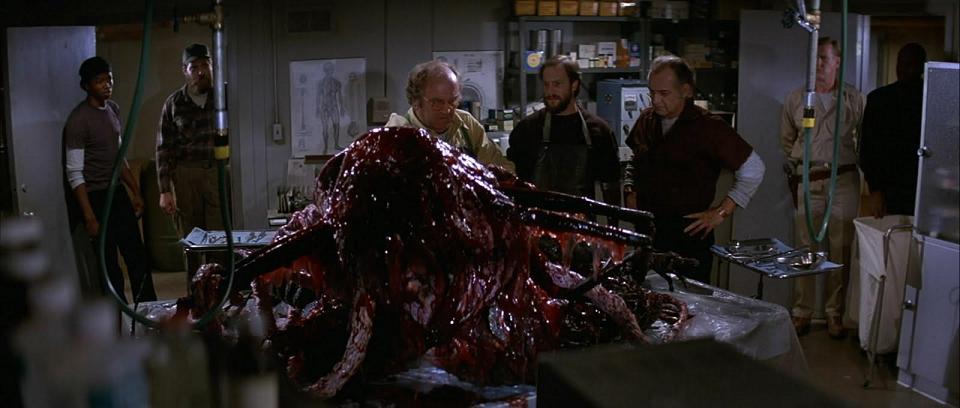
The Thing (J. Carpenter) 


Sleuth (J. L. Mankiewicz)


Metropolis (F. Lang)


October (S. M. Eisenstein)


Frenzy (A. Hitchcock)


Rope (A. Hitchcock)


The Trial of Joan of Arc (R. Bresson)


Thank you for your support in 2017!

by Ed Law
2/1/2018

Film Analysis


Saturday, 23 December 2017

The Thing, Part 2


‘The Thing’ (1982) is the sort of the film I start to be able to identify more and more when I grow up. True, E. T. has once been my favorite film of all time, but we all have our past, right? The more I return to the film, the less I see it as a horror film. What happened in ‘The Thing’ does not necessarily happen in another universe – it can just happen in our real world. ‘The Thing’ can be anything, be it a rumor, a disease, or something destructive for our well being. The reason why The Thing is scary is not merely because it was violent and chopped off someone’s arm as if it was nothing; The Thing was a reflection of our dark side – it exposed humanity’s darkest aspect. Carpenter could have changed the ending of the story and given us a happy ending, as an affirmation of human spirit, yet he chose not to do so. He wanted this monster movie to inspire us, to give us entertainment (I know it is sick) and a chance for self-reflection in one package. ‘The Thing’ can just be Carpenter’ most philosophical and intelligent film.

What made this cinematic monster chilling was that, while we had no idea whether it possessed a brain or any cognitive faculties, it certainly was a cunning opponent. The Thing brought out the dark side of human nature – the ego, fear, and suspicion inherent in all of us, and what made us so human and not a mere robot. Rather than physically facing humans one-to-ten – rather like The Matrix or the Kung Fu Master – this monster stirred up the paranoia from the back, and led the humans to mistrust each other and started killing each other in return. If The Thing is a cowboy, it certainly was one that shoots someone at the back!

The American team was doomed from day one. A sense of fatalism was detected – the fact that the American team did not understand or aware what has happened to the Norwegian team meant that history was doomed to repeat itself, the ‘Thing’ scenario would happen to the American team in exactly the same way. It was quite sad to see when MacReady (Kurt Russell) was alone in the room, and did a recording to tell the later generations about the team’s encounter with ‘The Thing’. He certainly understood that they would not survive this ordeal, and sooner or later the remaining members would likely be eliminated one by one. Men might not have the ability to stand up to ‘The Thing’, yet there was something even worse – the fact they could not even stand by each other in such a critical situation.

What paranoia is all about is an irrational and subjective view towards others, especially when at a situation where trust and confidence are more important than ever. In ‘The Thing’, every action, no matter how positive and contributive it may first seem, can be interpreted in the opposite manner.  Even the most objective form of test would be suspected and failed to deliver the promise. When all the men agreed on that the fairest test was to have a blood test to see who has turned into a monster, the next thing they have found was that the blood has already been sabotaged. Another standoff ensued, as now everyone was suspecting that someone among them has already turned into ‘The Thing’ and attempted to skip the acid test. Even the apparently objective evidence could be questioned – when Mac’s torn shirts were found in the wrong place at the wrong time, suspicions all turned onto him, and he has to literally defend his ‘innocence’ by holding the other men at gun point. Everything has to be tied up – which is ironic because it seemed to be only time when they were literally branded together as a team. Even worse are the testimonies by the characters. The trust and credibility of every character was questioned, even if the audience assumed that MacReady was the protagonist and likely to be the hero after all. When someone’s statement is contradicting what others have seen, his credibility was immediately put to question, and the focus was on whether he was ‘The Thing’ or not, even if there is another guy doing some funny business behind to distort the fact.

In the film, there were characters who were just plain unlucky. It could be the case that because one was standing just next to an infected character, he would be infected right away. If we take the meaning of ‘The Thing’ in a more metaphorical meaning, that will be the case if the destructive effect of paranoia, disease or rumor can pass on very effectively – because our dark and often irrational sides are so committed (The Hateful Eight reference) to choose to believe that, without analyzing it beforehand.

At the most stressful situations, people will retreat, and it really is the sad fact of humanity. Some of the members simply walked away, and were never to be found, or their corpse were later discovered, either devoured by The Thing or a suicide. One of the members, Blair was sort of like a ‘wiki’-freak and he just straightly went to the computer and engaged with a bit of dynamical equations – to see if ‘The Thing’ did escape and go to the civilized area, how long everyone on Earth would be infected. When the output stated ‘a few years’, Blair became consumed with awe and paranoia. He went as far to disconnect all the transport and communication for the others to escape. At the point he became the monster, he started building an aircraft, to achieve the aim of infecting the humanity with the nasty Thing.

Carpenter has placed a lot of clever ellipsis through the films. There are characters that disappeared for a while and suddenly reappeared some moments later, without stating , or showing objectively what has happened to them during their ‘time-off’ – all the characters and the audience can know was the verbal testimonies and reasons the character provided, and there are no ways to see whether their claims are true or not. The effect is that makes both the characters and audience alike more paranoid, because especially for us, we are not even allowed an objective point of view of the real answer to the mystery. Anyone who disappeared without a good reason could already be proof that they have been transformed to the monster. An relevant point I feel was that maybe some audience are over-analyzing the actions of the characters, especially when they tried to identify which character was ‘The Thing’. Statements like ‘Oh, he is not breathing all the way’ could be very subjective, because Carpenter deliberately misled us to follow that way. There is not an answer of who is ‘The Thing’ or not – if some ‘Man-Thing’ tried to pretend to be a human being – it certainly would behave like a genuine human being, and one would be hard to figure it out – except with the blood test or at the point it exposed. The director was playing a mind game with the audience, and to fuel their suspicion through the various ups and downs of the narrative.

At the end, the only 2 survivors were MacReady and Childs. Childs has disappeared throughout the final showdown, and no reasons were provided for his disappearance. Since Carpenter intended the ending to be dark and ambiguous, there were many debates and speculations about the final conclusion of the story - just search for ‘Is Childs the Thing’ on the web and you will be assaulted with loads of hits about the various theories. A very famous fan theory is that, while it appeared that MacReady was sharing a last bottle of liqueur with Childs, it was actually gasoline to test out whether Childs has transformed to the Thing. Since Childs appeared to have no hard feeling about the offer after he has taken a sip, MacReady confirmed that he was sitting next to a bloody monster. Of course, the flip side was that MacReady himself was the Thing (I understand it could be hard for Kurt Russell to be seen as the bad guy).

To me, I feel that there is no point to decide who is The Thing, because Carpenter’s idea is not to give a definite answer. The power of the ambiguous ending is that it would generate a sustained paranoia in the audience’s mind, because the ends will never be tied up properly, and the mystery would never be resolved. The team of men might be facing a powerful alien, yet it was the weakness and dark sides always inherent in humanity that have defeated them, and prevented them from devising more intelligent means to conquer the shadows that have haunted them.


So, any-Thing else to deal with?

-End-

(2/2)

by Ed Law
24/12/2017

Film Analysis


Monday, 18 December 2017

Star Wars, Part 2


I have planned to finish off my article on Star Wars with my personal view on the more dramatic and intimate issues of the story. Originally, I plan to divert the attention from another film from 1977, Steven Spielberg’s ‘Close Encounters of the Third Kind’ (‘CE3K’ hereafter), as both films curiously are influenced by a great film from the 1950s, John Ford’s ‘The Searchers’. Yet after some consideration, I find that are way more to be explored in CE3K and it totally deserves an article on its own. Thus, here I will only concentrate on a comparison between Star Wars and The Searchers, and there may be some overlapping points in my next article on CE3K.

John Ford’s ‘The Searchers’ (1956) is considered as one of the greatest work in the Western genre. What is interesting is that the Western film has served as a predominant influence for many American filmmakers of the New Hollywood era, especially those filmmakers active during the 1970s. I presume there are 2 key reasons for that. First, the film was shown as the time when most of these filmmakers were teenagers, so this film from the master of Western served as a good example for them. Second, the character and theme portrayed in ‘The Searchers’ seemed to resonate well with the attitude of the 1970s – the ambiguity of moral issues, the drifter, the alienation and so on. It should not be surprising that directors like Scorsese, Schrader, Milius, Lucas, Spielberg, Coppola and many others have paid homage of some kind to this film. The plot and analysis are prevalent on the internet, and here we will concern with its influence on our great space opera.

There are always scores to be settled in the family, be it Darth Vader / Luke Skywalker, Anakin / Obi-Wan, or Han Solo / Kylo Ren. I believe Lucas’ original genius is to create this tension between father-son relationship, and the desperation for both parties to get a bit closer. In ‘The Searchers’, the story was about a not-so-perfect male character, Ethan Edwards, who has to redeem himself for his past mistakes and prejudices. Certainly, the two films may be different in tone and outlook, yet in the ‘Star Wars’ movies, many of the male characters have fallen into a state of redemption, as they believe they are the culprit  of ‘screwing some good things up’. They believe that they are responsible for ruining the potential of some gifted individuals (e.g. Anakin, Ren and the Jedi Order), and lead these young guys to the Dark Side and chaos. Thus, they are often consumed with guilt and regret, and in some case they attempt to turn away from the problem – which is the case for Obi-Wan Kenobi in Episode 4 and Luke Skywalker. In ‘The Searchers’, Ethan was a drifter from home for many years, and he did not want to say where he has been to and what he has done. He wanted to remain anonymous and retreated from the stress he has got in life. I guess a good thing common between ‘Star Wars’ and ‘The Serachers’ was that, while the characters were courageous and often were willing to stand up to challenges, they were also complex and realistic characters, and reflected aspects in life that we might also identify with.

Characters who regretted their past mistakes would first tend to drift away to reduce the pressure of it. Thus, Obi-Wan Kenobi isolated himself from the Jedi clan, giving himself the new name ‘Ben’. When Luke quizzed about the name ‘Obi-Wan’, he said with a regretful tone that it was a name people has not mentioned for a very long time. He tried to run away from this identity, as much like Ethan Edwards in ‘The Searchers’. Yet, there was no way to hide, because at a certain point, they would have to confront their pasts. Obi Wan Kenobi, Darth Vader, and the aged Luke Skywalker have to come face-to-face to what they have done and the dark sides that have often hidden there, and Ethan Edwards had to face his own prejudices against Indians and his irrational obsessions, towards his sister-in-law and daughter-in-law. Obi-Wan felt that it was his own fault to create Darth Vader, as Darth Vader put it succinctly when he faced Obi-Wan for the final showdown, ‘The Circle has finally come around.’ Obi-Wan and Anakin Skywalker could only redeem themselves while facing his mistakes – albeit through their own sacrifices. Ethan Edwards, after rescuing his daughter-in-law, finally appreciated that there would be no place for him in the community, chose to leave and drift away once more, completing his redemption.  


What ‘The Searchers’ is driving at is the fact that we are always ‘searching’ for something – our identities, our roles and how we fit into the story. As Rey, our heroine in the new trilogy, has put it in The Last Jedi – ‘I need someone to show me my place in all of this.’ You do not have to carry a lightsaber to be able to identify with this statement. It is a universal condition for anyone, and we are eternally searching for our own meanings to exist in our world. While it seems that it is a more pessimistic end for Ethan Edwards – because he was literally going in circles, searching everywhere and eventually going nowhere. It is great to see that ‘Star Wars’ placed a more optimistic outlook in this issue. If one was willing to follow a moral conscience, much like the Jedi way, and exercised with reason when making decisions, they would eventually discover the right direction and the meanings for their own lives. If you feel that something has been awoken – then it is the time to wield it!!

-End-

(2/2)

by Ed Law
18/12/2017

Film Analysis


Friday, 15 December 2017

The Thing, Part 1


When you hear the slogan ‘Together we will make it’, will you laugh it off as a joke or a delusion? When you do something for a group out of good will, do you expect your contribution will have exactly the opposite effect? When you place trust on someone else, is it based on any rational foundations or merely a blind faith? Is that a point that the paranoia inherent in all of us will eventually consume all of us in a community? These appear to be very dark, yet relevant questions to us to face, because they lead to a better appreciation of what that means to be human after all. And, these are the questions the great filmmaker John Carpenter explored in his masterpiece, which is celebrating the 35th anniversary this year – ‘The Thing’ (1982)!! 

 What is interesting about the history of ‘The Thing’ is that the film had its theatrical release at the same week as ‘Blade Runner’, and the fate of the two films have also been very similar. Both films suffered from initial mixed reviews and unsatisfactory box-office results, yet their reputations elevated to the level of the greatest work in their respective genre, and are considered modern classics by today’s standard. The similarities do not stop here – if we look into the 2 films, we can find a lot of common themes in the two great films. Another similar work is of course Stanley Kubrick’s ‘The Shining’, which appeared only 2 years before ‘The Thing’, and David Cronenberg’s ‘The Brood’, which the director has stated as his version of ‘Kramer vs. Kramer’. One can have the impression that the style and world view from these films are also very comparable to each other. These films were misunderstood as they were first shown to the audience, because they defied the audience’s expectation with regard to their alleged genre – which were sci-fi and horror – and they have shown something beyond their genres, for which the audience members were not ready for. If the viewer is willing to look beyond the surface, he/she will find the films are not merely about scary stuffs or high-tech wonders, but are about very elemental questions about human nature – that of alienation, identity, family relationships, institutions, and most of all – what makes us to be human.


When I first watched ‘The Thing’, like other viewers I was of course fascinated by the power of horror and the numerous WTF moments that has become legend for the film. The more I looked at it, I found it disturbing because it addressed the reality that we all situated in – and Carpenter seemed to have the foresight to realize what happened in ‘The Thing’ –the paranoia, the faulty interactions and so on- could just happen in the real world, maybe without the monsters itself. I see the film more as a psychological rather than a horror film, as putting the scary bits aside, the film gives you a lot of insights about human nature and how things can go wrong in human interactions. If one is saying that ‘The Thing’ is merely about a monster devouring every human characters he can cross path with during its 2 hours of cinematic life, then I would say the film is more about a potential breakdown of community, or civilization itself. ‘The Thing’ is great because it did not rely on cheap scare tactic to unsettle the audience, it brings out and liberates the innermost, and unconscious fear inherent in all of us. The film is beautiful because Carpenter has painstaking installed a lot of ambiguities throughout the film, meaning that the audience can not jump to simple conclusions regarding the actions and underlying motivations of any characters in the film. An apparent ‘good-natured’ action can just have the completely opposite motivation in the film. Not only this will generate a continued discussion of the film for the years to come , very much like ‘The Shining’ and ‘Blade Runner’, it can generate a tremendous sense of paranoia in the  audience’s mind, as they have no definite point of reference they can focus on when they try to make sense of the film.


I believe why ‘The Thing’ is so successful is not merely because it is a scary or entertaining film – the real reason is because it brings out some of the audience’s most fundamental concerns regarding themselves, very much like ‘The Shining’ and ‘Blade Runner’. The film itself represents the projection of the audience’s most intimate fear – the interactions with others, the paranoia that drives and leads to mistrust and nasty relationships, and the often futile attempts to stand up to problems that have proven to be too big for them.

‘The Thing’ has influenced many subsequent films in the horror / sci-fi lexicon, and its influence is not limited to these genres. Quentin Tarantino, for example, is a big fan of the film and he has cited influences of ‘The Thing’ in Reservoir Dogs and The Hateful Eight (which can be seen as ‘The Thing’ of the American West).


A quick look at the plot. 'The Thing' is actually an extraterrestrial life form, which is parasitic, and its only drive is to survive, survive, and survive, no matter what destructions it will cause to whatever universe it finds itself fall into. The untimely victim we have got is an all-man team working in Antarctica. When the man rescued a husky from the snowy landscape, they had absolutely no idea that this 'man's best friend' has some unfriendly company - 'The Thing' has always assimilated it and transformed it to a 'Dog-Thing'. When the 'Dog-Thing' has killed all its canine mates in the kernel and transformed into a monstrous being, all the men panicked. The power of this extraterrestrial monster was just too much for the humans - it started to assimilate the team members one by one, resulting in violent death (and spectacular WTF moments for the audience alike). What was worse, however, was that the team could no longer work together because of the unsettling fear and paranoia that has resulted. Who is there to trust? Who is the cowboy with the black hat? Who is the enemy and who is the comrade? And who is the next lucky guy to become 'The Thing'? As the situation became more dangerous and hope became more futile, the remaining men prepared for the final showdown with this monster - or, are they even aware of the fact they have turned to 'The Thing' already? 


The director of ‘The Thing’, John Carpenter has developed a very early interest in cinema since his childhood, and he in particular likes the Western genre and is inspired by the old great American director Howard Hawks. Hawks was sort of an all-rounder of cinema, as he was adept in delivering great work from a variety of genre. Yet, he was most likely remembered for his work in the Western genre and a sub-genre known as screwball comedy. At the surface, Hawk’s films are often about the spirit of working together professionally towards a common aim, yet he also made a slight twist through the introduction of a sort of characters known as ‘Hawksian woman’, a few example being Lauren Bacall, Katherine Hepburn, and Angie Dickinson. It is important first to be clear Hawks himself has no intention to place feminist ideas in his work in the first place. The introduction of ‘Hawksian woman’ is to challenge the way how cinema or the common people’s perception of female characters in culture. Hawksian woman, while situated in an era where the equality of sex was not a common belief, tended to challenge and destabilize the power, and expose the underlying weakness and vulnerability of the male character. That is exactly the reason why ‘Hawksian woman’ worked particular well in Film Noir (which Hawks has made a few great classics) and the screwball comedy, a genre where the writer-director Preston Sturges was famed for. The film noir often required a femme fatale, whom presence would significantly influence and contribute to the fate of the underdog protagonist. For the screwball comedy, which was an extremely common sub-genre of comedy back in the Hollywood 1940s, was about the battle-of-the-sexes, often an (intellectually and spiritually) strong and resourceful female characters versus a more ‘antiheroic’ or mellow male character. 


Why do I bother to talk so much about an old-school filmmaker? Well, Carpenter has cited Hawks as an influence for his filmmaking, and one can easily see that in many of his films, not just limited to ‘The Thing’. Indeed, Hawks have also made a film about a monster based on the same source of ‘The Thing’ back in the 1950s. Both films seemed to deal with some form of paranoia, in Hawks’ version, the allegorical paranoia of the Communist or the Red power that haunted many Hollywood filmmakers in the 1950s, and in Carpenter’s case, some people believed ‘The Thing’ served as an allegory for the cultural concern of the AIDS epidemic in the 1980s (If we see ‘The Thing’ in a biological perspective, its mechanism is very much like a biological virus), and more obviously, the paranoia of suspicion and mistrust of others inherent in all of us.   In a number of films, Carpenter did agree to the Hawksian vision that one should face challenges and problems with courage, and work together professionally to combat the avalanche of problems that arise, like in ‘Assault of Precinct 13’, which was considered as a remake of ‘Rio Bravo’ in the modern setting. Yet the power of ‘The Thing’ is that Carpenter has struck the most intense deconstruction of the Hawksian ‘teamwork and community’ value, and while in the films all the characters (it is a rare all-men film) were at least shown to be reasonably courageous and willing to get their hands on problems, Carpenter questioned whether the idealistic belief of ‘working together to a good end’ would break down.

Many critics also believed that Carpenter’s film, like Hawks’ older version, addressed the cultural concerns of his era, albeit with different emphasis. In Hawks’ version, he was illustrating the paranoia of the political climate in the 1950s –  the Communist paranoia and so on. In Carpenter’s version, he was addressing a pathological transformation of the individualism back in the 1970s – people became more self-interested, self indulgent and willing to strive for personal gain, and falsely asserted this is a sort of individualism. Any senses of group or community, or the pledge of co-operation or collaboration, were merely appearance. Everyone wanted to be number one, and they had to shoot someone from the back – indeed the taboo of classical Western film. ‘The Thing’ was delivering a possible vision that everyone was so alone with themselves that they would be no beneficial relationships with others around, and the only interaction possible was mistrust and paranoia.


Let’s now focus on the visual aspects. Carpenter, while famously known as a great director for the Horror genre, has a stunning gift for cinematic composition. I believe this is an aspect being overlooked by much audience because they often place their focus on the thrilling aspect of Carpenter’s work. While the theme of his films is often about the horror both inside and outside of humanity, the cinematic images from Carpenter’s widescreen films can be of a tremendous beauty, and his unique vision regarding the composition of cinematic images also addresses the themes he often tried to convey through his films. This aspect is particularly illustrated in ‘The Thing’, making it one of Carpenter’s signature films.

While Carpenter preferred the use of anamorphic composition, which often gave a nice and photogenic shallow depth of field for the final cinematic image, he often made efforts to stage the set so that everything in the frame is in sharp focus. While he tended to emphasize the horizontal vista in the wide screen, the composition is often sparse and not filled with a lot of details and people, as opposed to the original intention of widescreen films – to show epics and large scale activities. It afforded a sort of emptiness in a vast area.


Carpenter’s composition relied on a lot of claustrophobic framing, in contrast with the widescreen scope format he always preferred to employ. He also did a lot of nice close-up shots of the character’s faces – an attribute which was advantageous for anamorphic telephoto lenses, and the shots were held so tight on the faces that they provided an intense atmosphere for the narrative. Ennio Morricone’s sparse and minimalist score also contributed a lot to the atmosphere – the notes were so simple that nihilism could be detected, yet it was warning us that the truth was so deep that there was always something beyond surface appearance.

It was also noted that Carpenter has used another of his favorite camera techniques – a subjective, point of view and mobile camera (in some cases, a Steadicam). What was interesting and quite frightening was that this point of view belonged to none of the characters. It therefore seemed like a ghostly vision, exploring around the complex the men lived in, ready to stalk on any unlucky victims. 


I feel that Carpenter's visual approach served a number of purposes in terms of addressing his theme. First, this type of antagonistic composition generated a very high contrast feel for the audience, and the visual impact would defy expectations from the audience, and generate tensions both in the scenes and the audience alike. Second, these arrangements illustrated the fact one could not see things from the surface. Indeed, the whole point of the film was about the sad fact that you could not figure out who was The Thing and who was not, including the fact that you have become the monster. The idea that a different arrangement would lead to a different impression from the audience would induce fear and urged the audience to look beyond the appearance. When two faces are held very close in a shot, it could suggest intimate and heart-to-heart relationships, yet it could just be a very tight face off. When audience expected a lively environment from the vista provided by widescreen, all they saw were snow and lifelessness. Carpenter has successfully staged effective scenes and used innovative photographic style to generate unease from the audience, even before they encountered The Thing. Finally, the preference to stage in depths would illustrate the power struggle between different parties, and it was quite like the cowboy films, and The Thing has clearly drawn influences from the Western genre. This would certainly increase the tension in these scenes.

To be continued!

(1/2)

by Ed Law
16/12/2017

Film Analysis