|
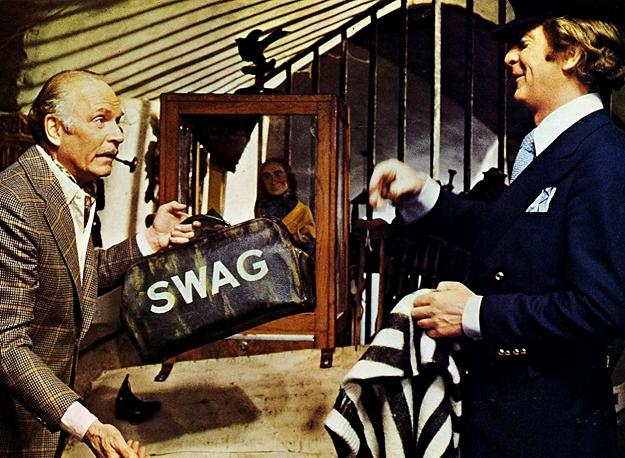
| Mike and Larry: Milo (Michael Caine) and Andrew (Laurence Olivier) in 'Sleuth'. |
Is there a thin line between farce and reality? Can a game
be going too far? When you are locked in a Game of Death (hope you still have
life to finish this article), will you be like King Charles the First, keeping
your dignity as you mount the step to the scaffold? When is the moment when
performance ends and reality starts? The most thrilling encounter is likely the
moment when two individuals lock in a battle neither can easily turn away from,
and this is the theme of the film I talk about this time – ‘Sleuth’ (1972) !!
‘Sleuth’ was the last film directed by the American director
Joseph L. Mankiewicz, who was the director for classic Hollywood
films like ‘All About Eve’, ‘Barefoot Contessa’, and ‘Cleopatra’. The film was
based on Anthony Shaffer’s play, which won a Tony award; and starred two
legendary British actors – Lord Laurence Olivier and Sir Michael Caine. If
there is something ‘Sleuth’ could be proud of, it would be that the film made
‘The Godfather’ (by Francis Ford Coppola) have a run for the money. Both films
competed for the Oscars in a number of the common categories 1972, though
eventually Marlon Brando won the Best Actor for The Godfather, and Bob Fosse
defeated both Mankiewicz and Coppola in the Director category. Ironically, Lord
Olivier has been offered the chance to star as the Godfather because Brando
finally took the place.
My personal feeling about ‘Sleuth’ is that it is a curious
blend of a comedy (albeit a very black one) and thriller. The dialogues
throughout the film are tongue-in-cheek, or facetious (as Inspector Doppler would
have put it), yet at the same time, the heavily dialogue-driven film was also
very tense, and surprises and table-turning moments could just appear at any
time. The cinematic version of Sleuth was quite alienating for most viewers –
which I believe was deliberate by the director – because the dialogues just
went on and on like a non-stop motor, and though they were beautifully written
and full of witticism, it could be quite harsh for the audience. The presence
of the complicated sets and the various mechanical dolls, accompanied by the
eerie sound, also generated an unsettling atmosphere for the audience. It is a
very rare instance I can find a film both comedic and thrilling at the same
time. Indeed, a similar aspect between ‘Sleuth’ and ‘The Godfather’ was that
both films relied on very strong performance and a dialogue-driven screenplay
to make the films work, and at the same time these considerations did not undermine
the visual and technical aspects of the films.
A comment regarding spoilers. From now on the article will
be loaded with spoilers, and it is important for ‘Sleuth’ because there are a
few important twists in the story. It will be great if you can experience it
first hand – though the story itself is not that of a secret if you look at the
internet. Also, it is an extremely dialogue-driven film, and it is so intense
in terms of dialogue that some viewers may be alienated by it. Yet, the
dialogue is an important aspect of the film, and probably the film’s strength
because they are so witty, dynamic and facetious. Sleuth is a film that rewards
repeated viewing, as when you watch this great film again, you will be able to
appreciate the cleverness of the plot and also the brilliant dialogues from
Mankiewicz and Shaffer.
Sleuth is special because the film only has two characters –
the other names on the cast are fake and are used to mislead the audience. The two
characters interact for almost 140 minutes predominantly inside a house, and
the claustrophobic and suspenseful atmosphere of their games generate a sort of
unsettling and thrilling impression for the audience. The absolutely brilliant
performance from Lord Laurence Olivier and Sir Michael Caine was one of a kind
and that represented one of the most spectacular encounters between two
legendary actors.
The story concerned Andrew Wyke (Olivier), a rich mystery
novel writer; and his love rival, Milo Tindle (Caine), a hairdresser who had a
salon. Andrew was aware of the fact that Milo was dating his wife, Marguerite,
and after sending her and the servant out for a holiday, Andrew invited Milo to his manor to settle things out. Andrew seemed to
offer a friendly hand to Milo, and suggested that Milo should commit a fake burglary,
to steal Andrew’s jewelry and valuables from the safe in the house, so that Milo could have the money to support his life with
Marguerite, and Andrew could claim the insurance and settle himself with his
mistress, a girl called Tea. Milo agreed to
the plan. After the burglary, Andrew exposed his true face – it was a trap for Milo. Andrew pulled a revolver and explained to Milo that
he wanted and humiliate and kill him because he was pissed off with Milo stealing his wife. Milo begged for mercy, yet Andrew
pulled the trigger anyway – and apparently killed Milo.
Of course, that is only a trick. Andrew used blanks, so he did not really kill
him. His intention was only to humiliate Milo
and made him embarrassed.
In the next evening, things started to go wrong. A policeman
known as ‘Inspector Doppler’ visited Andrew and stated that the police
suspected that Andrew was responsible for the disappearance of Milo and his alleged murder. Andrew desperately explained
to the Inspector his charade, and maintained that Milo
did not die and has been sent away safely. Yet, Inspector Doppler found out
more and more evidence around the manor, pointing to the conclusion that Andrew
has killed Milo. At the point Doppler was
going to arrest the helpless Andrew, a twist appeared! Inspector Doppler
revealed himself to be no one other than Milo
himself (so the films only consisted of 2 characters), and all those evidences
were planted by him. While Andrew acknowledged Milo’s wit, Milo
were not finished with it yet. He wanted to play with Andrew a game he coined a
‘real murder’. Milo told Andrew that he has
killed Tea, and he has placed evidences around Andrew’s manor so that the
police would likely confirm Andrew as the suspect. When Andrew has confirmed
that Tea was indeed murdered through the phone, he was forced to play the game
by solving Milo’s riddles. After Andrew has
disposed of all the evidence, Milo exposed the twist – everything was fake and
Tea was still alive, the game was a plan by Milo
and Tea, who wanted to come back at Andrew’s meanness. Milo
said he has got even with Andrew and planned to leave the manor.
Andrew, however, would not let this go. He loaded his
revolver his real bullets, and said he wanted to kill Milo
this time for real. Milo warned Andrew that he
did anticipate such a possibility and so has already called the police.
Thinking that Milo was lying, Andrew killed Milo
with the revolver. Then, the sirens of the police cars could be heard outside
the manor, as Milo did indeed call the police.
As the helpless Andrew waited for his own destruction, the dying Milo told him, ‘Andrew – be sure to tell them – it’s all
a bloody game.’
Joseph L. Mankiewicz, a key filmmaker from the golden age of
Hollywood, has devised
a very unique style to his cinema. First, his films were often described as
‘theatrical’ – some French critics termed them as ‘théatre du filmé’. In a
Mankiewicz film, it was often noted for the spectacular performance from the
key actors. In ‘Sleuth’, this was particularly evident because the 2 lead
actors were using a mannerist style of acting, and their actions and dialogues
reflected the social status and personalities they had.
Mankiewicz was known as a director of the interior. His
films were predominantly taking place in interior space, such as a house, a
room, or a private space, rather than out in the open, like the Film Noir or
Western popular at his times. With a gift for screenwriting and direction,
Mankiewicz often provided atmospheric and dramatic narratives in these limited
spaces, and his interior mise-en-scene often reflected the mental landscape and
interior life of his characters. In Sleuth, the fact that the 2 characters were
matching wits inside the house generated a claustrophobic feel for audience
alike. The maze-like manor also signified the unpredictable and deceptive
attitude by both characters, and the
preponderance of all sort of mechanical dolls not only generated a paranoid and
uncanny atmosphere, it also emphasized the playfulness and artifice of the
whole situation.
On the other hand, Mankiewicz was often seen as a woman’s
director, as his films were mostly about a female protagonist or concentrated
on a female character. While ‘Sleuth’ was special because it was concerned with
two male characters, the motives behind their every action were about a woman
they both wanted to get to themselves.
It is worth noting that while Mankiewicz’s ‘Sleuth’ is ‘theatrical’,
he has also employed very cinematic means to achieve a dramatic effect on the
screen. In the film, he has employed very stunning long takes and tracking
shots to let the audience convey the space of Andrew’s manor. This is a
significant point because, for such a dialogue-driven film, you can literally
deliver it out without any form of set design – which is an approach in some styles
of theater (e.g. Theater of the Absurd) – and the non-visual dialogue itself
will be able to attract a sustained attention from the audience. Mankiewicz has
placed emphasis on mise-en-scene in his many films. In his version of Sleuth, Mankiewicz
has placed emphasis on a complicated set, and in no way this set would lead to
a comfortable and homey impression for the audience. It seemed more like a
decaying maze, and the movement and gestures of the two characters became as
critical and tight of a chess move. Their movements around the house reflected
the continuing and ever shifting power struggle between the two sides, and
whatever room they entered, the topic of their conversations would address to
the nature of that interior space – private talk in bedroom, bargaining in the
game room, charade in the attic. The alienating set and movement reflected the
unknowable motives behind the two characters, and how the table could be turned
at any instance in this game of death. In terms of cinematography, Mankiewicz
shot everything by an old-school approach, using deep focus for most of the
scenes, playing out sharply the tug-of-war for control between the 2
characters.
The French philosopher Gilles Deleuze, through his studies
of cinematic signs, have designated Mankiewicz’s films as an example of the
time image (recollection image), and called Mankiewicz the ‘greatest flashback
auteur’. The use of flashback or recollection sequences can be considered
important for his films, because they often made sense of the motivations of
why the characters in question made a certain decision that would lead to
consequences of all kinds. While in Sleuth there were no genuine flashback
sequences, there were substantial amount of the narrative where the characters
were engaging memories or some form of recollections (though the latter ones
could be fabrications, as in Andrew’s case when he faced ‘Inspector Doppler’).
I feel that a tragic aspect of Andrew’s situation was that he could not move on
from his past, for which at a time he was the winner of his game, and he became
over nostalgic on that, and treasuring only the good old days. He could not
come to terms that his younger rival, Milo,
was more intelligent, charismatic and resourceful than he was, and Andrew could
only rely on his outdated racial stereotyping and prejudice to make himself
feel a bit better. Andrew wanted desperately to win in this game - yet Milo was too much of a formidable opponent for him.
‘Sleuth’ clearly illustrated the concept of ‘The Double’
often found in many films and literature, and this concept was also evident in
the case of the story structure. The
story is deliberately separated into 2 parts, and one can easily see that the
two parts follow very much the same plot – the first time Andrew outwitting Milo, the second time the other way round. If we set our focus on Andrew’s point of view
(which I guess it may be underlying motivation on Mankiewicz’s side), you can
also see the whole film is the ‘Rise-and-Fall’ story of Andrew, who believed
his intelligence and status deserved a triumph over his love rival. The first
part is Andrew’s Rise, to his successful humiliation of Milo,
and the second part is obviously his Fall, how he got doubly-outwitted and eventually
was provoked to commit a true crime. As I have said before, a story with a
over-formalized structure or too many coincidences will likely attract
criticism, because it may be seen as a lack of creative input from the author
and also a lack of spontaneity in terms of the dramatic action. Yet, the
‘double’ structure in ‘Sleuth’ served the purpose well, because it illustrated
the tragic dimension of the story itself – if none of the two men were willing
to stop the destructive engine of play and deception, things would repeat
itself – only with a more disastrous outcome.
(1/2)
by Ed Law
9/12/2017
Film Analysis