 |
| One of my favourite shots in 'Last Tango in Paris'. Bertolucci's and Storaro's paintly composition and use of color made it memorable.
Bertolucci’s ‘Last Tango in Paris’ has always been an enigma. The film
has inspired discussions and debate regarding its meaning ever since it
emerged, and all sorts of interpretations have been proposed to the story.
Bertolucci did not spell out all the details in the plot, because he wanted to
engage the audience to think and use their imaginations. The style of the story
is very representative of the style of European art films, when ‘scenarios’ are
staged – in a often episodic or poetic manner – and motivations are often
ambiguous. Indeed, the scenes in the film were formalized and could be compared
to ‘snapshots’ of the characters’ lives. The story of ‘Last Tango’ unfolded in
an alternating manner, where the scenes could be either categorized as (a) Paul
and Jeanne’s carnal experience in the apartment; and (b) the experience of
either Paul or Jeanne in the outside world. The fact that these two scenes were
staged in an alternate manner make it similar to a day-and-night dichotomy, and
as I have suggested in the previous article, it sort of symbolized the
unconscious (represented by desire) and conscious (represented by reality) of
the characters’ psychological makeup.
Even when one watches ‘Last Tango’ many times, different
interpretations can be given to the story. Did Jeanne have any feelings at all
to Paul? Why did Paul’s wife commit suicide? Did Jeanne and Tom have a genuine
love relationship? And after all why did Jeanne keep on coming back to Paul if
she was not comfortable about that – was she just not sure, or as someone might
provocatively suggest, that represented a sadomasochist relationship or
Stockholm Syndrome? These are just some of the mysterious questions that have
been haunting the audience over the ages, and I believe that is the continuing
attraction of ‘Last Tango in Paris’.
Marlon Brando has delivered one of his best ever performance
in the form of Paul, the depressed widower. Audience tends to concentrate too
much on the controversial sex scenes, and they may overlook Brando’s brilliant
performance in this film. As a big fan of him, I in particular enjoy Brando’s
performance in the 1970s – from ‘The Godfather’ to ‘Apocalypse Now’ and even
his cameo as Jor-El in ‘Superman’. He has delivered first rate monologues, and
there was an intricate aspect about most of his roles. While he often starred
as characters who possessed power or had the courage to fight for it, there was
always a vulnerable dimension in the same character, and that was most evident
in his role as Paul in ‘Last Tango’. Paul, having lately lost his wife, was
empowering himself through the control on Jeanne, and to be honest, certain
cases of his advances towards Jeanne could be considered harassment or even
rape. Yet, he was truly desperate and mournful at the same time. I guess the
magic from Brando originated from a delicate balance in terms of performance,
and that was what made his characters fascinating.
As a method actor, Brando has contributed a lot to his role
through improvisation in the film. Indeed, some of the quotes were based on his
past recollections. Two sequences were absolutely sublime – Paul’s monologue
about his past, when he was reclining in the apartment; and Paul’s monologue to
the corpse of his wife. These were brilliant moments because they were the
points when Paul really expressed his feelings about his life and beliefs in
general. In the other scenes, either he maintained an anonymous relationship
with Jeanne, or he tried to distance himself from the others around him, and
most of those quotes were banal and vulgar. In general, one could see most of
the quotes in the film were in an opaque style, they were often contextual and
one could not really draw most inferences from what the characters were
thinking – unlike in the narrative-oriented style of classical cinema – and I
think that was Bertolucci’s intention after all.
When Paul was alone in front of his wife’s coffin, the
monologue delivered by Brando was probably one of the actor’s greatest moments
in cinema. Literally talking to a corpse, he has expressed a rich feeling of
regret and persecution. Paul lamented the fact he could not access to his late
wife’s psyche, and doubted that the intention of his wife to marry him was
merely to retreat from life. The scene was important because it exposed Paul’s
character flaw and weakness. Bertolucci did not tell us much about Paul’s wife,
all the information was from the subjective, and often opinionated comments
from Paul. Paul did not feel responsible for the failure of their relationship,
and he felt that the reason why the marriage led to a tragic end was because of
the infidelity of his wife, which he castigated her as a ‘pig-fxxking liar’ or
so on. The comment being both banal and misogynistic, Bertolucci put the
audience into Paul’s shoes, and led us to experience the situation from Paul’s
point of view. If there was any reason why Paul could never understand his wife
– or other women in general – that was because of his passivity. What the story
suggested was that Paul’s character could not provide compassion and care to
the other half of his relationship, and therefore he could only have these
relationships – sexual in many cases – in an instrumental manner. I suppose
what Bertolucci was implying was that Paul was repeating history – his
relationship with his late wife probably mirrored his relationship with
Jeanne.
Paul the desperado
So, is Paul a bad guy? Well, yes and no. The beauty about
the film was really the complexity of Paul’s character, and anyone will
probably have a love-hate relationship with him. The audience would hate him
for being vulgar and treating women in a disrespectful manner, yet they also
wanted to love him because he was vulnerable and was crying for help. I would
say Brando has successfully portrayed a character of nihilism, because he could
not find much meaningful aspect after he lost his wife. He was just like
someone into drugs or severe alcoholism, and foolishly believed that these instruments
could help him to pass the time and eventually lead him to a better endpoint.
For Paul, his poison was sex. Paul had absolutely no idea that he was railing
on a self-destructive path, and his experience with Jeanne would most likely
traumatize her also. Instead of looking for genuine romantic love or positive
relationship, Paul succumbed to a detached and carnal sexual relationship, and
eventually got nothing from that.
After all, the anonymous sexual relationship with Jeanne was
merely his psychological defensive mechanism. He wanted to divert his focus
from the regret and guilt he had for his failed relationship with his wife.
That was why he stressed all the times ‘no names’ to Jeanne, because in a
philosophical point of view, names led to associations of things, and thus
entailed responsibility. Paul wanted to live the sexual experience one at a
time, even if Jeanne provided the subtle implications that their relationships
could be developed to another level, like friendship – Jeanne did not mind
telling Paul about herself, but was always stopped by him. By engaging with
Jeanne in this banal way, Paul was rid of any responsibility and commitment,
and could therefore fuel his most nihilistic existence.
Jeanne the enigma
An interesting aspect noted by many viewers was the
imbalance of knowledge the audience would be accessible for the two main
characters. Bertolucci appeared to allow full access for the audience to
understand Paul – he spoke out what he felt and thought about, through his introspective
monologues. Yet, Jeanne was very much an enigmatic character. We did not know
clearly what her motivations throughout the film were, and how she really felt
about her relationship with Paul. That was ironic because it served as a
parallel to Paul’s scenario with his dead wife. He failed to understand her and
see through her soul, he could not connect with her emotionally.
Jeanne seemed to be a more flexible character, and she was
able to fit in to both Paul’s world and her boyfriend’s cinematic world. She
was willing to explore for different possibilities, yet it was evident that she
has not been able to make up her mind. To me, the reason why Jeanne kept coming
back to Paul was because she was confused and she did not see that much harm of
engaging the relationship with Paul. Maybe there was a psychological need for
her, and she probably did not take the issue seriously. Jeanne was oblivious –
or not fully aware of, to be fair – Paul’s emotional turmoil and did not see
that he was using her as an instrument to get over the hard times. Because both
characters had such a distorted expectation from the relationship, it would be
clear that Paul was asking too much from Jeanne. At the near end of the film,
Jeanne has made up the decision to marry her boyfriend, and gone to try the
bridal gown. Yet out of a bout of indecision, she ran away and went back to the
apartment. Later, when she and Paul was in the dance hall, she was juggling
with all sort of conflicting feelings about Paul, and eventually decided to
leave Paul for good. Yet, Paul continued to pursue her into her apartment, and
impulsively, she pulled a gun on her and killed him.
As Jeanne stood almost frozen in the apartment, she kept on
rehearsing and repeating that she did not know Paul, and said he tried to rape
her, as if practicing the statement to say to the police later. Certainly, the
murder was an impulsive act, yet it was clear that Jeanne regretted doing that.
Because, Jeanne clearly had some feelings for Paul after all these. In order to
defend her from the psychological stress, she tried to pretend the whole
relationship has not existed at all. While in a legal standpoint there was a
smart move – because after all their relationship was secretive and anonymous,
and Jeanne could argue her action as a self-defense from a stalker –
emotionally it was unsettling because she was lying to herself. In her heart,
she would not forgive herself for doing this, no matter how repulsive Paul
might have seemed shortly before that.
Over the years I watched ‘Last Tango in Paris’ again, I have
the feeling that Jeanne and Paul’s story could lead to a good ending if they
had a better direction for their relationships. What Paul needed was not sex,
but someone who could give compassion and listen to him. There should be
someone who was willing to understand his plight and prove him wrong on his
bleak outlook towards his world. If a romantic love relationship was not
possible – Jeanne had a fiancé – then a ‘father-daughter’ type friendship would
still be possible, given their age difference. In such a relationship both
would be able to contribute. Paul could share more about what he knew to the
younger girl, and Jeanne could provide hope and emotional consolation to him. I
suppose the reason why ‘Last Tango in Paris’ has become so iconic is not merely
because of the dirty lust or so on -
that is because Bertolucci has been able to dig deep into the audience’s soul
by expressing something we all care about a lot – the need for human
relationships.
-End-
(2/2)
Film Analysis
|
Monday, 30 April 2018
Last Tango in Paris, Part 2

Friday, 27 April 2018
Last Tango in Paris, Part 1
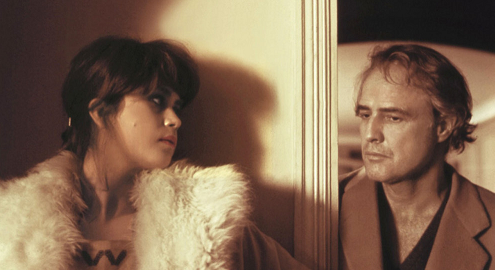 |
| Maria Schneider and Marlon Brando in 'Last Tango in Paris'.
|
About 45 years ago, the film critic Pauline Kael made the
bold statement that a landmark in the history of cinema emerged. The unusual
suspects included a young Italian filmmaker, a middle-age American actor who
has just delivered one of the most iconic characters in the history of cinema
(and made others a few offers they couldn’t refuse), and a French actress who
just reached 20. This international wonder was recognized by many awards, and
yet generated enough controversies for which active discussions regarding it
have continued to this day. The film is of course Bernardo Bertolucci’s ‘Last
Tango in Paris
 |
| The contemplation of life. |
Before we indulge ourselves in this modern classic, I would
like to offer a bit of a warning. This film is extremely sexually explicit, and
while my discussion will be more about psychology – because I feel it was
Bertolucci’s focus after all – there are certain points that we may encounter sexual
content, and I hope that will not be offensive to certain readers. The first
part will be about background and style, the second part will be about content.
 |
| Bernardo Bertolucci |
‘The Last Tango in Paris
 |
| Bertolucci directing Brando and Schneider. |
Marlon Brando was one of the actors I admire the most in the
history of cinema, and therefore it shouldn’t be surprising that his
performance here is among one of my favourite, alongside with ‘Godfather’. One
cannot stop falling in love with Brando’s talent, if you really love cinema,
because his style was just so unique. Brando could be considered as one of the
key actors who involved in method acting. The way he mumbled through his lines,
and his monologues, especially in his films from the 1970s, offered a hypnotic
effect. I can say I have fallen in love with Brando’s monologues – I just want
to hear him talking on and on and on.
 |
| Bertolucci and Storaro's painterly composition. |
While ‘Last Tango in Paris
 |
| Light, shadow, body, psyche.
Is ‘Last Tango in Paris’
pornographic, as some detractors may suggest? I disagree. It is fair to say the
film has a strong sexual element, yet the intention is not to make the audience
feel ‘dirty’ about sex. If Bertolucci’s intention was to make ‘Last Tango’ a pornographic
film, then he would have failed miserably, because it was clearly not his
intention (and he would also not need all the efforts to write all those
beautiful dialogues and figure out the painterly compositions). The audience
will not feel horny or sensationalized by sex from this NC-17 film, rather,
they will likely feel emotional and garner sympathy to the two major
characters. To me, ‘Last Tango in Paris’
is not merely about sex. It is about relationships. It is about feelings. It is
about how things can go horribly wrong if you do not understand others, or have
a wrong expectation from others due to the lack of a proper and sincere
communication. The tragic consequence of the film is due to character flaws and
the failure to express feelings that can strengthen relationships. Sex, after
all, is merely a vehicle to tell the story and express the theme.

After watching 2 paintings by the 20th century
artist Francis Bacon, Bertolucci invited us to the story of Paul (Marlon
Brando) and Jeanne (Maria Schneider). Paul was a middle-age American who was
mourning over her wife’s recent suicide. Wandering aimlessly around the streets
of

The inevitable union of 2 tortured souls?
Now you owe me Bacon
While ‘Last Tango in
Bertolucci has cited the influence of Francis Bacon to the
style in ‘Last Tango in Paris’, as far as asking Brando and Storaro and others
to observe Bacon’s paintings and tried to imitate the style from them. Bacon
had a unique style to his painting, and one could feel that his painitings on
human characters were often very abstract, rather than relying on the
foundation of realism. In the opening titles of the film, Bertolucci showed 2
paintings from Bacon, one male and one female. Not only the grotesque effect
was evident, the paintings also showed ambivalence. While the characters in the
painting appeared to be in relaxing position, their facial expressions were
distorted and ambiguous, far from suggesting they were enjoying themselves. It
thus appeared if they were ‘placed’ into such a position deliberately rather
than following their natural composure and feeling comfortable. Indeed,
Bertolucci advised Brando to imitate the gesture and composure from these Bacon
paintings (you can say it as a sort of method acting), and Brando has committed
to this approach and has all sort of different composures in the interior
scenes. In the final moment of the opening credits, Bertolucci deliberately
placed the 2 paintings aside once more, as if to symbolize the inevitable cross
of path of the male (Paul) and female (Jeanne). Call it fate or whatever, that
was when the two tortured and confused souls finally encountered each other
amidst the streets of
 |
When one watches a film by Bertolucci, the significant
contributions from Vittorio Storaro, who is Bertolucci’s long-term collaborator
on cinematography. Though I will talk in detail about Storaro’s general style
in the article for ‘The Conformist’, I will pick up a few points which are
relevant to ‘Last Tango’ here. Drawing inspirations from Bacon, many scenes in
the film had a painterly feel, and to be sure, if one pauses the film every now
and then, the shot may appear as if they are paintings from an artist. The
beautiful compositions, the brown hues, with the balanced and often stylized
use of light and shadow, Bertolucci and Storaro created images as if they were
painting on celluloid. It was quite clear that there was a contrasting
atmosphere when one compared the scenes outside the apartment (i.e. Jeanne’s
normal life), and those inside the apartment (i.e. Jeanne and Paul). While the outdoor
scenes were naturalistic, the indoor scenes were painterly and stylized in
terms of lighting and composition. In many of those scenes you can almost
always see light mingling around with shadow! I am not sure if an analogy to
Freud’s ideas are totally relevant here, yet I feel that the intimate scenes
inside the apartment are very similar to the unconscious side of our minds, and
the place is where the more carnal desires lurk around. While the indoor scenes
can be seen as limited, often only involving Paul and Jeanne, they are among
the most atmospheric and emotional moments of this film, and Bertolucci’s
mastery for the story should be recognized. I remember reading a negative
review of Bertolucci’s flawed classic ‘1900’ from Roger Ebert, and in there
Ebert pointed out that Bertolucci’s greatest moment was when he was directing 2
characters in a room. I think at least Ebert could appreciate the strength of
Bertolucci’s work (also think about the ‘Plato’ scene in ‘The Conformist’). To
sustain the fascination and attention from the audience in such a minimalist
mise-en-scene requires a lot of talent and creativity from the filmmaker.
Bertolucci should be proud of that!
(1/2)
Film Analysis
Friday, 20 April 2018
The Trial

I have always been fascinated by the writer Franz Kafka.
Through the absurd situations his characters found themselves in, Kafka
explored the human conditions and the possible search for the meaning of life.
Orson Welles, who has adapted a number of literary sources to his films, have
adapted Kafka’s ‘The Trial’, which is the topic of this article. The film
starred Anthony Perkins, who has famously portrayed Norman Bates in Hitchcock’s
‘Psycho’, as Josef K.
Welles has been faithful to the original story, and has not
added much in terms of plot in his film. What he has instilled, though, was an
original visual style that not only enhanced the narrative impact of the story,
and that also made his film a unique spectacle of its own.
Most of the Wellesian mise-en-scenes were evident in ‘The
Trial’. The Wellesian deep focus emphasized the power struggle of all the
players in the existentialist fable. Welles deliberately staged the composition
in depth, so that a repetitive and regimented pattern could be observed by the
audience, signifying the bureaucratic nature of the society Josef K. found
himself in. Since the 1950s, Welles’s visual style has become more complex, and
the high contrast black and white also enhanced the dream-like and disorienting
impression which could be easily felt by the viewers. The complex spatial
aspects in his films, as in ‘Touch of Evil’, ‘The Trial’, and ‘Chimes At
Midnight’, appeared like a cinematic labyrinth, and the protagonists were often
stranded in the maze-like structure. Their entrapments were not merely
physical, but also metaphorical – they were confused and misled by the
deceptions, conspiracies, and paranoia that originated from self-interested
individuals or institutions, and the story testified their humanistic struggles
against these forces, even if the chance of escaping unscathed was slim.
A nice example was the sequence when Josef K. attempted to
escape from a maze-like structure. Through a fantastic use of the tracking
shot, where similar approach was also found in ‘Touch of Evil’, Welles captured
the panic and anxiety when Josef K. was exploring the absurd labyrinth he fell
into. The dynamic long take showed his weariness regarding the situation, and
the audience could be easily identified with Josef K.’s futile attempt to run
away from this bureaucratic environment. While the outlook might appear bleak
to many, Welles at least celebrate our underdog hero, by showing his courage to
shoot back on a system that was unsympathetic to any human freedom and
potential.
Orson Welles’s ‘The Trial’ is a relatively unknown work from
the great filmmaker, yet it is a brilliant one. It should be of interest to
anyone who likes visually driven films.
Film Analysis
Friday, 13 April 2018
Day of Wrath

After talking about Bergman’s ‘The Silence’ last week, I am
talking about a film with a similar theme regarding spirituality this time –
Carl Theodor Dreyer’s ‘Day of Wrath’, which was made during the Second World
War.
The story took place in the 17th century, at a
time when witches existed and witch hunting was an important act for
normalizing the beliefs of people. The story was divided into 2 parts, and they
paralleled each other as similarities could be observed. The protagonist was a
young woman called Anne, who married Absalom due to obligation. Absalom was a
pastor who served as a judge for the prosecution of witches. An old woman,
Marthe, was insinuated as a witch, and she was hiding from the church
officials. What connected the two women was that Absalom was actually one of
the judges responsible for Marthe’s condemnation. Before Marthe was captured
and eventually burnt at stake, she chanced upon Anne and told her a startling
truth - Anne’s long dead mother was actually a witch. This revelation fascinated
Anne, and yet jeopardized her because she would be seen as a descendent of a
witch, and would likely face condemnation when the appropriate reason came to
her. On the other hand, Anne could not find happiness with her marriage to
Absalom, and she found out that she loved Martin, Absalom’s son instead. When
Anne was increasingly consumed by paranoia and suspicions, what would
eventually come out of these characters?
Day of Wrath was a film very representative of Dreyer’s
style because it illustrated a tug-of-war between his two predominant styles –
the spiritual and the psychological. Dreyer has always expressed the
transcendental aspect of the human condition in his films, most notably in
‘Ordet’ and ‘The Passion of Joan of Arc’. Yet, he was just as inspired by
Expressionism, and the resulting psychological edginess could be in particular detected
from ‘Vampyr’ and this film.
For the first half of the story, when Marthe was condemned
as a witch, the plot paralleled ‘The Passion of Joan of Arc’. It has been
pointed out that Dreyer did not make any moral judgment on Marthe, unlike the
characters in the film whom definitely saw witchcraft as something evil. I
think this amoral stance is important for the film because Dreyer was
questioning either there was a clear boundary between the spiritual /
psychological or the morality debates.
The tones between the two parts were different. In the first
half, the viewer could easily conclude that witches did exist. Yet, the second
part’s concern was naturalistic. Anne’s paranoia had no supernatural elements, and
the origins were totally psychological – jealousy, insecurity, and mental pressure.
In a sense Anne had to hide from her true feelings – because the person who she
really cared and loved was Absalom’s son , Martin, hence those intimate
excursions in the green fields. Of course, the time of intimacy was tragically
brief. The pressure also arose from her duty of marrying Absalom and the
appreciation that she might be connected to witchcraft, given that she was
living in such a non-secular era – meaning that there would not be a runaway
explanation for involvement in witchcraft and the activities would not be
tolerated.
Whether Anne could be considered as a genuine witch was
meant to be ambiguous. Marthe did inform Anne that her own mother was a witch,
and that seemed to be the only connection between Anne and witchcraft. What was ironic was that Anne’s nasty wish for Absalom’s
demise did eventually materialize, and that might suggest she did possess the
gift of some black magic. Critics did point out that the apparent miracle
(albeit a nasty one) was more an expression of Anne’s delusion, and that made
sense because the philosophy behind Expressionism was often to externalize the
psychotic feelings in one’s mind into the mise-en-scene, hence the edgy
composition and setting. Indeed, Dreyer made Anne appear witch-like by using
very high contrast lighting, and staged her as catatonic in certain scenes. When
she creepily looked out of a window to witness Marthe’s death, it sounded as if
a foreshadowing was taking place - soon it would be her turn to be condemned as
a witch.
The final condemnation of Anne could also be interpreted in
a social context, though Dreyer had no intention of making a political
statement or making allegories on Nazism and the Second World War The story
took place at an age which was ruled by totalitarian power, and the need for scapegoating
was an aspect that defined such a political system, which relied on a black-and-white
logic to govern the people. When Absalom died, someone had to be held
responsible for that. Therefore a witch hunt has taken place, and irrational
judgments have been passed onto Anne to deem her guilty. The scenario has bore
similarities to the totalitarian powers and racial hatred around the time of
Second World War. While the story was medieval, it was ironic that a modern
blend of witch hunting appeared only a decade after ‘Day of Wrath’ was first
shown – the House Un-American Activities Committee and McCarthyism in the
1950s. Critics since then appreciated the relevance of the film to the modern
world – when paranoia and prejudice joined forces, only the innocent ones would
be victimized.
Film Analysis
Friday, 6 April 2018
The Silence

This time, I will talk about Ingmar Bergman’s film ‘The
Silence’. This 1963 film is often grouped as a trilogy with 2 other films from
Bergman, ‘Through a Glass Darkly’ and ‘Winter Light’. I have written an article
about ‘Through a Glass Darkly’ before.
Bergman has stated that the three films of his shared a
common theme on spirituality, and he felt that the ‘silence’ in the title
represented ‘God’s silence’, which, of course, is a belief many people share in
a secular world. While Bergman has often been critical of the orthodox and
ritualistic aspect of religion, he did maintain that a spiritual quest for
inner truth and faith was important for humanity.
The surface plot concerned a pair of sisters, Ester and
Anna, and accompanied by Johan, Anna’s son. It was evident that the pair did
not get along, and of stark contrast in terms of character – Anna was the more
sensual and active on, while Ester was the more intellectual and distant one.
Things got worse because Ester was also suffering from illness, and the trio
found themselves in an alien place – a fictional central European country
(Bergman went as far to invent the country’s language to make it sound
alienating), when it served as a mid point for their train journey to home. It
was also clear that the country was going to have war pretty soon. Internal
turmoil coupled with external threat, that represented the ‘perfect storm’
situation for a film. What would be the outcome for the trio in such an
untimely scenario? Of course, as in any Bergman’s film, like ‘Persona’, what I
have just described was only the apparent storyline. If one looks at the story
differently, he/she may find a completely different meaning.
Bergman has been heavily influenced by the chamber plays of
August Strindberg and he has contributed by extending this idea into his films,
most notably in the spiritual trilogy and ‘Persona’. Bergman followed music
laws, rather than dramatic ones, in these films, and as a result he established
a cinematic rhythm, very unique and different from the norm – the prevalence of
narrative films around the world.
Chamber plays give an intimate sense of feelings for the
audience. There are a number of characteristics for this type of style, which
is also common in theater. Chamber plays tend to show a sparseness of
characters and settings. The number of characters is minimal, and so is the
setting. That is done so that the actors can focus on their intimate aspects
rather than, say, the detailed set. The actors give naturalistic acting, most
notably, they can turn their back on audience, to give a ‘realistic’ rather
than a mannerist acting style, and that prevents the audience impression that
the play is being ‘staged’.
Many critics and filmmakers do believe that the meaning of
‘The Silence’ is not as obvious as the plot may appear, and certainly such an
interpretation has also been made to ‘Persona’ and some of Bergman’s other
films. A common interpretation about the film is that Ester and Anna actually
represented 2 conflicting dimensions of humanity, as illustrated by their
respective character. Thus, the film portrayed an eternal struggle between
spiritual realm (Ester) and physical realm (Anna), for which this struggle is
something we are all aware of throughout our lives.
I would like to divert your focus onto the child. Johan was
portrayed positively in the film. He represented a hope for humanity – with his
inquisitiveness, sense of wonder around his world – even if it was devoid of
objective meanings and haunted by the fact that ‘God is silent’. He was the
embodiment of potential, both in an aesthetic and developmental manner.
The great thing about Bergman’s approach was that, while he
showed the positive attributes of Johan when he interacted with his world,
Bergman did not insulate him from the hidden darkness inherent in humanity.
When Johan interacted with the kind-hearted waiter in a non-verbal manner –
because they did not show each other’s language - the waiter did not forget to
demonstrate him the ‘sausage’ show. When he interacted with the apparently
funny all-male dwarf troop, one of them went as far to put Johan in a dress and
kissed him. Johan might not be intellectually ready to understand the
implications behind these scenarios, yet no one could make him immune to the
nasty things of the adult world, just because he was a child. Johan had to experience
the tanks, the aircrafts, the embodiments of war in Bergman’s bleak landscape,
no matter how mysterious that might first seem to his nascent mind.
Nevertheless, a very powerful act by Johan was that when
Ester believed that she was beyond all points of revival, she covered herself
with a sheet on the bed to serve as a gesture of her ‘death’. Johan, walking
by, proceeded to lift up her sheet and exposed her again. Though it was just a
simple gesture, it took a very spiritual dimension, as if Bergman was offering
a sort of hope in a rather hopeless situation portrayed in the film. The child
might show innocence, yet he did possess an inherent sense of compassion when
facing the demons of degradation.
I can also think of a further meaning of the film’s title.
Because Bergman has portrayed a world that had a lot of ambiguities and
uncertainties, and the silence of God meant that there were no ways to strive
an impartial viewpoint in all of these. A silence of the inaccessible truth. After
all, contradictions have to co-exist in our world – that is the aspect that
makes us human.
Film Analysis
Thursday, 29 March 2018
Red Desert, Part 2

1. An important point about Antonioni’s ‘
2. I feel that the stance posed by ‘Red Desert
3. Though Antonioni did celebrate that humanity has the power
to master and control nature, he was not at all oblivious to the consequences
of that. He was indeed viewing the issue in a very realistic stance. As he
stated in another interview, each era has demanded sacrifices upon which other
things were built. There is no evolution without crisis. Antonioni appreciated
the problem that arose from any form of progress, and demanded the audience not
to retreat or run away from them. Before we think about the big questions,
let’s deal with a bit of psychology first.
4. Giuliana seemed to have the ability to see things in a
unique way. Yet, the heightened sensation might just be subjective (and
probably delusional) point of view from Giuliana, suggesting she might have
some form of mental illness. Antonioni, on the other hand, did not provide any
clue about an impartial perspective, therefore the audience has no clue whose
(or which) point of view was the correct one that points to reality? Certainly,
this was the style that Antonioni employed in many of his films, as an allusion
to Nietzsche’s philosophy.
5. And, I believe there is a vision that Antonioni has been
always delivering, much like that of Dreyer and Bergman as I will discuss in
later articles – that in real life there is only a thin line because vivid
imaginations and potential psychosis. When you see something so different from
other people, as Orson Welles would have put it, ‘he / she is either a genius
or a complete idiot’. Moreover, it is rather ironic that Giuliani’s idealistic
thought - the island she was mentioning in her story was the only one that
seemed to reconcile with any attributes grounded in reality, as least the way
the audience would find comfortable with. The colors in the sequence were
natural, not deliberately deformed or heightened in any way.
6. Objectively, Ugo, Giuliana’s husband, was quite concerned
that she has probably contacted some sort of mental illness and therefore she
was not acting quite right. Worse still, Giuliana was distressed by a nightmare
involving herself sinking in quicksand. This aspect is interesting because it
reminds me of another 1964 film from the East, Hiroshi Teshigahara’s ‘Woman in
the Dunes’, which I have talked about before. That film was also surrealistic
and dealt with existential issues, and I am not sure that is a mere coincidence
or maybe there is some inspiration between the two. The content of the dream
was not random, it was quite deliberate. When Giuliana was hospitalized before
that, she heard an anecdote from a woman that she was afraid of drowning
because she felt that was no ground beneath her, as if she was sliding down a
slope. Later on, when courting with Corrado, she expressed that she couldn’t
look at the sea – though she liked the feeling of it – because she would lose
interest on the land - which was what her issue seemed to originate. This is a
very nice analogy because the very act of ‘drowning’ was like the unquestioning
and conformity to the situations people found themselves in. Giuliana seemed to
be aware of the existential ennui, no matter how sick she might be judged by
psychiatry, that she had to get away from this turmoil.
7. What is quite obvious, though, was that Giuliana’s real
issue originated from her isolation and alienation from the world around her.
Not only the modernizing environment has led to her distress, she found it hard
to find a true and lasting relationship from others, including her family. The
people around her might have offered some possible distractions – sex,
politics, material possessions, or mindless RPGs – but any of them would not
lead to a better status for her. She had the responsibility to figure it out
for herself.
8. The memorable fog scene signifies the existential angst of
many characters of Antionioni’s films in general. In the scene, characters
appear and disappear amidst the fog, as if not certain of who they are, and
what their individual identities lead them to. The very fact that the
characters are widely separated in the scene separated the inevitable loneliness
inside every one of us, the isolation inherent in the individualism of
humanity. This memorable scene was Antonioni’s poetic portrayal of the human
condition we must all confront at some point.
9. Corrado, who was Ugo (Giuliana’s husband)’s business partner,
was an interesting character. While he was not a model character – there were
no model characters in an Antonioni film – he was at least concerned with
Giuliana’s plight and was willing to connect with her. Like everybody else, he
was also in a state of alienation, but he was a bit more open to interact with
his surroundings and has always attempted to look for a solution. He told Giuliana
"You wonder what to look at; I wonder how to live." So, he was
exploring the attitude to live for a meaningful life. His voyage to Argentina
10. Antonioni disagreed. He felt that the right attitude was not
to long for the more primitive times, with the belief that it was a more
natural landscape for man. Nor was it to escape from the painful condition. This
is best illustrated in the final minutes of the film. When Giuliana and Valerio
were walking near his husband’s industrial plant, a stream of exotic yellow
smoke was shooting out. And while Valerio wondered whether the birds would be
harmed by the poisonous smoke, Giuliana gave an answer that showed she was
enlightened regarding her situation. The birds did not just escape or never
came back, rather, they figured out a way to get around the poisonous smoke, so
that they could be suited to the ever-changing environment. Antonioni believed
this flexible attitude was something that we had to develop to meet the changes
we encounter in the modern age.
11. Antonioni also believed in hope from the younger
generations, like Bergman in ‘The Silence’. Giuliana’s son, Valerio, had a
fascination with the robot toy, and his attitude was more open to changes than
the other characters. Regarding the robot, that’s a scene where the ambiguity
has led to contradictory interpretations from the viewers. The robot
accidentally switched his direction and repeatedly crashed into a wall, without
the people noticing it. After the light of the room was switched off, the only
visible aspect was the robot’s shining eyes. Antonioni appreciated that this
scene was meant to be open to interpretation, though he did not want the
viewers to feel that the scene had a negative outlook suggesting the technological
direction was leading humanity to a dead end. Rather, he pointed out that
because in the dark the shining eyes of the robot was the only source of
illumination, it could be the thing that could assist humanity to a better
outcome. Because Valerio could easily accept this new toy, he would be more
equipped to face the many changes that he would eventually encounter in his
adulthood.
12. With ‘Red
Desert
(2/2)
Film Analysis
Friday, 9 March 2018
A Few Words on Oscar

The Academy Awards ceremony has taken place on 5th March, 2018 . While
there were not many surprises for the winners, it is a great idea here to
review a few of these wonderful films from 2017.
‘The Shape of Water’ has won the Best Picture Oscar, and Guillermo
del Toro has won his first Oscar for his stunning directorial effort. Del Toro
has been acclaimed as a visual and imaginative director over the years, and
while ‘The Shape of Water’ has similarities with another of his masterpiece,
‘Pan’s Labyrinth’, these films are about the potential of imagination and
fantasy within a harsh reality. The two protagonists of ‘The Shape of Water’
were both underdogs – who were the victims in a paranoid and prejudiced world.
There should be no surprise that the story took place in a setting of the Cold
War because that was exactly the time when people did not put much
consideration on the well-being and dignity of individuals – even if it was a
blue, fish-like creature – and subject to bouts of electric shocks and
vivisections. Yet, del Toro is willing to offer us hope – the setting was
exactly where fantasy and love could become possible, when the mute protagonist
and the creature could fathom a compassion beyond human. The scenario is very
similar to ‘Pan’s Labyrinth’, when the little girl has to imagine a fantasy
world with the creature with horns to ‘detox’ her really stressful situations.
The evil clutches may prevail sometimes in the real world through the brute
force, yet those with golden hearts deserve more than just the world. Just like
the 2 protagonists in the film, they can reach a realm where they can be happy
together, and this is what a visionary filmmaker like del Toro can offer. After
all, the analogy of water (which somewhat recalls Bruce Lee’s philosophical
statement – ‘Be water, my friend) is related to humanity. Water is
free-flowing, can come in all sort of forms and shapes. It only depends on the
context, and gives meaning to itself. And, what you can make meanings out of
your existence depends on you.
Gary Oldman and Frances McDormand won the Best Actor and
Best Actress respectively for their brilliant performances in ‘Darkest Hour’
and ‘Three Billboards Outside Ebbing, Missouri’. All the nominees in the Best
Actor category are wonderful, and it really is a bit of a Mexican Standoff
there. Gary Oldman has steadily proved to us that he is a spectacular actor who
deserves to be loved throughout the years. One can never forget his killer
performance in ‘Leon: The Professional’, when he played the Beethoven loving
bad cop. Just like when he was portraying Winston Churchill, he put all his
feelings and efforts into the character, and with the stunning makeup effects
he literally became Churchill. I suppose many of the film lovers would feel
great about Oldman finally winning the Oscar. Frances McDormand, who has
already won the Best Actress Oscar years ago in ‘Fargo’, completely nailed it
as the obsessive, foul-mouthed, and determined mother in ‘Three Billboards’.
Her intense look only showed her determination of getting things right, and she
would drop F-bombs and go NBK (interesting that Woody Harrelson was also in the
film – a bit sad he did not get the Oscar, but then Sam Rockwell is also great)
on the injustice that befell around her. The three billboards represented her
modus operandi when facing with the disjointed time, direct and to the point. McDormand
is channeling Klaus Kinski here – her character is obsessive about her aim, and
she can easily go a bit too far – at a certain point throwing Molotov cocktails
(and F-bombs and racial slurs) to the police station. I do not feel the
director was asking the audience to judge his characters. There is no point to
ask whether McDormand’s character is good or evil, so are Harrelson’s and
Rockwell’s, because the flaws are what make them so human and realistic. The
dark sides portrayed in the film – the prejudice, obsession, anger – are
something present in our world, and we have to be courageous and confront them
often. Ms. McDormand’s talent should be lauded because, as a leading lady often
in Coen Brothers’ films, ‘Blood Simple’, ‘Fargo’ etc., she always delivered the
first rate performance of surviving and fighting in an absurd, bigoted, and to
be plain, effed-up universe. The intensity of her performance testified the
fighting back of the individual, something that humanity should really cherish
and celebrate.
‘Dunkirk’ won 3 technical awards, and Christopher Nolan was
nominated for both director and picture. The film is special because Nolan has
painstakingly turned away the narrative structure common in many American
movies. The idea of the film is very simple, very different from his past work
like Memento or Inception. The plot is sort of similar to The Wages of Fear,
where basically the soldiers were fighting for their lives through round after round
of obstacles, asking themselves when they will hit the wall. What Nolan has
achieved is to present the story through a very visual and aural way, and the
scenarios here would give the audience snapshots and experience of war. Nolan
did not try to give us a coherent story of the evacuation, and this should not
be seen as a shortcoming of the film, as some critics may have assumed. He
deliberately downplayed the importance of the use of dialogue to explain the
story and feelings of the characters, so in a Kubrickian sense - the film is
possibly the closest in terms of his influence from Kubrick - Nolan ‘banalized’
the dialogues and made the characters opaque. Because, like Mildred's case in ‘Three
Billboards’, there was no room for polite society, everyone was just reacting
to survive and passing the round. I really love the fact that since the first
meeting of the 2 main characters on the beach, they have not really said
anything to each other, but no one would deny that they were friends. I believe
this is a testament to Nolan's caliber, where you do not need any sentimental
dialogues to convince the audience they are comrades - all you need is a
creative vision.
How did Nolan achieve this visual experience? It is
instructive that he has taken inspiration from silent films, an era that
dialogues were only presented as title cards, and the filmmaker had to exert
the power 100% by the cinematic images. That is the reason why some of the most
memorable cinematic images come from the silent era, because the filmmaker had
to fully rely on the visual aspects to make the point. Nolan used purely visual
means to portray the stress and excitement when one was locked in battle, and the
spectacular sound effects lead to a cinematic poiesis of action. The effect is
further enhanced because Nolan played in parallel 3 sets of action of various
durations, and the relativity of the time difference clearly heightened and alienated
the effect of viewing the film. The stylized score evoked stress for the
audience, and completely matched the theme of escalation as shown in the film. When
watching the film, I could only think of the famous quote from Churchill, ‘If
you're going through hell, keep going!’
Finally, how can we miss 'Blade Runner 2049', a genuinely
fantastic film from 2017? Though I was a bit disappointed the film was not
recognized by any major category nominations of Oscar - I would be surprised if
the film was not a top 10 film of 2017 - it did finally get the respect from
the great reviews from critics this time, and got 5 nominations in Oscar,
eventually winning 2 well deserved ones - Visual Effects and Cinematography.
Though I will always see BR as a Ridley Scott masterpiece, Denis Villeneuve has given new life to the story, and he has
made significant contributions in terms of the interpretations of BR.
Roger Deakins, a first-rate director of photography who has worked
with the Coen Brothers, Scorsese and Villeneuve, finally won his first Oscar
for BR2049. Deakins is the rare sort of cinematographer
who has a style as distinct as a
filmmaker, some other examples are Vittorio Storaro, Gordon Willis and
Emmanuel Lubezki. Say, in Storaro’s case, no matter it is a Bertulocci, Coppola,
or Beatty film, Storaro always provides his signature fluid camera movement,
and complements with the approach of the director in question. When we look at
Deakins’s style, one can usually identify with a gritty atmosphere, and that is
why he has such fruitful collaborations with the Coen Brothers and also Villeneuve,
as it will be very different if Deakins’s signature style is absent in films
like ‘Prisoners’ and ‘Sicario’. Deakins’s style perfectly fits the future noir of
Blade Runner, and affords a sense of edginess to the not-that-black-and-white
film. Speaking of style, we should also acknowledge and appreciate the original
effort of Jordan Cronenweth, the cinematographer for the original Blade Runner
film in 1982. It was him who gave us the atmospheric feel of the original
masterpiece, and literally influenced every sci-fi or cyberpunk films since then.
Scott has always maintained that Blade Runner was intended to contain elements
of Film Noir, and it should be of no surprise that Cronenweth’s approach to
cinematography was also inspired by the aesthetics of Film Noir. The low key,
expressionistic feel that penetrate both Blade Runner films is exactly what
make them visually stunning and that achievement deserves the recognition from
Oscar.
Really look forward to more wonderful films in 2018!
Friday, 23 February 2018
Red Desert, Part 1
 |
| Monica Vitti in 'Red Desert' |
This time, I would like to talk about Michelangelo
Antonioni’s ‘Red Desert’. Though it was a film more than 50 years ago, it is
still a recommendable film for today’s audience. While I first became
fascinated in Antonioni’s work after working ‘Blow Up’ many years ago, it has
turned out that ‘Red Desert’ would become my favorite Antonioni film of all. I
am impressed by the thoughtfulness and philosophical outlook of the film, and I
think the central theme of the film is relevant for people from any era – what
sort of attitude and action should one take in an ever-changing world? Just
merely try to fit in and get every gadgets that are just on the web 5 seconds
ago? Or to retreat and celebrate the good old times and a simpler life? As we
will see, Antonioni recommended a more positive plan of action for the audience.
The visual style of ‘Red Desert’ has influenced many
subsequent films. Alfred Hitchcock, who admired Antonioni, has been impressed
by the color use in ‘Red Desert’ and ‘Blow Up’. He tried to adapt a similar
visual style in his unrealized film ‘Kaleidoscope’, and what a shame this film
could never be made. On the other hand, John Boorman has also cited his
influence from Antonioni and other European filmmakers when he made the Lee
Marvin classic ‘Point Blank’ in 1967, which was also about the question of
subjectivity and alienation.
The story concerned the experience of Giuliana, the mother
of a single child, in a modernizing and industrial town. She struggled to come
to terms in the technological progress around her, and a subtle suggestion
stated that she might be suffering from some form of neurosis – and certainly
existential crisis. Through her interaction with the people, and also landscape
and environment around, would she be able to find her own place, and also have
the wisdom to figure out a meaning of her life?
Once in an interview, Antonioni has expressed a lot about
his view on ‘Red Desert’. He noted that this film represented a shift of focus
for his filmography, because for his 3 films before that – the trilogy that
started with ‘L’ – they were more concerned with relationships between people.
In ‘Red Desert’, a more cosmological and outward perspective was taken – he
wanted to explore more about how individuals interacted with their surroundings
– the ‘human in universe’ theme, which I have mentioned quite a lot before in
other films. While this approach would likely require an impartial perspective,
Antonioni’s style turned out to be far more imaginative than that.
The style could be considered artificial or even abstract at
points, very much like a high-end modernist artwork. While color may at the
surface seem to enhance the realism of the scenes – human beings see in color,
right? – Antonioni’s evocative use of color seemed to lead to the very opposite
paradoxically. His use of color led to a ‘formalist abstraction’, which served
his anti-realist motivation. Thus, the color was seen as very ‘heightened’ for
the audience, and to be honest, it has a weird sort of pleasure when one looks
at it. Antonioni has also explained that the artificiality of his color would
enhance the expressivity of his images, I guess much like the edginess seen in
German Expressionism. It is notable that Antonioni used a telephoto lens when
he shot ‘Red Desert’, because in order to achieve an anti-realist effect, he
was committed to reduce the depth of field often evident in Bazinian Realism,
and his use of the lens led to a flattening effect of his images, where the
distance between foreground and background was reduced.
As noted by many critics, the motif of landscape is very
important for Antonioni's films. Antonioni has succinctly stated that all his
works were born of a landscape, and his desire to explore the landscape. Thus,
one can start by saying that Antonioni has provided an impersonal view of
humanity, as there is a delicate balance between the emphasis of humans and
environment.
Antonioni employed some nice editing strategies to
illustrate an abrupt shift of focus and to illustrate to the audience how his
characters were trapped by their surroundings. He deliberately did sudden cut
from a conversation between 2 characters to a background shot, to state that
the characters were locked in a larger surrounding they might or might not be
appreciating. Interestingly, this strategy has been used by a lot of great
directors, where they attempted to show an alienation and entrapment of the
characters. Stanley Kubrick’s ‘Barry Lyndon’, Joseph L. Mankiewicz’s ‘Sleuth’, Martin
Scorsese’s ‘Taxi Driver’ contained nice examples of this great approach. The
placement of the characters were also quite unusual in many cases, as if
Antonioni was attempted to undermine them, suggesting a loss of agency of these
characters towards their environment or the context they found themselves in.
The poiesis from Antonioni meant that he was not only
determined to confront his audience visually, but also aurally. He portrayed
the irony that, in some senses, the industrial noises were even louder than the
character’s dialogue – which would NOT be the case for the traditional approach
of Western cinema – symbolizing that these characters were entrapped and
alienated, and could not deliver clearly their thoughts and feelings to each
other.
(1/2)
by Ed Law
24/2/2018
Film Analysis
Friday, 2 February 2018
La Notte

1. In January and February this year, a number of films
by the Italian filmmaker Michelangelo Antonioni are re-released in Hong Kong. This
time, I am going to talk about ‘La Notte’, which is part of a trilogy with
‘L’Avventura’ and ‘L’Eclisse’. I will
present my viewpoints in an episodic manner, as if they are some random
thoughts from my mind.
2. ‘La Notte’ is fascinating in the sense that it can
be qualified for the guideline for classical unities in Aristotle's ‘Poetics’ -
the unity of time. In terms of theme, ‘La Notte’ shares similarity with another
film of the same era, John Cassevetes’s ‘Faces’, though the approaches to the
issue were quite different between the 2 filmmakers. It has also been compared
to Stanley Kubrick's 'Eyes Wide Shut'.
3. The story concerned Giovanni and Lidia, a couple
from Milan, and how the experience in an evening would push them to examine
their relationship. While the activities
might sound a bit random and episodic, Antonioni’s intention was probably
deliberate and these activities will lead to meanings if one is willing to look
beyond the banality of the surface.
4. The relationship between the couple was detached,
and soon Lidia felt that she needed some solitude and thus wandered into the
evening lights. When she strolled through the place she once lived, some
solutions seemed to offer to her in the form of her perceptions – aggression (a
fight) or running away (the setting off of some homemade rockets). As one would
see also in the later Antonioni’s films, these are often not the best way to
deal with one’s existential terror, though they might have provided some form
of short-term solace.
5. Memories have been confronting the characters,
especially our 2 protagonists. Antonioni the filmmaker seemed to provide his characters
a lot of things to think back on, say, where they lived in the past, and the
love poem Giovanni has written a long time ago. Giovanni went as far to claim
that all he was left with were recollections of the past, though, ironically,
Lidia caught him off by noting that he even forgot his own poem, where he has written
for Lidia to show his love.
6. It is also worthwhile to see that the mise-en-scene
has also emphasized the detached relationships for the characters. Antonioni deliberately
installed barriers like gates and doors to symbolize the distance between
characters, and the limits that impeded them to get closer to each other in an
emotional way. One of the scenes involved a floor which resembled a chessboard,
as if the characters were players in a game, always keeping safe distance from
what others could offer.
7. Giovanni succinctly stated to Lidia regarding his
existential angst, "I no longer have inspirations, only
recollections". Inspirations are what we need to move on with our lives,
to find out our own meanings throughout the journey of our existence. Giovanni
pinpointed the stalemate in his own life, and probably his relationship with
Lidia. All Lidia could recommend, which was understandable at first glance, was
that "One must do something", and they just dropped in to a lavish
party, to explore any new opportunities for gratifications.
8. The party by the millionaire was fascinating,
because although the activities might appear banal, Giovanni and Lidia were
forced to confront a number of issues – fidelity (in the form of Monica Vitti
and her invented game), fame and wealth, mortality and nature (the sudden
shower). What I have often wondered is to what extent Kubrick has been influenced
by this double-flirting sequence and put it into ‘Eyes Wide Shut’ (he did
mention ‘La Notte’ was one of his favorite films). The force of nature also
exposed the carnality of some of these ‘civilized’ guests – they literally
jumped into the pool like kids when rain started to pour.
9. The millionaire, Gherardini, was portrayed rather
neutrally in the film, given the belief Antonioni would likely have regarding
this sort of people. Gherardini indeed gave a few insightful observations about
modern life. Not only he saw through the decadence and wealth-oriented nature
of the modern ago, he also felt that the meaning of life has to be figured out
by the individual himself. Gherardini cared less about his position on the billionaire
list, yet he wanted to create something ‘solid’ – which was a legacy of himself
to be remembered. He also pointed out a nice point regarding writer and or form
of artist – one should create an art work because of necessity, because the
artist had a will to do it – they just wanna do it, period. It could not just be
reward or recognition that one wanted to involve in art work. Gherardini’s
vision also coincided with some key ideas of existentialism, for example his
affirmative insistence that ‘Life is what we make of it through our own
efforts.’, and his concentration on the present rather than the inaccessible
future.
10. After all
that happened throughout the evening, they reflected one last time on their
relationship. Lidia was sad because she felt that she no longer loved Giovanni,
and she felt like dying because there was clearly a relationship she has
cherished all the time, and she saw it as an intense loss. Giovanni could
appreciate the seriousness of the issue and he kept on reassuring her that he
definitely loved her.
11. It should be fair to state that both of them were
experiencing some form of crisis, so we cannot say who should be more
responsible for the marriage failure. Lidia, by noting that Giovanni has
forgotten his own love letter, allowed him to confront his own memories, his
vision of the affair. In a sense, Giovanni would be able to discover new
meanings in these lost memories, and see how they might be inspiring him to
regard his relationship with Lidia, just like he has once written for Lidia,
"Beyond your face I saw a pure, beautiful vision showing us in the
perspective of my whole life...all the year to come, even all the years
past.".
12. Antonioni concluded La Notte with an open ending, by
not giving the answer of whether Giovanni and Lidia reconciled at the end. I
would be optimistic and speculate that they would have a greater chance to be
back with each other. Because throughout the night, they had so many chances to
rediscover themselves and realize where the problems were. Both of them still
treasured the relationship they have sustained, and would feel depressed if
that ended with a nasty note. When Giovanni was forcing himself on Lidia (sort
of), it was almost the dawn, suggesting the beginning of a new day, and a new
chapter of their relationship. That is the idea of ‘lost and found’ – through
the recognition of the the value of what that has been lost, it will then orient
for a new start. After all, that is what I think Antonioni has always wanted us
to be able to do.
by Ed Law
3/2/2018
Film Analysis
Subscribe to:
Posts (Atom)