Showing posts with label Ingmar Bergman. Show all posts

Saturday, 1 February 2020

Persona : Bergman x Ibsen x Strindberg


    Ingmar Bergman's 'Persona' is one of the most iconic films from the European Art Cinema of the 1960s. The unique and enigmatic style from Bergman has led the film to diverse interpretations over the years. On surface reading, Persona appears to be a film about the intimate relationships of the two female characters. That is in tune with Bergman’s turn from a more spiritual perspective in the 1950s to a focus on human relationships from the late 1960s. The film suggests companionship can be therapeutic when one is confronting existential angst and alienation that are inherent in human nature. 

    Yet if one looks beyond the surface of this apparent narrative, one will likely discover a more immanent meaning offered by Bergman. Along with Antonioni, Resnais, Godard, Straub and others, Bergman belonged to the cinematic Modernists from the 1960s to the 1970s, whose idiosyncratic films often defy straight-forward readings. In order to discover the new meanings, we have to two of Bergman’s influences, who have shaped the Modernist Drama in the early 20th century – Henrik Ibsen and August Strindberg.   

    It is well known that Bergman has been heavily influenced by Ibsen and Strindberg. Other than the films he has directed, Bergman has been involved in a number of theater productions, including the most iconic plays from Ibsen and Strindberg. To Bergman, cinema is a distilled essence of his theater work, and the two art forms intertwine with each other. After all, who is a more suitable candidate to direct Ibsen's 'Ghosts' than someone like Bergman? 

Ibsen x (Bergman x Strindberg)

    Starting from a theatre grounded in realism, both Ibsen and Strindberg moved towards on symbolic and expressionistic style over their careers. The late plays by Ibsen can be considered the precursor of chamber plays, for which Strindberg has both reacted against and further developed at the same time. The chamber plays became a very popular type of theater at the early 20th century in Europe, popularized by Max Reinhardt and other theater directors. The popularity coincided with the rise of German Expressionism, and one can easily connect the dots of this towards Strindberg’s artistic tendency in his late plays. For a number of Bergman’s films, such as ‘Through a Glass Darkly’, ‘The Silence’, ‘Cries and Whispers’, ‘Autumn Sonata’, and ‘Persona’, can be categorized as cinematic ‘chamber plays’. If one watches a televised version of Ibsen’s ‘Ghosts’ from UK (1987, directed by Elijah Moshinsky and starring Judi Dench), one will not find it to be too different from a typical Bergman film.  

    Many critics have noted that Strindberg’s plays, with their apparent naturalism, cannot be accepted at face value. A common technique adopted by both Strindberg and Bergman was to use characters in a non-realistic way, where they symbolized conflicting psychological drives from the same ego. From Strindberg’s ‘Miss Julie’ to the aforementioned Bergman films, they also served as nice examples. One can rationalize why chamber play is a great candidate to portray this kind of theme : because the ‘chamber’, usually a manor or a house, can symbolize a mental landscape, like the psyche as a totality; and the characters represented the differing psychic drives that battle for control and dominance. The 4 female characters in ‘Cries and Whispers’ symbolized 4 types of human sentiments, conflicting with each other in the red mental chamber until the end of one’s existence.   An example in American cinema, likely influenced by ‘Persona’, is Robert Altman’s ‘3 Women’. The film possesses an allegorical style and it certainly attracts a lot of different perspectives about its ‘meaning’ from the audience.  

(Ibsen x Bergman) x Strindberg

    Bergman has also been influenced a lot by Ibsen, and ‘Persona’ shared a number of themes from the Norwegian playwright. Elisabet Volger, the mute actress in ‘Persona’, can be seen as a continuation of Ibsen’s heroine. Ibsen, similar to Antonioni in cinema, has created some of the most iconic female characters in theater – From Hedda Gabler, Nora Helmer to Mrs. Alving, while his perspective could not be labelled as ‘feminist’, these female characters were instrumental because they reflected the problems of the society and culture they found themselves in.  

    Elisabet ceased to talk, not only as a pathological condition, but that served as a revolt. That represented Bergman’s modernist critique of language and the quest for stable meanings in the world. Alma, who was responsible for caring Elisabet, kept on asking ‘why’: Why are you not talking to me? Why don’t you response to anything? What is really on your mind? Alma tried to make sense of things and looked for reason. Yet from the start, Bergman has already taken sides. Much like Ibsen, who was critical of Romanticism and Platonic Idealism, Bergman has to defeat Alma – that represented the symbolic defeat of Idealism by Modernism. Ibsenism would prevail.

    It is the realization that Alma (Idealism) and Elisabet (Modernism) are really the Yin and Yang of a unity, and they represented the 2 fundamental drives of the psyche. As a reversal of fortune, Alma the nurse turned into the patient herself. Reminiscent of a psychoanalytic therapy, Alma observed that she has told everything to Elisabet, which she has never told anyone before. She understood that Elisabet would not have the slightest indication of response, yet this was a therapeutic experience for her. She developed a self-knowledge for herself after all these confessions. This again reconciled with Ibsen’s belief, that you can only gain full understanding when you look into the psychological makeup of the individual, not deceived by the persona by culture and society at large. 
  
by Ed Law
1 Feb 2020

Film Analysis


Sunday, 16 December 2018

Cries and Whispers


Can the serenity of everyday life undermine the darkness that threatens to haunt all of us? Can the institution of family control the rawest desire and emotions that are inherent to any human beings? When you are faced with the bleakest and most inhuman moments that is nonetheless fundamental to our existence, would you choose to turn away from those, or have the courage to admit our weaknesses? As I have always maintained, the truths of humanity will only emerge at the most extreme situations, when the instinct for self-preservation rules over any notions of the polite society and cultural machine. That is indeed the wonderful aspect about cinema, which represents a chance to provide all these hypothetical scenarios to provoke our thoughts. All these themes are brilliantly explored in my favorite European film of all time - Ingmar Bergman's 'Cries And Whispers'!

If you have read my previous articles, you would probably have noticed ‘Cries and Whispers’ has already been mentioned many times. Now is the time to have a formal introduction of this film. It is fair to say that I have fallen in love with the film since I first watched it many years ago, because the film is so one-of-a-kind and fantastic in many aspects. Not only it deals with and presents the issues of human nature in an inspiring manner, it also presents some of the most memorable visual images ever in film. Be warned that while the film appears like a ‘chick flick’ about 4 women, it is probably one of the most emotionally intense films in cinema history, and the images in the film will imprint and haunt your minds even a long time you have watched it. I think ‘Cries and Whispers’ is kind of a chilling film, because the more you think about that, the more you can identify with the film and it is totally possible that the scenarios in the story can take place in real life. Though it is in no way a horror film, the darkness of humanity portrayed in ‘Cries And Whispers’ will make your heart pound more than any of those ‘cheap-scare’ movies nowadays. The beauty of ‘Cries and Whispers’, as one may appreciate from the title, lies in its inherent contrast – while it is a very stylized film in terms of form and narrative, it also bears relevance to the audience because of its stark realism.

The story took place in a mansion in the 19th century, and concerned 4 women, Karin, Maria, Agnes, who were siblings; and Anna, their maid. Agnes, due to a weak health, was dying from cancer. Did this crisis draw the family closer together? Unfortunately, no. Karin and Maria, while having contrasting characters, were emotionally distant to Agnes and reluctantly came back to the mansion to take care of her. While bearing with the negative aspect of death and decay, they also had to confront their own personal problems, and the relationships between each other. Only Anna, who had a religious faith, was emphatic and could be able to console Agnes, who was already bombarded with tremendous physical pain and mental anguish (which is pretty nasty to see on screen). Bergman presented the story in a very stylized and formalized way. He divided the story into parts, and each part was concerned with one of the characters,  and provided insights on that character and how she has come to possess such a personality. Though the most memorable moments of the film were often concerned with the darkness of human nature –   be it emotional coldness, self-mutilation and meanness to others, Bergman also celebrated the noble nature of humanity – selflessness, redemption, and the consolation achieved from imaginations and dreams.

Ever since my childhood, I have pictured inside of the soul as a moist membrane in shades of red. 
– Ingmar Bergman , 1972

(To be continued.)

by Ed Law

Film Analysis


Friday, 6 April 2018

The Silence


This time, I will talk about Ingmar Bergman’s film ‘The Silence’. This 1963 film is often grouped as a trilogy with 2 other films from Bergman, ‘Through a Glass Darkly’ and ‘Winter Light’. I have written an article about ‘Through a Glass Darkly’ before.

Bergman has stated that the three films of his shared a common theme on spirituality, and he felt that the ‘silence’ in the title represented ‘God’s silence’, which, of course, is a belief many people share in a secular world. While Bergman has often been critical of the orthodox and ritualistic aspect of religion, he did maintain that a spiritual quest for inner truth and faith was important for humanity.

The surface plot concerned a pair of sisters, Ester and Anna, and accompanied by Johan, Anna’s son. It was evident that the pair did not get along, and of stark contrast in terms of character – Anna was the more sensual and active on, while Ester was the more intellectual and distant one. Things got worse because Ester was also suffering from illness, and the trio found themselves in an alien place – a fictional central European country (Bergman went as far to invent the country’s language to make it sound alienating), when it served as a mid point for their train journey to home. It was also clear that the country was going to have war pretty soon. Internal turmoil coupled with external threat, that represented the ‘perfect storm’ situation for a film. What would be the outcome for the trio in such an untimely scenario? Of course, as in any Bergman’s film, like ‘Persona’, what I have just described was only the apparent storyline. If one looks at the story differently, he/she may find a completely different meaning. 

Bergman has been heavily influenced by the chamber plays of August Strindberg and he has contributed by extending this idea into his films, most notably in the spiritual trilogy and ‘Persona’. Bergman followed music laws, rather than dramatic ones, in these films, and as a result he established a cinematic rhythm, very unique and different from the norm – the prevalence of narrative films around the world.

Chamber plays give an intimate sense of feelings for the audience. There are a number of characteristics for this type of style, which is also common in theater. Chamber plays tend to show a sparseness of characters and settings. The number of characters is minimal, and so is the setting. That is done so that the actors can focus on their intimate aspects rather than, say, the detailed set. The actors give naturalistic acting, most notably, they can turn their back on audience, to give a ‘realistic’ rather than a mannerist acting style, and that prevents the audience impression that the play is being ‘staged’.

Many critics and filmmakers do believe that the meaning of ‘The Silence’ is not as obvious as the plot may appear, and certainly such an interpretation has also been made to ‘Persona’ and some of Bergman’s other films. A common interpretation about the film is that Ester and Anna actually represented 2 conflicting dimensions of humanity, as illustrated by their respective character. Thus, the film portrayed an eternal struggle between spiritual realm (Ester) and physical realm (Anna), for which this struggle is something we are all aware of throughout our lives.

I would like to divert your focus onto the child. Johan was portrayed positively in the film. He represented a hope for humanity – with his inquisitiveness, sense of wonder around his world – even if it was devoid of objective meanings and haunted by the fact that ‘God is silent’. He was the embodiment of potential, both in an aesthetic and developmental manner.   

The great thing about Bergman’s approach was that, while he showed the positive attributes of Johan when he interacted with his world, Bergman did not insulate him from the hidden darkness inherent in humanity. When Johan interacted with the kind-hearted waiter in a non-verbal manner – because they did not show each other’s language - the waiter did not forget to demonstrate him the ‘sausage’ show. When he interacted with the apparently funny all-male dwarf troop, one of them went as far to put Johan in a dress and kissed him. Johan might not be intellectually ready to understand the implications behind these scenarios, yet no one could make him immune to the nasty things of the adult world, just because he was a child. Johan had to experience the tanks, the aircrafts, the embodiments of war in Bergman’s bleak landscape, no matter how mysterious that might first seem to his nascent mind.

Nevertheless, a very powerful act by Johan was that when Ester believed that she was beyond all points of revival, she covered herself with a sheet on the bed to serve as a gesture of her ‘death’. Johan, walking by, proceeded to lift up her sheet and exposed her again. Though it was just a simple gesture, it took a very spiritual dimension, as if Bergman was offering a sort of hope in a rather hopeless situation portrayed in the film. The child might show innocence, yet he did possess an inherent sense of compassion when facing the demons of degradation.

I can also think of a further meaning of the film’s title. Because Bergman has portrayed a world that had a lot of ambiguities and uncertainties, and the silence of God meant that there were no ways to strive an impartial viewpoint in all of these. A silence of the inaccessible truth. After all, contradictions have to co-exist in our world – that is the aspect that makes us human.

Film Analysis


Monday, 2 January 2017

2016以戲服人集合(1)-心.神恍惚


當理智已到了盡頭; 當困惑將思路逼進死角; 當信念只能換來質疑; 當孤獨令自己與人性絕緣..., 就是勢難擋之時! 大家可再看看我在2016年關於心理探索的電影, 包括的士司機’, ‘Persona’, ‘野良犬等等!

Taxi Driver (Martin Scorsese)

Persona (Ingmar Bergman)

Through a Glass Darkly (Ingmar Bergman)

A Tribute to Ingmar Bergman

野良犬 Stray Dog (Akira Kurosawa)

by Ed Law
2/1/2017

Film Analysis


Saturday, 3 September 2016

Through A Glass Darkly


Ingmar Bergman’s ‘Through a Glass Darkly’ (1961) is considered as a member of a trilogy of films, which also includes ‘Winter Light’ (1963) and ‘The Silence’ (1963). While I plan to discuss all 3 films as a whole in a later article, as they all possess a common theme on religion and the related spiritual questions, I am in particular fascinated with ‘Through a Glass Darkly’ as it also involves psychological themes. That will be the focus of this article.

Influenced by the chamber plays of Strindberg, ‘Through A Glass Darkly’ possesses a 3-act structure and the setting is extremely claustrophobic The scenes are minimalist in the sense that there are only four major characters in the film, and, while it may sound a bit of a cliché, the characters act as mirrors for each other. The intensity of the story rests on the claustrophobic environment and also the intimate interactions for the limited number of characters. On the other hand, the story takes place on a defined place and a defined period of time – a 24-hour period, which reminds me of Aristotle’s Poetics – and his criteria on the unity of drama. This is also an attribute much treasured by Andrei Tarkovsky’s later work.

Four family members took a vacation in a secluded island, but in a Bergman film, it was unlikely to be a happy experience. First, the schizophrenic Karin was just out from an asylum. His father, David, was not too content, neither. He was a novelist suffering from a writer’s block. And then there was Karin’s husband, Martin; and Karin’s younger brother, Minus, who did not have a great relationship with his father David. Karin’s delusions (or genuine spiritual experience) led her to believe that God was calling her; and David was desperate to have progress in his work by writing about Karin’s plight as the inspiration. Martin was not too happy about this. On the other hand, Karin insisted that her experience with God was real and she pressed responsibilities of everything, including her misconduct with his brother Minus, as callings from God. Frustrated by the fragmented experiences that were tormenting her psyche, Karin asked for permission to return to the asylum, before stating one final time that she has seen God coming and ‘God is an evil-faced spider, and his eyes are cold and calm’ - as it was only a spider which emerged from the place where she believed God would have emerged. Karin was returned to the hospital by Martin, and Minus finally had a real conservation with his father, and they both knew they had the chance to reconcile.

The minimal number and intimacy of the characters suggested that each of them could serve as mirrors for the others. While these reflections were not objective representations of the true affairs, they could at least serve as a motivation for introspection, and also served as a viewpoint for the various characters to ponder on their own personalities. Bergman’s faces are the mirrors for the characters and the audience alike – it is the gesture to invite all of us to confront our true nature.

Bergman, like Robert Bresson and Carl Theodor Dreyer, could be all considered as ‘spiritual filmmakers’. Yet in Bergman’s work, he has often been skeptical about the existence of God. Karin’s spiritual experience in the attic was questionable, as Bergman has not indicated to the viewers whether her hearing from God was a genuine experience or just clinical dementia. This has led me to draw parallel to the situation of Joan of Arc, for which Bresson and Dreyer have made stunning films about; and I have also talked about ‘The Passion of Joan of Arc’ in the past articles. Many subsequent academics have questioned the authenticity of Joan of Arc’s spiritual experience, suggesting what she has believed to the ‘voice of God’ could just be her schizophrenic condition. So, the call to protect her country may after all be a clinical delusion! Certainly, these theories are all speculations because that are no ways to verify these hypotheses empirically. Nevertheless, this serves to illustrate the complexity of psychological issues, and the interplay between the spiritual and psychological dimensions of the human condition.

by Ed Law
3/9/2016

Film Analysis


Saturday, 27 August 2016

Persona


‘Persona’ (1966) is one of Ingmar Bergman’s most iconic achievements. The film possesses some of the most powerful filmic images that have ever emerged from the medium, and the style and theme presented in this piece of great European art cinema have inspired so many later filmmakers. This black-and-white film is confrontational, and it has a starkness that reminds me of Hiroshi Teshigahara’s ‘Woman in the Dunes’ (1964). On the other hand, it also reminds me of ‘2001: A Space Odyssey’ (1968), as both films pose questions rather than offering answers. ‘Persona’ is a total mystery, and there is simply not one unifying interpretation regarding what it is about. You do not go to Bergman or Kubrick and ask them what the movies mean – it is you who are supposed to connect and understand these masterpieces in your personal way.

The story of Persona is indeed quite simple. Elisabet Vogler was a theatre actress, who has suddenly become mute during a stage performance. So, a nurse called Alma was called in to take care of her, and the majority of the story revolved around their intimate interactions. Alma talked to the mute Elisabet throughout the film, and in most cases Elisabet did not response in any verbal means. Yet, as the story progressed, all lines of divisions were blurred. Past and present were linked up, dream and reality were no longer clear, two faces seemed to merge into one...

Bergman’s Masks

The word ‘persona’, which is derived from a Latin origin, means the masks that are worn by actors when they are performing on a stage. Isn’t life a drama after all? We all wear various masks when we interact with others. We present ourselves to the others as a certain persona, and too often, we hide our true selves behind the curtain. What is even more depressing, however, is that we often do not have the courage to face our real selves. The theme of mask and façade is prevalent also in Jean Renoir’s films – from ‘The Grand Illusion’ to ‘The Rules of the Game’. Renoir firmly believed that, only by looking beyond the façade and tearing off the masks, one could finally see the true face of humanity.

Why do we have to hide behind these false personas and exist as if we are theatre performers? To Bergman, we do have quite a lot to hide. We all have a lot of problems and angst to confront, and when we start to consider the meaning of life, we are exposed to an emptiness and loneliness for which the implications are often tough to take in. The ennui and emptiness of modern existence is also a major theme in Michelangelo Antonioni’s films, and it should not be surprising that both Bergman and Antonioni’s most productive periods are both in the 1950s / 1960s. To repress these hard feelings, we desire to run away from all these intimate problems and long to play another easier role, through the undertaking of another persona.

The fun of acting, however, is hard to sustain. In the film, Elisabet suddenly broke down during a stage performance and ceased to speak anymore after that. The breaking point represented the dissonance between her stage persona – or in a more metaphoric way – the persona she was pretending in real life – and her truest inner self. It was the massive conflict of her true and assumed self that made her aware of her existential problems. Her powerful response was that of silence - this was her statement that she did not want to play this assumed role anymore.

The axis of turning

In Bergman’s films, turning is one of the most important and symbolic gestures. In many cases, it is the turning away that represents the most painful experience for the characters. Turning away is to run away from problems, relationships, and human interactions. That explains why Bergman’s faces are his most resourceful motifs for his work. The movements and gestures of the faces very much convey the interactions of the characters, and also symbolize whether they are willing to commit or not.

In Persona, Elisabet has been trying to run away. She was mute most of the time, and she did not response to any of Alma’s questions. Alma served to confront Elisabet, to ask her questions about her past experiences. Alma’s challenges invited Elisabet to confront her true self, and to add to that, the stunning close-up of faces also invited the audience to examine themselves. Elisabet, like any other characters in Bergman’s films, could not run away from her problems. She might be mute for no sensible reasons, yet the true voice in her mind would not cease. The intensity of the film was contributed from the two great actresses, Bibi Andersson and Liv Ullmann. In most of the film, there were only the two of them performing, and the claustrophobic intimacy only added to the intensity and the psychological thrill of the resulting masterpiece.

Offering a helping hand

Bergman’s films often deal with existentialism, and the journey to find one’s meaning of existence is often a lonely one. I feel there is an optimistic aspect in many of Bergman’s bleak pictures – the company of someone who is willing to give a hand. The most powerful ‘face’ scenes in Bergman’s films often consist of two faces – with someone who is willing to ask questions and to inspire. It is the presence of an ‘other’ who will motivate you to look beyond the surface and give you the courage to face the spiritual sickness, which in Bergman’s view, is far more problematic than any physical sickness that has appeared in this world.

by Ed Law
27/8/2016

Film Analysis


Saturday, 13 July 2013

致褒曼的情書


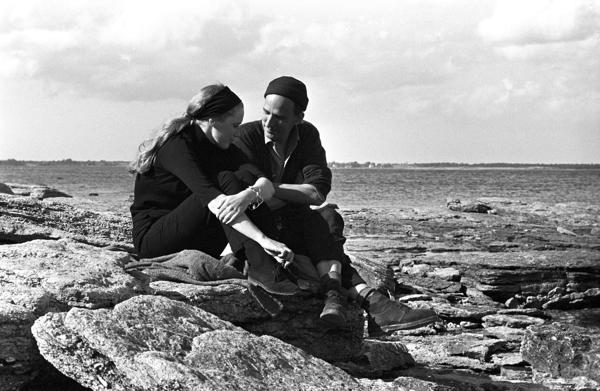
莉芙歐曼(Liv Ullmann)和英瑪褒曼 (Ingmar Bergman)


人生中, 如果找到一位可以相依的好拍擋, 必然可以締造一部又一部的經典。


瑞典電影大師英瑪褒曼 (Ingmar Bergman) 和他的'靈感女神'莉芙歐曼(Liv Ullmann)的故事被拍攝成紀錄片'致褒曼的情書' (Liv And Ingmar, 2012) 莉芙曾在多部褒曼作品擔任女主角。 在合作了第一部電影後, 兩人更相戀了五年 - 縱然雙方都各自有另一半。 雖然兩人的戀情最後無疾而終, 他們仍能保持工作上的默契 : 大多數最傑出的褒曼作品, 都是在兩人分手後拍攝的。 自此以後, 莉芙的名字 便與英瑪結下不解之緣了。


這位北歐電影大師受盡當今電影愛好者的擁戴。 無論是黑白片或是彩色片, 褒曼運用簡約(minimalist)的場景鋪排 (例如一個簡單的大特寫, 或寂寥的景色), 面部特寫, 鏡像, 或是虛幻的現象, 來挑戰戲中角色以及觀眾的主觀感覺。 不同的技巧, 都是用來顯露人性最真實的一面。 偏偏戲中的角色往往選擇逃避, 不敢正視人性的幽暗。 經典例子, 就是'哭泣與耳語 ' (Cries And Whispers, 1972): 姐姐被癌病煎熬得痛不欲生, 她痛苦得如馬一樣的嘶叫。 但兩個妹妹仍是要勾心鬥角, 互存偏見。 姐姐離世後, 導演褒曼便安排了一場人性試驗給兩位妹妹: 姐姐的靈魂忽然現身, 要求兩位妹妹接受自己。 豈料兩人斷然拒絕! 兩位妹妹精神上的患疾, 實屬無可救藥。 褒曼如此獨特的風格, 令他創造出無數極具震撼性的影像, 引來後世多位導演的模仿 褒曼經常攝影鏡像和時鐘的理由, 似是暗示人生如一場又一場的審判 : 我們要不斷審視自己, 包括面對自己黑暗的一面。 看一套褒曼的電影, 他就下一次戰書: 你有膽量面對自己嗎?


不過說到褒曼電歌影最重要的元素, 非莉芙歐曼莫屬。 莉芙不但參演了多部褒曼電影外, 她的角色往往表現着褒曼所探討的人性特徵。 莉芙所演的角色往往處於一些不可思議的情境裏, 所以這些作品 都有存在主義 Existentialism)色彩。 例如在假面 (Persona, 1966), 她飾演一個突然失聲的演員。 在沉默的過程中, 她要與Bibi Andersson飾演的護士, 一起探索現實與虛幻的分界, 和找尋那迷失了的自我。 在‘哭泣與耳語Cries And Whispers, 1972) , 她演那'童心未泯', 毫不成熟的妹妹 - 她要面對的, 是自己所代表的晦暗人性。 '面對面' (Face To Face, 1976), 她是一位需要接受精神分析的精神分析師 - 她瘋掉了, 不但要在夜深面對祖母的鬼魂, 還要應付自己幾近精神分裂, 同時扮演三個角色的狀態。 莉芙的角色往往都要面對這些荒謬的情况: 她要了解自身的心理缺陷, 然後勇於探索步出陰霾的方法, 才能完善自我。 而了解自己的旅程, 都需要其他人結伴同行的 - 這就是褒曼電影中兩面頰在同一鏡頭的象徵意義了。 現實中, 褒曼與莉芙這對老拍擋, 亦是在一導一演的情況下, 找尋人生的真義。 他倆多年來互相扶持, 才能拍攝出一部又一部的佳作。 兩人藕斷絲連, 早就超越相愛的境界了。


一個人, 只會擁抱孤寂; 兩個人, 足以改變一切。


秋水E
13/07/2013


英瑪褒曼 (Ingmar Bergman) 


莉芙歐曼(Liv Ullmann)
假面 (Persona) 裏的經典一幕


哭泣與耳語 Cries And Whispers)劇照