Showing posts with label Cries and Whispers. Show all posts

Sunday, 16 December 2018

Cries and Whispers


Can the serenity of everyday life undermine the darkness that threatens to haunt all of us? Can the institution of family control the rawest desire and emotions that are inherent to any human beings? When you are faced with the bleakest and most inhuman moments that is nonetheless fundamental to our existence, would you choose to turn away from those, or have the courage to admit our weaknesses? As I have always maintained, the truths of humanity will only emerge at the most extreme situations, when the instinct for self-preservation rules over any notions of the polite society and cultural machine. That is indeed the wonderful aspect about cinema, which represents a chance to provide all these hypothetical scenarios to provoke our thoughts. All these themes are brilliantly explored in my favorite European film of all time - Ingmar Bergman's 'Cries And Whispers'!

If you have read my previous articles, you would probably have noticed ‘Cries and Whispers’ has already been mentioned many times. Now is the time to have a formal introduction of this film. It is fair to say that I have fallen in love with the film since I first watched it many years ago, because the film is so one-of-a-kind and fantastic in many aspects. Not only it deals with and presents the issues of human nature in an inspiring manner, it also presents some of the most memorable visual images ever in film. Be warned that while the film appears like a ‘chick flick’ about 4 women, it is probably one of the most emotionally intense films in cinema history, and the images in the film will imprint and haunt your minds even a long time you have watched it. I think ‘Cries and Whispers’ is kind of a chilling film, because the more you think about that, the more you can identify with the film and it is totally possible that the scenarios in the story can take place in real life. Though it is in no way a horror film, the darkness of humanity portrayed in ‘Cries And Whispers’ will make your heart pound more than any of those ‘cheap-scare’ movies nowadays. The beauty of ‘Cries and Whispers’, as one may appreciate from the title, lies in its inherent contrast – while it is a very stylized film in terms of form and narrative, it also bears relevance to the audience because of its stark realism.

The story took place in a mansion in the 19th century, and concerned 4 women, Karin, Maria, Agnes, who were siblings; and Anna, their maid. Agnes, due to a weak health, was dying from cancer. Did this crisis draw the family closer together? Unfortunately, no. Karin and Maria, while having contrasting characters, were emotionally distant to Agnes and reluctantly came back to the mansion to take care of her. While bearing with the negative aspect of death and decay, they also had to confront their own personal problems, and the relationships between each other. Only Anna, who had a religious faith, was emphatic and could be able to console Agnes, who was already bombarded with tremendous physical pain and mental anguish (which is pretty nasty to see on screen). Bergman presented the story in a very stylized and formalized way. He divided the story into parts, and each part was concerned with one of the characters,  and provided insights on that character and how she has come to possess such a personality. Though the most memorable moments of the film were often concerned with the darkness of human nature –   be it emotional coldness, self-mutilation and meanness to others, Bergman also celebrated the noble nature of humanity – selflessness, redemption, and the consolation achieved from imaginations and dreams.

Ever since my childhood, I have pictured inside of the soul as a moist membrane in shades of red. 
– Ingmar Bergman , 1972

(To be continued.)

by Ed Law

Film Analysis


Saturday, 13 July 2013

致褒曼的情書


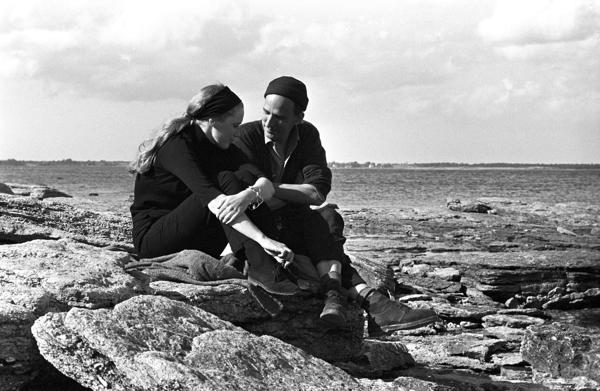
莉芙歐曼(Liv Ullmann)和英瑪褒曼 (Ingmar Bergman)


人生中, 如果找到一位可以相依的好拍擋, 必然可以締造一部又一部的經典。


瑞典電影大師英瑪褒曼 (Ingmar Bergman) 和他的'靈感女神'莉芙歐曼(Liv Ullmann)的故事被拍攝成紀錄片'致褒曼的情書' (Liv And Ingmar, 2012) 莉芙曾在多部褒曼作品擔任女主角。 在合作了第一部電影後, 兩人更相戀了五年 - 縱然雙方都各自有另一半。 雖然兩人的戀情最後無疾而終, 他們仍能保持工作上的默契 : 大多數最傑出的褒曼作品, 都是在兩人分手後拍攝的。 自此以後, 莉芙的名字 便與英瑪結下不解之緣了。


這位北歐電影大師受盡當今電影愛好者的擁戴。 無論是黑白片或是彩色片, 褒曼運用簡約(minimalist)的場景鋪排 (例如一個簡單的大特寫, 或寂寥的景色), 面部特寫, 鏡像, 或是虛幻的現象, 來挑戰戲中角色以及觀眾的主觀感覺。 不同的技巧, 都是用來顯露人性最真實的一面。 偏偏戲中的角色往往選擇逃避, 不敢正視人性的幽暗。 經典例子, 就是'哭泣與耳語 ' (Cries And Whispers, 1972): 姐姐被癌病煎熬得痛不欲生, 她痛苦得如馬一樣的嘶叫。 但兩個妹妹仍是要勾心鬥角, 互存偏見。 姐姐離世後, 導演褒曼便安排了一場人性試驗給兩位妹妹: 姐姐的靈魂忽然現身, 要求兩位妹妹接受自己。 豈料兩人斷然拒絕! 兩位妹妹精神上的患疾, 實屬無可救藥。 褒曼如此獨特的風格, 令他創造出無數極具震撼性的影像, 引來後世多位導演的模仿 褒曼經常攝影鏡像和時鐘的理由, 似是暗示人生如一場又一場的審判 : 我們要不斷審視自己, 包括面對自己黑暗的一面。 看一套褒曼的電影, 他就下一次戰書: 你有膽量面對自己嗎?


不過說到褒曼電歌影最重要的元素, 非莉芙歐曼莫屬。 莉芙不但參演了多部褒曼電影外, 她的角色往往表現着褒曼所探討的人性特徵。 莉芙所演的角色往往處於一些不可思議的情境裏, 所以這些作品 都有存在主義 Existentialism)色彩。 例如在假面 (Persona, 1966), 她飾演一個突然失聲的演員。 在沉默的過程中, 她要與Bibi Andersson飾演的護士, 一起探索現實與虛幻的分界, 和找尋那迷失了的自我。 在‘哭泣與耳語Cries And Whispers, 1972) , 她演那'童心未泯', 毫不成熟的妹妹 - 她要面對的, 是自己所代表的晦暗人性。 '面對面' (Face To Face, 1976), 她是一位需要接受精神分析的精神分析師 - 她瘋掉了, 不但要在夜深面對祖母的鬼魂, 還要應付自己幾近精神分裂, 同時扮演三個角色的狀態。 莉芙的角色往往都要面對這些荒謬的情况: 她要了解自身的心理缺陷, 然後勇於探索步出陰霾的方法, 才能完善自我。 而了解自己的旅程, 都需要其他人結伴同行的 - 這就是褒曼電影中兩面頰在同一鏡頭的象徵意義了。 現實中, 褒曼與莉芙這對老拍擋, 亦是在一導一演的情況下, 找尋人生的真義。 他倆多年來互相扶持, 才能拍攝出一部又一部的佳作。 兩人藕斷絲連, 早就超越相愛的境界了。


一個人, 只會擁抱孤寂; 兩個人, 足以改變一切。


秋水E
13/07/2013


英瑪褒曼 (Ingmar Bergman) 


莉芙歐曼(Liv Ullmann)
假面 (Persona) 裏的經典一幕


哭泣與耳語 Cries And Whispers)劇照

Sunday, 5 August 2007

A Tribute to Ingmar Bergman

Ingmar Bergman was acclaimed by many critics, filmmakers and film fans as one of the greatest and most original filmmakers of all time, Bergman’s style has made a lasting impression on many audiences, and the filmic images in many of his work are among the most memorable in the history of cinema. Gathering influences from a number of different fields, Bergman has developed a very original style that can be coined as ‘Bergman-esque’, and this style has since inspired, and have been imitated by, so many filmmakers, from Woody Allen to Ang Lee, from Andrei Tarkovsky to Park Chan Wook, from Lars von Trier to Mamoru Oshii.

Since I have first watched Bergman’s ‘Cries And Whispers’ in my teenage years, I have fallen in love with Bergman’s style. Among my favorite Bergman films are ‘Cries And Whispers’, ‘Persona’, ‘Through a Glass Darkly’ and ‘Face to Face’.

The reason why I have been drawn to the cinematic world of Bergman is due to a Woody Allen film known as ‘Interiors’ (1978). Allen has known to admire Bergman intensely and ‘Interiors’ seems to be heavily influenced by Bergman’s style, especially from ‘Cries and Whispers’. This less known Allen film has changed my impression of the often comedic filmmaker and has also led me to the Bergman films.

Bergman’s films are all very confrontational – he has employed the most powerful images to press questions on the audience. He demands answers and opinions from the audience regarding the questions of the human condition. Even if the audiences are disillusioned by the stunning images they have experienced in a Bergman film, and are left silent during this experience, they will still be able to ponder on these questions long after the end of the film.

Bergman’s films are all very dark. Because he did not want to feed the audience with easy answers, he would like the audience to contemplate on difficult scenarios. His films are seen as very spiritual and in many cases philosophical. Influenced by Sjostrom (whom Bergman has casted as the protagonist in ‘The Wild Strawberries’), Ibsen and Strindberg, Bergman’s films are often related to existentialism. From these influences, one can easily appreciate why Bergman’s films are often minimalist, have very few key characters, and quite often are ‘chamber dramas’. These designs have all contributed to a starkness in his films, and it is especially so in his black-and-white films. When Bergman started making color films, he often employed Eastmancolor as the color source. In Bergman’s case, the use of Eastmancolor has provided the impression of coldness to his films. This coldness is also apparent in some other Eastmancolor films, among those Stanley Kubrick’s ‘Barry Lyndon’, many of Jean-Pierre Melville’s color crime films, and Akira Kurosawa’s ‘Kagemusha’. The Eastmancolor effect is most evident in ‘Cries and Whispers’, when the red color is presented in a very saturated way. In the film, the rooms in the manor is almost like the chambers of the heart, and the redness of the set design only heightens this aspect. In Bergman’s own words –

 ‘I have pictured the inside of the soul as a moist membrane in shades of red’.

Bergman’s clocks and mirrors

There are many recurrent motifs in the Bergman cinema. The first is the tools for contemplation and judgment. Clocks, watches and mirrors are often seen in many of Bergman’s films. The ticking of the clock and the reminder of the watch signify the time for judgment. And the mirror is the instrument for the character to face themselves and to contemplate their problems. Bergman’s characters cannot run away from their problems – they have to face the music when the time has come for confrontation. It is nevertheless not the end – because Bergman gives his characters an opportunity to examine their true selves and to gain self-knowledge from these often painful confrontations.

Bergman’s Faces

If there are the Kubrick stares and the Leone glares, then we have to remember the Bergman faces. The close-up of facial expressions in the Bergman cinema are certainly among the most powerful images in world cinema, and that is certainly an aspect many subsequent filmmakers have attempted to imitate. The camera angles and arrangements for the facial close-ups are often very innovative, and to this end ‘Persona’ and ‘Cries And Whispers’ serve as monumental achievements. The use of this motif is not merely about giving surprises or enhancing the visual sensations – the gestures and movements of the faces often convey important themes in the respective film, which I will discuss in specific circumstances in the future. In a sense, the face is the canvas for the human drama to take place, it is the place where the characters present themselves for the world, or just for themselves.

One final thing - I would love to recommend a great book, known as ‘The Films of Ingmar Bergman’ by Kalin (ISBN 0521389771). This is a great analysis on Bergman’s films and style, and I have been benefited a lot from the book. Hope you like it!

by Ed Law

Film Analysis