Monday, 13 July 2015

The Terminator, Part 2


Terminator 2 : Judgment Day

When a cold, steely metal skeleton emerged from the smoky screens in October 1984, we knew a star has been born. Arnold Schwarzenegger, with his portray of the Terminator, became one of the ultimate superstars in Hollywood, and the stone-faced robot has always been his most iconic role. James Cameron, on the other hand, went on to direct more science fiction spectacles. They both know that they have to keep the promise – ‘I’ll be back’ – so they decided to continue the wonderful story of humans vs. machines. This time, they had a larger budget, they developed a greater and more humanistic storyline, and they were more than willing to put the visual effects to its very limit. The result was TERMINATOR 2 : JUDGMENT DAY, the top-grossing film of 1991. It received 4 Oscars, and was considered as the most popular and technically brilliant Terminator film in the series. At least, it was considered on equal terms with the original Terminator film. The moving story has asked so many questions about technology and the human condition in general, and this film will be the focus of this article.


Like the other Terminator films, Terminator 2 (abbreviated as ‘T2’ thereafter) followed an easily recognizable plot, but let’s start with some background. In ‘Terminator 1’, Sarah Connor has killed the Terminator who was supposed to terminate her, in a factory of the Cyberdyne Corporation. Cyberdyne was actually a company which produced artificial intelligence appliances for the country, including the military-related products. Due to the termination of the robot, one of its metallic arms and its chip resided in the factory, which was soon discovered. Unaware of their origins, the company carried out research on these components, which led to the development of a super computer – ‘Skynet’. Skynet, as it would turn out, was the ‘boss’ of all the machines and terminators. Eventually, Skynet caused a ‘Judgment Day’, which wiped out almost the whole human civilizations, on 29th August, 1997. The terminators, still believing they could manipulate the past, decided to try again and send a more advanced terminator, a T-1000 model, back to 1995 to kill John Connor. On the other, the future John is aware of this plan and therefore he also sends a re-programmed T-800 robot, which has an uncanny resemblance in terms of appearance to the first terminator, back through time to save him. Our story begins...


Both terminators arrived in 1995, for which the T-1000 has acquired the clothes of a policeman, and the T-800 has acquired the clothes from a biker club, and also an ultra-cool Winchester-type rifle. Both robots began to track down John Connor. John was now under the care of his foster parents, as Sarah was locked into a mental hospital due to her intrusion into the Cyberdyne building. After some efforts, T-800 was able to find John, and they narrowly escaped the attack from T-1000. That involved Guns and Roses, a giant truck smashing the way through, and a wonderful bike-jumping stunt. While there were misconceptions at first, John and the Terminator came to trust each other and John was able to command ‘his terminator’ to do good things. They tried to contact John’s foster parents, yet the T-1000 has already terminated them. Then, John decided he would have to save Sarah. Though the strategic assessment seemed to point to negative, T-800 complied with John’s order. They broke into the mental hospital, and quite unfortunately the T-1000 has also intruded into that. After another brief chase, Sarah escaped again with John and T-800, yet she was furious because she felt that John was risking his life, causing disappointment to John. They retreated to a small isolated house to treat their wounds, and (in the Director’s cut), John and Sarah re-programmed the robot from a ‘Read-Only’ to a ‘learning’ mode. When they set off the next day, John attempted to teach the robot to become more human, like saying ‘Hasta la vista, baby’ and so on. They came to a friend’s compound to acquire heavy firearms, including a Gatling-type minigun and also a grenade launcher. It was there their relationships improved, and the T-800 fed them with information about the ‘Judgment Day’. He stated that when the Skynet was online in 1997, it learnt in a geometrical rate that it eventually became self-aware, fearing its human creators would ‘terminate’ itself. When the humans attempted to pull the plug, Skynet decided to fight back and eventually led to the inception of ‘Judgment Day’. Upon learning all these, Sarah decided to re-write history by killing the chief scientist, Dyson, who was responsible for the research regarding Skynet. While John pleaded with him to stop Sarah, T-800 was reluctant about that, as it was quite possible to invite attack from T-1000.


They eventually arrived at Dyson’s house to stop Sarah, and T-800 exposed his metallic arm to tell Dyson who he is. Dyson, totally unaware of the hell he would soon create, agreed to take the trio to Cyberdyne to destroy Skynet. Their antics soon attracted the attention of the police, and a SWAT team was sent to take care of these dangerous individuals. John was afraid that his killer robot would cause a massacre, yet after stating ‘Trust Me’, T-800 used his Gatling minigun to blast off every single police cars, while sparing the cops’ lives. The SWAT team led a sudden attack on the trio, wounding Dyson at the same time. After the trio escaped by an elevator (!), Dyson sacrificed himself by blowing up the whole Cyberdyne building, while the trio took hold of the terminator arm and chip.


They escaped the building, yet the T-1000 was closing on them. T-1000 used a helicopter to cause the trio’s SWAT van, and after the crash, he rode on a liquid-nitrogen tanker and continued to pursuit the trio. Eventually, both vehicles crashed into a steel mill and the ruptured tanker led to a massive outpour of liquid nitrogen. The T-1000 was frozen, and with a bullet, it was scattered into pieces.


Unfortunately, that has not terminated the liquid metal cyborg. With the heat in the steel mill, the metal components were able to reform and T-1000 came back to life, albeit with evident malfunctioning. T-800 asked John and Sarah to go, and attempted to fight against the superior T-1000. This proved to be futile, as T-1000 easily subdued T-800. When T-1000 was getting closer to his target, with a demonstration of caliber, T-800 used the grenade launcher to pop a big hole in T-1000’s body, and after a big explosion, his body parts were almost all out of place. Losing his balance, T-1000 fell into the molten steel, and was terminated as a result!


With his mission successful, T-800 asked John to throw the metallic arm and also the chip into the molten steel. Yet, he stated he also has to be terminated, because this could then prevent the terminators from existence, restoring the integrity of the time-universe. Because he could not self-terminate, he asked Sarah to help him. John cried and asked the terminator not to go. ‘I understand why you cry now, but that’s something I can never do’. The learning robot finally could appreciate the values of humanity. Sarah lowered the T-800 into the molten steel, destroying it as a result. Finally, as Sarah and John were travelling towards an unknown future, Sarah stated that -

‘The unknown future rolls toward us. I face it, for the first time, with a sense of hope. Because if a machine, a Terminator, can learn the value of human life, maybe we can too.’  


One of the ultimate reasons why T2 is considered as the best in the series is because it is the most moving one, the one which most audience can identify with. This is mainly due to an almost warm-hearted Terminator, who is sort of a father figure for the vulnerable John. Some audience even wept at the end of T2! This addresses the main theme of Terminator 2 – can a robot or machine become more ‘human’?


In T2, the key reason why the Terminator scenario emerges is because Skynet, the supercomputer, becomes self-aware. That means that the computer becomes more ‘human’, and starts to develop paranoia about its human creators. What is the big deal about a machine becoming more like a human? This is really critical – as that means a robot is evolving into something it is NOT of its nature. It is challenging the possible boundary between human and machine.


Before we go any further, we have to define the key issues regarding this. A first condition is – can a robot possess learning capacities that will enable it to possess human attributes, and what will be the consequences of that? The machines, being humane, will have to confront questions which is unprecedented for their existences, which is obviously beyond their implanted programming. Ethical questions that we humans often end up in dilemma do not exclude a ‘human-like’ machine, and indeed there are real examples for this. An example is the ‘A-Robot’, which rescues victims from dangerous situations. When the A-Robot is only required to save one victim, it is likely to succeed. However, when 2 victims are present in the situation, how will the A-Robot react? Two outcomes are observed. First, the A-Robot is fast enough to optimize its track to save BOTH victims. However, it is the second outcome that is disturbing – the A-Robot, having no clue which victim to save first, just stops and DOES NOTHING. This is certainly disastrous, and it illustrates that providing an ethical dimension to these machines is the most challenging task of A. I. design.


The first question is, what are the requirements for a robot to become a human? This is never a straight-forward question, as the human condition is a topic that has fascinated and troubled lovers of wisdom for thousands of years. At every era, we have our own conceptions of humanity, and these ideas are challenged and refined as time goes by.

The likely starting point is the development of self-awareness. That means it is aware of own self, and aware of itself as a wholesome unity. The philosopher Spinoza has pointed out that, for a human being, the ultimate motivation of life is self-preservation, literally, to survive. That is why Skynet is so wary of human’s actions when it becomes self-aware. When its boss pulls the plug, it knows that it is his end. Yet, the computer may not be aware that, if it wants to take the attributes of human, it also leads to take the undesirable bits. Unlike a machine, human existence is a being-towards-death, as Heidegger would have put it. It is a truth that in no way can be challenged. Since the time travels irreversibly, it is therefore futile for the machines to send robots back in time to ‘fix things up’ – their rise is predicated by whatever cause-and-effect that leads up to that stage, rather than their efforts to rewrite history. A human subject has cognitive power. That is the famous statement by Descartes,’ I think, therefore I am’. This is also a theme prevalent in ‘Blade Runner’, which I will discuss soon. Yet, the cognito by Descartes or Spinoza was a rational one, and they couldn’t quite reconcile the presence of emotion in the rational mind. They tried to get around by illustrating the presence of a ‘soul’, yet it was not well-defined (with no empirical psychology) and so these ideas remained vague.

So how can a robot fit into all these criteria?  A machine certainly has a material presence. In an ideal manner, the machines are programmed through commands, so they can reason in a rational and mechanical manner, and in some cases optimize towards a best outcome when alternative choices exist. Yet, there will always be an empty hole inherent in all machines – the incapability of emotion. This, unfortunately, is what makes a machine a machine – indeed, why does the humans, or at a later stage, Skynet, program all the terminators to a read-only mode? Because they do not want the robots to be too ‘clever’, let alone being capable of compassion. So, the master will always exert control over their slaves. Even if a terminator really shows emotion, it seems to serve an instrumental purpose, a ‘means’ to trap its targets or victims. When T-1000 said ‘I know it hurts’ after stabbing Sarah in the steel mill, do you think he says this out of compassion? Machines may have the concept of emotion – like T-800 saying ‘I understand why you cry now’ rather than subjectively feeling it – but they are very unlikely to feel or experience it.

A further point about cognition is worth looking at here, as it also relates to the mechanism of machine learning. It is the philosopher John Searle’s ‘Chinese Room Argument’. Searle quotes this argument because he wants to illustrate a possible mode of learning, in particular language learning. What he is saying is that, when one is learning characters, they learn it in a coding way, by corresponding one character to a relevant description. So, it is like a mathematical function, with a one-on-one mapping. While you may map all the relations precisely, you do not really understand the inherent meanings of any of these. It is like a picture-matching exercise, when you do the matching mechanically. Indeed, terminators may work in such a way, when they are devoid of emotion. They match the possible solutions to a given task, and execute that mechanically. Even if their ‘detailed files’ in their CPU consist of concepts of emotion and sentiment, they will just match it mechanically, for example when a bullet crashes into its body the word ‘Pain’ shows in its visual display as a datum. They will not feel the pain or understand the inherent meanings of their experiences.

When the CPU of a terminator is reset, it acquires learning capabilities. T-800 states that its CPU is a neural net processor, which has a capability to build up knowledge. However, it is also likely to develop into uncertain frontiers. When Skynet is learning at ‘geometric rate’, no one will know how intelligence, and ‘human’, it can get to. This seems rightfully as an allegory of our relationships to technology. With the advent of machines and technology, human’s teleological endpoint is very much governed by that of technology. With an over-reliance on ‘techs’, their developments facilitate us to a future that we may not be prepared to confront.

I have been talking loads about machines and programming, yet the most relevant issue regarding human-machine interactions is the ethical implications of robotics. Ethical decisions, in many cases, entail subjective value judgments, which may lead to dilemma or unpredictable outcomes. If humans are so vulnerable to these dilemmas, will the logical robots be up to the challenges? It may not be the case. Indeed, Asimov has dictated 3 rules regarding robotics. Though it was dictated some 70 years ago, this gentleman had the clear insights to foresee a future we would be acquainted with. The point of the 3 rules is to counteract against a machine's potential self-preservation. That means if the machine really becomes self-aware for some reasons, there is still a set of logical guidelines to prevent it from becoming too paranoid about others. While these rules may be heuristically useful for a machine to determine the best pathway to optimize an outcome, we cannot rule out the cases that it will come to ‘Hobson’s choice’-type decisions,  for which harm will be inflicted to certain parties. Therefore, while robotics can aid humans to carry out tasks that may be too risky or challenging, there is no way that machine intelligence can completely substitute, or even replace human intelligence, as there is no unique way to ensure the best answer at all circumstances.


The nature of T-1000


T-1000, the bad guy in T2, is an extremely iconic sci-fi character, as he possesses strong caliber and is almost undefeatable. Indeed, this is a very creative character, as it not only addresses very novel scientific concepts, but also serves important cultural allegorical meanings. T-1000 is a robot made from a liquid metal, and it lacked a ‘central’ processor that controlled it. At first sight, it is a hard phenomenon to comprehend as we have no way to figure out where is the ‘brain’ that controls this scary monster. Yet if we look at this at another angle, we can see that its unity is constructed from the thousands of components that formed it – that is why T-1000 is a ‘shape-shifting’ creature, it just flows like a liquid. The components can be categorized as a large bundle, which have to come together to form the whole unit. For a primitive case, I can think of a short story by Edgar Allan Poe, ‘The Man Who Was Used Up’. In that rather gross story, a ‘brave’ general, due to humiliation and torture from enemies, suffered a bodily damage, which was so severe that he was actually nothing more than an assortment of all his body parts, which they had to be assembled by a servant every morning, to form the final, ‘human-looking’ general. This was a scary scenario, yet Mr. Poe was so insightful to perceive such a possibility. The general was a human bundle, and he looked more like a cyborg than a genuine human. So, don’t be tempted to ask where is T-1000 central chip, it is just everywhere in all its components. In a cultural perspective, T-1000 can also be seen as an allegory of a ‘rhizome’ (Deleuze / Guattari) – which is a geographical area where there are no central controlling spots, yet relationships are inherent between every component. These de-centralized areas are prevalent in a post-modern era, and the Terminator films certainly address them promptly.


'No fate'?


'The future is not set. There's no fate but what we make for ourselves.' - Sarah Connor

One of the ultimate reasons why I am so fascinated with T2, which I believe why other audiences find particularly moving, can be summarized in 2 words – ‘No Fate’. When I first watched it, I was so moved by this statement that I believe I have the courage, at least to attempt to change things around me. When I grow up and understand more about life, I have more reservations about this optimistic outlook. Indeed, Sarah, John and T800 did believe they have prevented Judgment Day from taking place, after blowing up Cyberdyne and killing T-1000. Yet, soon they know that it is not the case – the Judgment Day will take place anyway, all they can do is to postpone it. It seems that a determinism / fatalism is already installed in the equation, and the so-called ‘free will’ is just a hallucinatory illusion. Well, the reason why this question is so controversial is because it challenges the very foundation of human wisdom itself. It is pushing the frontier of Metaphysics, the ever-lasting ‘Free will vs. Determinism’ debate. Though philosophical investigations are not essential for human well-being, this controversy does have strong implications, for example, ethical judgments.


For me, this is a futile debate. It is not because I don’t want to take sides, but because we have no way to agree on a scope of the question. Everyone’s frame of reference can be different, and no one can perceive what the ‘ultimate reality’ is like – the big question is, when is the end of story that will determine who wins? When you feel that you have exercised a free will and changed something, is that really the end point? When is the ‘season’s finale’ that will allow you to assert your power to control fate? Humans can often be subject to a consequentialism and analyze the appropriateness of their past actions through known outcomes. That is why there is no point to devote time to pursuit this question, as that offers no existential benefits to one’s life.


Still, ‘No Fate’ is inspiring. From a psychological perspective, it fulfills the ‘self-actualization’ purpose of human existence. At least, a false consciousness of free will can provide us with a courage to change and fight for our well-being, to improve ourselves. In T2, we can see that the trio often exercises their own free wills to do something they firmly believe in their hearts. They may not be able to prevent the ultimate disaster eventually, yet they will have no regret in their decision, at least, they will be back when the machines rise again! ‘No Fate’ is a motto that can motivate us forward towards insurmountable task that gives us the bravery to fight the adversity like a warrior (or terminator if you want to be one). Only when you know you have given out everything you have, rather than sitting down like a coward, will you achieve a peace in your mind. 


You may not know what the future will be like, but you have every reason to fight for it!

Next time: How do the Terminator films help us to make sense of the modern condition?

(2/3)

by Ed Law
13/7/2015

Film Analysis - 50


Sunday, 5 July 2015

Terminator and Me

My treasure - a copy of the 35mm film stock of a scene in 'Terminator 2: Judgment Day'.

How 'The Terminator' becomes my favorite film of all time.

My first impression of the existence of ‘The Terminator’ film was in 1994, when I was studying Primary 4 in Hong Kong. We had a subject known as ‘General Studies’. When I skimmed through my textbook, at Chapter 7, which I remembered the topic was about Taxation, a picture caught my immediate attention. It was showing a cinema known as ‘Park Theatre’ (in Tin Hau), and the film ‘Terminator 2: Judgment Day’ was showing at that time.


When I first saw a handsome and stone-faced Arnold Schwarzenegger, holding a Winchester-type rifle and riding on a motorcycle, I was literally blown away. At that point I did not know that The Terminator was a robot, and I would guess this cool male character was some sort of an action hero. The inquisitive me of course imagined many storylines and plots for him, and asked many questions. What adventure will he run into? Is he like a Western hero, who will ride with the girl into sunset eventually? Can the shotgun take down as many bad guys as possible? Many of these questions would remain unanswered until a few years later, but this image has left a lasting impression on me. To be honest, this is very successful advertising – as the image becomes imprinted in my mind thereafter. If you want to make a successful poster, be inspired by the one from ‘Terminator 2: Judgment Day’!

This is the Laser Disc Version of 'The Terminator' I have first watched in 1997.


Then, I watched ‘The Terminator’ on Laserdisc (!!) in 1997 or 1998. I found that I have never been so engaged in watching a movie before, and every single moment in the film has been able to captivate my attention, and my inquisitive mind. This was by far the most wonderful film experience I have ever had in my life, and ‘The Terminator’ easily became my favorite film of all time. I have watched Terminator 1 and Terminator 2 for more than 100 times each! I should also credit ‘The Terminator’ as a catalyst to start my serious interest in cinema. It is then I start to look into many different areas in film theory, and explore various films by Akira Kurosawa and Stanley Kubrick.

My visit to the Terminator ride in Universal Studio Theme Park, Osaka.

The reason why I think ‘Terminator’ is cool is because, while it is popular, it is also an intelligent film. It is like a person who is popular and yet contributes important insights to the peers around. It is capable to strike a balance in both areas, and I always look upon to it as a model. If I can become a film, I want to be something like ‘The Terminator’.


It is also great to learn that, while Terminator has established itself as a cultural icon, and people starts to look closer at the film’s artistic merits. As an action / sci-fi film, Terminator has more substances than most of its counterparts, and the issues it has addressed have found more relevance to the real world than ever. The film has become an almost classic example of POSTMODERNISM, and it is studied in the field of Literary Theory, Cultural Studies and Philosophy. Open a reference book from any of these fields, and don’t be too surprised that this seeming pop-corn film has been cited as an example!  

30 years after this steely robot has emerged from the silver screen, it is fair to state that ‘The Terminator’ has long established itself as a modern classic.

by Ed Law
5/7/2015

Film Analysis - 50

The Terminator, Part 1


Some 30 years ago, a down-on-luck film director and a muscular actor were both looking for opportunities in Hollywood. The director had a funny idea about a sci-fi film, which was inspired by a nightmare he had some times ago. The concept was realized, and a movie with a low-budget was made. The producers from the studio did not have high anticipations of this movie, they believed this film would disappear into oblivion a few weeks after it was shown in cinemas. This was NOT the case – the 1984 film became the weekend champion in box office, one of the top 10 films in 1984 in Time Magazine, inspired no less than 4 sequels, a TV serial, numerous franchises, a Universal Studio park attraction. It was honored by the American Film Institute numerous times, regularly on the IMDB Top 250, and had no less than 3 million Facebook fans. It was ultimately chosen for preservation by the National Film Registry in 2008, which I believe it was something the bosses behind the film would never have anticipated. Indeed, I will be more than surprised if you have not even heard of this film, and those responsible for it – James Cameron and Arnold Schwarzenegger. This great film, is my favorite film of all time – THE TERMINATOR !!


‘The Terminator’ has stood the test of time. While extremely entertaining in its own right, ‘Terminator’ was unlike any typical popcorn movie. The film has asked so many important questions which are more than relevant in a world technology are so essential for us, a world that artificial intelligence has pervaded some many aspects of our lives. No matter how successful ‘Titanic’ or ‘Avatar’ may be, ‘The Terminator’ is James Cameron’s true masterpiece. Without the track record of the Terminator films, he will never be allowed to make films like ‘Titanic’ or ‘Avatar’.


As a big fan of Terminator for more than 15 years, I have so much to say about this great film! These films have addressed some many themes about the human condition, and therefore I decide to divide my discussion into 3 parts.

Part 1. Focus on ‘Terminator 1’ – this article. The human-machine relationships and also why we have a love-hate relationship with terminators.
Part 2. Focus on ‘Terminator 2’ – can machines learn to be more ‘human’ and ‘no fate’.
Part 3. Terminator and Postmodernism – how has ‘Terminator’ films helped us to make sense of the modern condition?


While we may have heard of the story before, let me describe, once and for all, the ‘Terminator’ storyline here. The background of the story is that, in year 2029, computational machines have become self-aware and they see their human makers as threats, so they wage war on the human civilizations, leading to a nuclear apocalypse. These machines are resourceful in terms of technology, and they come in many diverse forms. They have one thing in common – they call themselves ‘The Terminators’...


The terminators in 2029 know that their wars against the human race are coming to a dead-end, so they devise a ‘creative’ strategy – using the time-travelling device to go back in time, to prevent the birth of a male known as ‘John Connor’, who will become the resistance leader against the terminators. In short, they go back in time to ‘terminate’ John’s mother, Sarah Connor, back in 1984 (the year the film was shown). So, they send a humanoid robot of the model T-800 (played by Arnold Schwarzenegger) back through time to carry out the mission. On the other hand, knowing the plan of the machines, the humans also send a soldier, Kyle Reese, back in time to stop the terminator. The story begins now...

Kyle Reese


In 1984, both the Terminator and Reese arrived at the same night. After acquiring clothes and firearms respectively – including the Terminator asking in a shop for a ‘Phase Plasma Rifle with 40 Watt Range’, which was certainly fiction in 1984 – they began their quests to track down this ‘Sarah Connor’. Sarah was actually a young and vulnerable witness at that time. With no ideas which ‘Sarah Connor’ was the one to terminator, the terminator had to track down all 3 females with the name ‘Sarah Connor’. He unfortunately got it wrong twice – the first 2 dead Sarahs were not the ones who would give birth to Sarah Connor. At an evening, both Reese and the Terminator have garnered clues of the whereabouts of Sarah. Sarah, believing she was stalked, took refuge in a pub called ‘Tech-Noir’. The Terminator entered the pub and found Sarah, and at the time he was about to gun down Sarah once and for all, Reese had the first shot and shot down Terminator. Then, at one of the most surprising scenes of the film, the human-looking Terminator was simply unscathed by the bullet hit and stood up again, and started blasting through everywhere with his micro-Uzi, gunning down numerous victims along the way. He attempted to shoot Sarah again, and only stopped by Reese’s rifle blasts. Reese and Sarah escaped with a stolen car, with the panicked Sarah not convinced at all about Reese’s story. Meanwhile, the Terminator has car-jacked a police car, and he discovered Sarah and Reese again in a car park, starting another chase.  Eventually, police came after Terminator’s car crash into a corner, and narrowly escaped. Reese and Sarah were arrested.


The terminator retreated into a motel room, and in a memorable scene of special effects, he did self-surgery to repair himself, cutting arms, fixing blood vessels, even cutting out one of its eyes to restore his vision (this was where the ‘eye-damage’ cliché all started). He then put on the now iconic dark sunglasses to shield his eyes. Meanwhile, at the police station, no one believed in Reese’s terminator ‘fantasy’, calling him a loon instead. But then, the terminator arrived at the police station. Forging himself as a friend of Sarah, he asked for permission to get in. The clerk instead urged him to wait. The terminator, inspecting the surroundings, delivered one of the greatest movie quotes of all time, ‘I’LL BE BACK!!’ and walked out. He did come back – with a car crashing the hell into the police station! Now armed with 2 semi-automatic firearms, he started blasting the hell through the police station, killing anything he considered as ‘life’. Every single cops in the station were dead, yet Reese and Sarah were able to run away again.


Now appreciating the threat raging towards her, Sarah became intimate with Reese and their relationships improved. During a brief rest, Reese had a dream about the future, when he is, surprisingly, holding a photo of a sad-looking Sarah. Then, a bunch of terminators infiltrated the compound, and with guns resembling the legendary ‘Phase Plasma Rifle’, they caused as much damages as their potentials would allow them. Amidst fires and explosions, Sarah’s photo was burnt to ash...

Sarah and Reese


Sarah and Reese checked into a motel, and got ready for the robot’s inevitable attack. It was then Reese told Sarah the truth, ‘I come here for you, Sarah’. Reese was, is, and will be John Connor’s father. They made love, writing history along the way. Soon, the terminator tracked down their motel, and got one final chase. After both their cars have overturned, Terminator commandeered a large tank, and chased the couple. Eventually, Reese used a dynamite and ignited the terminator’s tank, leading to a massive explosion. Just when Reese and Sarah thought they have killed the terminator, he suddenly emerged alive, now in his metal-endoskeleton (rid of all human tissues). Knowing that they almost had no ways to defeat this machine, the couple desperately ran into a factory, with the name ‘CYBERDYNE’, and its importance would be evident in ‘Terminator 2’. Sacrificing himself, Reese gave one final futile struggle against the terminator, only to be killed by him. Now a one-on-one showdown, Sarah crawled and hid through the mountainous assortments of machines, with the terminator trying to get his hand on her. He unknowingly crawled into a hydraulic press, and seeing this opportunity, Sarah showed her caliber by pressing the button of the compressor, crushing the terminator’s skull! The powerful robot, terminator, finally met his ironic end – he was terminated by who he was supposed to kill!


Some time later, a pregnant Sarah was seen sitting alone a car, taping her story to her sure-born son, John Connor. A little boy took a photograph of her, which was the same photograph in Reese’s dream. A storm was coming, but would it be more intense than Sarah’s war, her war against the machines? We’ll see in ‘Terminator 2’!


The photo that travels through time.

Before we go into the artistic merits of ‘The Terminator’, we have to settle some scores. This is an issue that has generated some many controversies and arguments throughout the years, and has drained so many imaginative thoughts. It relates the logic behind the plot of ‘The Terminator’, namely the time-travel issue. Many viewers have discovered the inconsistencies in the story, especially after the emergence of Terminator 3, and the whole issue has become Rashomonic, full of contradictions and in no ways the issues can be reconciled.

As a big fan of The Terminator, let me plainly state my position – there is absolutely NO point to argue or reconcile any of these inconsistencies, as these attempts will prove to be futile. Because what we are dealing with here is challenging the very foundation of science and philosophy, and any diversions from that will almost lead to non-constructive circular reasoning. Time travel is a concept that challenges the foundation of Metaphysics. It is challenging the idea of ‘irreversibility of time’, and it can not be empirically verified. To try to treat it ‘logically’ will almost lead to tautological and invalid conclusions.

The reason why this ‘plot hole’ appears at first time is because, first, any plot involving time travel is thorny, and will be open to logical challenges. Second, James Cameron and the creators of the film never have anticipated the film would reach such a scholarly status, and therefore they have not been meticulous enough to write a totally logical story. Let’s just say the damage is done! 

If you really want an answer, there are indeed 2 schools of thoughts regarding The Terminator’s plot. The first, which I think I belong to, are the ‘traditionalists’. They treat the first two Terminator films as a whole, and leave out the other recent terminator films. That will make the storyline of the film ore logically consistent. The second school is more open to interpretations, and they often a ‘parallel universe’ explanation, stating that the ‘Reese’ comes from another time universe and thus can make love with Sarah, leading to John’s birth. Yet, both sides can in no way provide a version free of plot holes involving time-travel.

Let me put this simply, though. The plot holes in the Terminator should no way be detrimental to the merits of the film. Indeed, The Terminator has touched on so many important themes relevant to modern human lives that it has achieved a timelessness, which will be appreciated by many generations of audience.


The genre of ‘Terminator’ belongs to a sub-genre of science fiction, known as ‘cyberpunk’. Examples include Blade Runner, Robocop, Akira and The Matrix. These films often portray a realistic and rather dystrophic future, and they are considered as ‘Postmodernist films’. These films have often shared common themes, and I will leave the discussion regarding Postmodernism until the third part. This time, I would like to focus on the themes of the first Terminator film.

Technological advancement, to humans, can be both a promise and a curse. Throughout history, we have used our imaginations and creativity to create solutions for problems we may never materialize. We develop tools, automatons, and eventually sophisticated machines to make our lives easier, and better. The technological achievement is the sublimed essence of human civilization intelligence, and that is what motivates us to move further into the future, to conquer the machine. But, when is the point to stop? Humans are different from the lifeless machines, because we have cognitive powers, divided into reason and emotion. One cannot emerge without the other, and indeed the essence of human being is that we are capable to feel and be emotional, rather than acting like some cold, unthinking machines. That is the reason why since human’s earliest days, we have always been fearful of ‘dehumanization’,  which is the loss of essence of human and reduce to a mere machine-like existence. This IS exactly what The Terminator is about.
aped. Reese and Sarah were arrested.


The terminator is a ‘cyborg’, short for cybernetic organism. It is a humanoid robot, covered by live, human-like tissues and organs. But deep inside, there are mechanical components – the metal endoskeletons – and a CPU controlling his cognitive decisions and tasks. True, this terminator looks like Arnold, but he can never be considered a human, he is a cybernetic non-human, the exact opposite of human being. Yet why we feel weird about this human-like robot? Freud’s concept, ‘uncanny’, may shed some light on this. The reason why we feel unconformable about this humanoid robot, but not, for example, a washing machine, is because the terminator resembles us. It is this similarity that gives us an uncanny feeling, and makes us weary of our subjectivity. Indeed, a sentiment for the ‘fear of technology’ is a theme that is evident in many films, including those of Shinya Tsukamoto and David Cronenberg.

The Terminator is insightful because it asks a daring question – can computers be self-aware? Are they merely machines, the ‘slaves’ of humans, or can they affirm their subjectivities and feel jealousy, threat, anger, or estrangement like us? The Terminator delivers this statement bluntly, in the most straight-forward manner – the terminators are human’s enemy, it is between them and us. Indeed, the theme of computers losing control and causing havoc has already been portrayed before ‘The Terminator’, though ‘The Terminator’ is likely the most obvious example. In Kubrick’s ‘2001: A Space Odyssey’, the HAL computer lost control and ejected astronauts to the outer space at will. In ‘Westworld’, the cowboy robot, played by Yul Brynner, got into computational problems and started murdering the tourists in the theme park. In ‘The Terminator’, the machines suddenly became self-aware, having the ‘false’ belief that the humans were going to destroy them. The computers felt that they had to fight back first, and therefore wrecked havoc and created the whole ‘Terminator’ episode.


The human-machine relationships have become even more alarming nowadays. Our lives are indeed orchestrated by computer technologies and artificial intelligence. How many of our daily activities have nothing to do with a computer-controlled system? On the other hand, artificial intelligence is taking the central stage in many different tasks – medical robots, military robots, or various robotics, these cyborgs are going to be involved in many dangerous and important tasks in many different fields. If we have to rely on these ‘friends’, mutual trust has to be established. Wait a minute, ‘mutual’? How do you know what is in the robot’s mind? The robots are controlled by algorithms and logic languages, and their reasonings can be understood by understanding the formal logic behind their commands. However, machines can learn, for example, if they have an evolutionary algorithm, it is quite possible to reach conclusions that humans cannot be accessible to. Thus, we have a long way to go in terms of ‘A.I.’, because there are black-box areas that we have not been able to reach a definite and conclusive answer.  That is the wisdom behind ‘The Terminator’ – it is asking questions for which the answers will shape our future lives.


What makes The Terminator so fascinating? To me, it is built on a love / hate relationship between the audience and Terminator. The reason why much audience finds resonance with the T-800 robot is because, while we are afraid of this ‘monster’, he has possessed qualities that the audience finds as some sort of an ideal – we want to be the Terminator!

The Terminator is frightening because, while he looks like a muscular version of many of us, he is so different from us. He is almost impervious to any forms of bullets or firearm blasts, he walks around, through the fire, showing virtually no emotion. He literally shows no fear at all, and he is so mean – he doesn’t stop, and he will not help, until he has killed his target. Reese has succinctly stated this in the film, and this quote has almost become the ‘Terminator Anthem’ –

‘It can't be bargained with. It can't be reasoned with. It doesn't feel pity, or remorse, or fear. And it absolutely will not stop, ever, until you are dead.’


That’s him. Indeed, some may even feel pity for this robot. He has no choice, he is a workhorse, with a set of commands written in his programs, and he shows no qualities that humans are proud of – the rich emotions, the possibility of moral actions. He is a loner, because as a cyborg, he will not be able to connect with anyone on an emotional level. If a human being can be as dehumanized and cold as the Terminator, that is ultimate tragedy.


Yet the reason why he is so captivating is very much because of the same reason. He is a real warrior, and he fights hard to succeed. He is focused, calm and not afraid of the monumental tasks that await him. He can fail, but he will not stop and try again. ‘I’LL BE BACK’ is his motto, his philosophy. Even if he cannot get things right the first time, he will not give up. He will just stand up and come back, to the very last minutes. It is this meanness that human beings are so incapable of, and why we like this character deep down in our hearts. We all want to be as strong and determined as the terminator, when we want to achieve! I guess, this is one of the reasons why Terminator is popular among so many film lovers. It is a role that we in no way want to become, yet at the same time we can identify with so much. That, is what makes the Terminator so iconic.

Next time: Focus on Terminator 2: Judgment Day

(1/3)

by Ed Law
5/7/2015

Film Analysis - 50


Thursday, 2 July 2015

The Magnificent Ambersons, Part 2


‘The Magnificent Ambersons’ delivered the human drama not only through the plot, but also through the meticulous choice of stylistic elements. While deep focus and composition in depth represented artistic signatures, the use of mise-en-scene and long take addressed the theme of the story, ‘humanity’, ‘change’ and (cinematic) ‘time’ itself.


Mise-en-scene

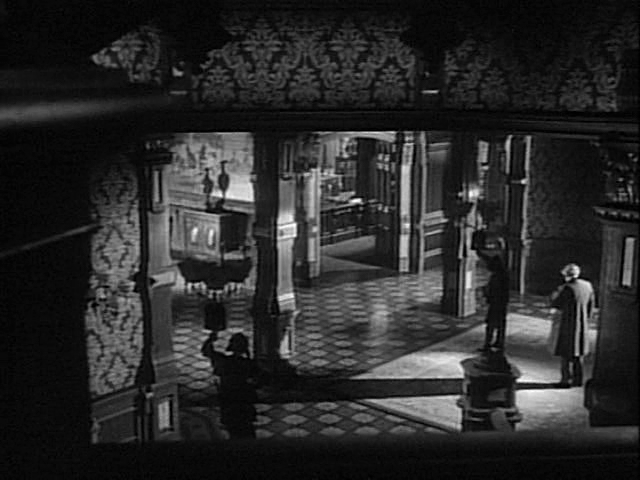
The greatest mise-en-scene in the film was of course the Amberson mansion. A vast and grandeur architecture, with high ceilings, stairways, and party halls, that was also the place where different characters and feelings were housed, and uncertainties about human nature found its own cry. Cortez, the photographer for ‘Ambersons’, employed high-contrast and expressionistic lighting to illuminate the scenes that took place in the manor. It was a dark, yet organic, psychological landscape, and none of the inhabitants inside had well-defined characters. They were easily affected by the circumstances that took place around their surroundings, and they had to come to terms with the flaws inherent in their psyches.


The long take

‘Ambersons’ was famed for its use of long take in many scenes, and some could be considered as artistic accomplishments. When you filmed a scene continuously for a defined period, without recourse to editing, the audience was literally experiencing ‘cinematic time’ itself. The long take was cherished by many critics because that represented an integrity for the photographic process, where you were filming the true performance or actions of a scene, rather than relying on cutting to abstract out ‘unnecessary’ or ‘undesirable’ scenes. One may argue an editing process is like a subjective action to divert the focus of the audience to certain desired scene!

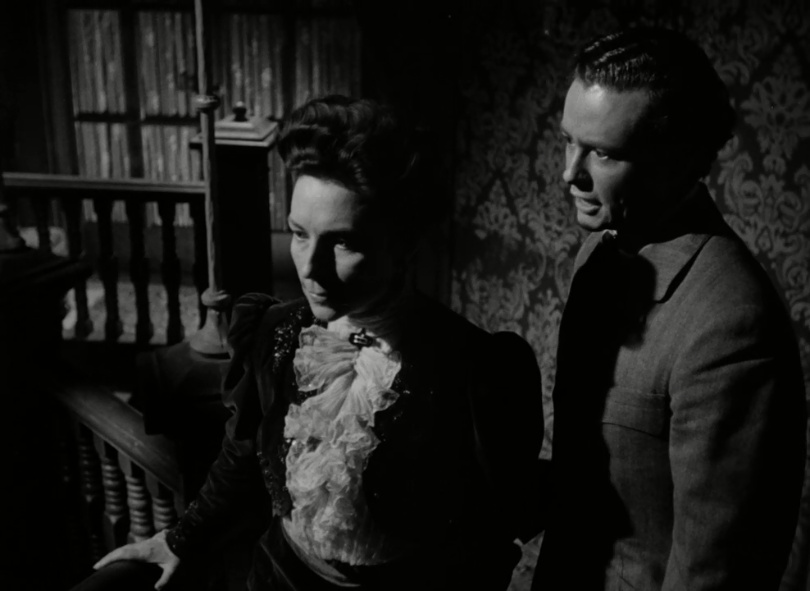
A very wonderful long take scene was the one when George and Fanny was ascending the staircase. While the whole action was of a continuity, the scene was stylized constructed as to provide a layered feel to the audience. Through the careful arrangement of lighting, the 2 actors passed through different areas of shadows, so they were respectively alternated between brightly-lit and unlit when the action unfolded. The intensity and the direction of the light also varied during the different faces, so the emphasis on their faces and gestures became graded and layered. The audience were very much catching up with them, sensing what was on their minds, but all their sentiments were so ephemeral, and easily changed that,  their true feelings seemed distanced and inaccessible to the audience, or perhaps, to each other.


Yet the long takes in ‘Ambersons’ served the major purpose for the film, to express the idea of ‘loss’. As mentioned before, the ‘long-take’ artists employed this technique to, in many cases, express a nostalgic sentiment for ‘time’, ‘pastness’ and loss. [1] This also resonated with the impermanent nature of things, a theme frequently addressed by Yasujiro Ozu and Mikio Naruse. The camera was not willing to lose the very last moment of an action, when it had to end. It captured the action completely, and at least took it away from time, at least as a sort of nostalgia. Yet time is irreversible, when the action ends, you have to move on. So the camera is fighting with ‘time’, and this is the pathos of the photographic. [1]

‘Ambersons’ was about loss, and in many way mirrored that of ‘Citizen Kane’ or a life story known as ‘Orson Welles’. The marriage of Isabel and Wilbur was defined by its emptiness, a loveless marriage. Isabel was aware that she had passions for Eugene, but she was willing to be blind to this sentiment, and instead chose to stick to Wilbur and submitted to his son, George’s control, leading to an unfulfilled life. A Welles picture should have at least one ‘Wellesian’ character, and in ‘Ambersons’, that was George Minafer. He seemed to be protective of his family, and had real feelings for Eugene’s daughter Lucy. Yet he made miscalculated choices and was opinionated and overbearing. He could not see through his mother’s real needs, and alienated Eugene in numerous attempts, even when Isabel was dying. Tragically, what that would lead to was his loss of his true love, and Lucy would see him as a loner and overbearing brat. George could also not come to terms with history. He could not face the inevitable changes (i.e. the arrival of automobiles) and eventually he was lost amidst a modern world he was never familiar with. He was literally lost in time.  


Time is flowing. The things that happen now will become history in the next second. The big question is, are you willing to go with the flow?

-END-

(2/2)

by Ed Law
2/7/2015

Film Analysis - 49

Reference:
1. 'The Magnificent Ambersons' BFI Film Classic.


Wednesday, 1 July 2015

The Magnificent Ambersons, Part 1


After Citizen Kane, Orson Welles has become the biggest thing in Hollywood, or at least, as the studio system was concerned. He was offered another chance to make his own movie. The result was 'The Magnificent Ambersons', a flawed masterpiece. It was flawed because it was not Welles ' original vision. Ambersons was the classic example of studio interference, the studio bosses, while finding certain scenes ambiguous, decided to cut or even worse, added extra scenes which they believed would clarify the meanings. Of course, all these were against Citizen Welles ' wish, and the existing shortened version is never the complete version. Ironically, the plot in Ambersons mirrored that of Welles ' experience, after this film , Welles have lost all the artistic control he could devote to his later work, and his later life was consumed with false promises and disappointments. Nevertheless, Ambersons was still considered magnificent by its peers, and the film appeared twice on the Sight and Sound Critics Top 10 list .


Cars are useless...

Too often, as time goes by, great things fade out. This was what happened to the Amberson family, a wealthy dynasty based in Indianapolis at the dawn of the 20th century. That was a time when there were no, you know, cars. Isabel Amberson married Wilbur Minafer, a stone cold man who didn’t know how to feel passion. Indeed, Isabel was more attracted to Eugene Morgan, yet she did not express her love to him. The couple had a son, George, a brat who was rather infamous in town.

George came back from college, and there was a celebration for him. Eugene was amongst the guests, and he was now an automobile businessman. He was widowed and had a daughter called. While young George had an instant positive impression on Lucy, he did not like Eugene. Soon after, Wilbur died and Isabel became a widow. George even made the sweeping statement that ‘automobiles are a useless nuisance, which had no business being invented’. Eugene, at an older age, turned out to be more far-sighted – he knew that would be a change, be it good or bad. George’s animosity escalated when his aunt, Fanny, implied that his mother Isabel might just love Eugene all the time, instead of his father. Knowing that Eugene was planning to restart a possible relationship with Isabel, he closed the door on Eugene. On the other hand, he decided to take his mother on a world tour, in an attempt to sever her ties with Eugene once and for all. Yet by committing to this, that meant George was leaving his love – Lucy, and all she could do was to fake a smile as they parted (E.L. This is the scene subject to studio interference.)

Eventually, Isabel became ill and was on the edge of her life. The overbearing George still insisted to not to allow Eugene to care for his mother. After Isabel died, George’s grandfather also passed away, and the bubble burst. The Ambersons were tore apart, and every member had to fend for themselves financially. The now vulnerable George had to earn to take care of aunt Fanny, who has descended finally into psychosis, a symbol of the disintegration of the once magnificent legacy. Confused and disillusioned, George wandered alone in the now industrialized city, having no clues whether ‘automobiles are useless’ anymore. To add to the irony at the end, he was actually knocked down by a car(!!), such a karmic consequence he was literally brought down and wasted by a car. Eventually he reconciled with Eugene and Lucy at the hospital...


The auteur behind ‘Ambersons’ was Orson Welles, he was the director, writer and narrator for the film. The narration was indeed essential for the film, as it provided a dramatic tension between narration and image – Welles was sort of the unreliable narrator here. The film worked by duplicity, and some of the scenes were supposed to be ambiguous. However, the ‘old-school’ executives in the studio certainly did not have the will to appreciate or comprehend these narrative possibilities, and thus they cut down as many as 60 minutes from the original version, and that only made the final version even more confusing. Worse still, they decided to provide meanings to those ambiguous scenes (e.g. the scene when George left Lucy), and that undermined the imaginative contributions from the viewers. The studio executives liked answers, not questions!


Orson employed a lot of stylized techniques in ‘Ambersons’, and they all addressed the theme of the story. The techniques could be neatly summarized as deep focus, composition in depth, long take and mise-en-scene composition.


Deep focus photography

The photographer for the film was Stanley Cortez, who was associated with Gregg Toland, so one should not be surprised that deep focus photography was employed a lot in ‘Ambersons’. That was Welles’ signature style, and he used it as a visual motif to stage the actions.


Composition in depth

Another way to play with distance is ‘composition in depth’, and this technique goes hand-in-hand with deep focus.  One can stage objects and characters horizontally in a frame, and if each of these motifs has a different depth of field, then the overall result will appear ‘layered’ – as if a number of different, distinct visual layers can be abstracted from a given frame. To me, the application of this particular technique, and the assortments of techniques that was used in the iconic ‘stairway ascending’ scene, addressed the some of the most important themes in ‘Ambersons’, which will be the focus of my next article.
(1/2)
by Ed Law
1/7/2015
Film Analysis - 48a


The Best Years of Our Lives


When looking deep into ‘The Magnificent Ambersons’, another film from the 1940s naturally came to mind – ‘The Best Years of Our Lives’, directed by William Wyler. Indeed, Welles spoke very high of Wyler, for his judicious choices of the most appropriate shots to address a theme, and his meticulous selections for the best camera angles to deliver the sentiment. The story concerned the experiences of a few WWII veterans, and how they came to terms with the various challenges upon their home-comings.  The cinematographer was Gregg Toland, the creative force who was so important for Citizen Kane’s unique visual style.

William Wyler
Deep focus at its apex.

Wyler was famed for his concentration on realism and also its signature use of deep focus and composition in depth. For Wyler, his rationale for his style was liberal - he aimed to present a holistic portrayal of emotions in every frame of his work, and he welcomed his audience to abstract the sentiment they identified with from the images. So, it was not a torrent of reverse angle shots that forced the viewers to concentrate on certain characters, but a series of deep focus shots that led the audience through the mise-en-scene. The most iconic scene took place in a cafe, when the father fatefully told a young war veteran not to meet with his daughter again. The young man had to make a phone call to the girl at the phone booth, and at the same time, three other patrons were playing an in-house piano, while the customers sitting at the bar were fascinated , utterly unaware of the bitter situation which was taking place nearby. By employing a deep focus style, Wyler’s camera captured three sets of emotions in the same frame, and enriched the whole spectrum of human sentiments in such a closed space. The effect was further enhanced by a composition in depth technique, so the different groups of people appeared layered to the viewers, and thus Wyler’s desire to let his audience choose could be fulfilled. 

by Ed Law
1/7/2015

Film Analysis - 48b