Saturday, 5 September 2015

H. G. Clouzot

Henri-Georges Clouzot (1907-1977)

Pablo Picasso : You want it done right no ?
H.-G. Clouzot : No I want you to finish on time you fxxk !
-From Henri-Georges Clouzot's 'The Mystery of Picasso'

If there is one person Alfred Hitchcock, the 'Master of Suspense', has to be afraid of, that person must be the director Henri-Georges Clouzot, widely known as 'The French Hitchcock'.

You may not have ever heard of Clouzot's name before, yet you are more likely to have heard of his 2 most iconic films. The first one is 'The Wages of Fear', which is likely to be my favorite European film of all time, and the second one is 'Les Diaboliques'. Both films have been remade and inspired countless other films. Due to his health and bad fortune, Clouzot may not have been capable of making as many as films as Hitchcock, yet Clouzot's most wonderful films have good reasons to make Hitchcock envious. Strongly aware of the dark side of humanity, Clouzot has no reservations to expose the darkest nature of the human condition, and the bleakness of his films has reached a point that many of Hitchcock’s films have no way to come close. We can say many of Hitchcock’s characters are perverse – they have mental problems that will lead them to the evil deeds, and their motivations can often be explained away through a psychoanalytical perspective. Clouzot’s characters are far more realistic, and to put it simply, these characters are just plain nasty.
Wife and Mistress - the double in 'Les Diaboliques'. 'The Double' is a plot device evident in many of Hitchcock's and Clouzot's films.
Both Hitchcock and Clouzot are known as masters of Suspense, yet, what does it mean to be suspenseful? Suspense, in short, is not identical to ‘scary’ or horror. Hitchcock, the real boss here, has provided an inspiring example of what it means to be suspenseful.

If two persons are having a meal at a table, and a hidden bomb under the table explodes, then this is known as ‘scary’. The whole point is to instill a shock factor that will scare the hell out of you. But imagine if the bomb doesn’t explode – a ticking bomb – then you are literally waiting for the bomb to inevitably go off, it is called ‘suspense’. 

To me, suspense is all about withholding and anticipation. You are disillusioned by the suspension of events, and a successful suspenseful plot will be able to strain your patience, captivate your attention and thus truly thrill you.

Suspense seems to have become a lost art nowadays. It can be attributed to the shorter attention span of the audience - movie viewers can’t just wait, they want reverse-angle shots and fast cuts. Frankly, it is not difficult at all to generate ‘horror’, you don’t have to be a filmmaker to scare the hell out of others. Yet generating suspense requires techniques and strategies. So how did the Master of Suspense do that?


Hitchcock employed a famous plot device, known as a ‘MacGuffin’, to generate suspense. A ‘MacGuffin’ is a plot device which is used solely to move the plot forward, to capture the audience’s attention. It is a sort of a ‘beacon’ to guide the audience, through time, towards the end of a Hitchcock film, but it does not contribute to the solution of the mystery. Put it simply, it is a ‘question’ in the film that never has a definite answer. The sole purpose of the ‘MacGuffin’ is to generate a suspenseful atmosphere for the audience, to lead the audience to the ultimate explosion of the bomb. Take ‘Rear Window’ as an example. James Stewart’s character has been spying on his neighbour’s activity, and he suspected one of his neighbours have committed a murder plot. The details of the murder itself are never shown in the film, it was the MacGuffin. We identify with Stewart’s character and we know his intuition is right, and the suspense is the anticipitaion that the neighbour will eventually come to attack Stewart, we just don’t know when it will be the time. That’s true – psychological manipulations are often used to craft a great film!

Clouzot and Picasso.

How about the ‘French Hitchcock’? It is quite crucial to realize that, while both masters have a deep understanding of the mechanics of suspense, their treatments are not all the same. Clouzot, unlike Hitchcock, has been derided by the young ‘French New Wave’ critics as ‘old-fashioned’. Whether it is a fair statement is another story, yet can we call all those voters who have voted for ‘The Wages of Fear’ and ‘Les Diaboliques’ at IMDB website old blcokheads too (both films are on the TOP 250)?! Clouzot did not use ‘fancy’ plot techniques such as non-linear narratives or streams of consciousness, he adopted a rather classical style, with the conventional narrative, continuity editing, and realistic settings. Yet it is the story of Clouzot’s film that has substances and insights. Clouzot’s film has a stronger sense of realism than many of Hitchcock’s film, and the audience can quite easily identify with the characters. The characters are people we will likely to encounter in real life, and many of them, to be frank, can be rather negative and nasty! Indeed, everyone’s mental condition is normal in an ‘absurd’ film like The Wages of Fear (as I will convince you soon), it is just everyone has their dark sides to deal with. Clouzot’s style is stark and unsentimental, he just wants to tell you the awful and unsavory truths of the human condition.

Jean Cocteau and H. G. Clouzot.

Clouzot and Hitchcock also have differing background philosophies. Many of Hitchcock’s film can be interpreted in a psychoanalytical / psychological viewpoint, and the reasons behind the evil character’s deeds are likely related to psychological defects, just like the classic Freudian explanations. Clouzot, rather like Jean-Pierre Melville, based his work more on Existentialism (the most obvious being ‘The Wages of Fear’). Although Clouzot seems to many like a ‘Yosemite Sam’ type character, he did have a circle of famous friends – Jean Cocteau, Jean-Paul Sartre and Pablo Picasso, to name a few. He has taken influences from these artists and put his own life views into his work. His universe is indifferent, and the characters are amoral  - they just wanna survive...


Fragmented identity in 'Le Corbeau'.

Clouzot also shows his mastery of mise-en-scene in many of his films, and these have been inspiring. Many of his films are about people doing immoral things, stabbing backs from the behind. His first film, ‘Le Corbeau’ (The Raven), was about a blackmailing spree in a community. The film is based on ‘falseness’. Every character has their mask to put on, to hide their true nature and intentions at behind. Adopting the style of Film Noir, Clouzot used stunning composition and mise-en-scene to expose the paranoia of these characters. A woman staring into a shattered mirror, that represented a fragmentation of identity. Or, did she even know what her true nature was, in the first place? This uncertainty enhances the paranoia, when everyone could just as likely to be the hunted one. Another stunning composition in the film was that when a character saw a shadow moving towards him, having no idea whether that guy could be trusted as a friend. In the same frame, a contrasting light and dark components were present, and tightened the compositional tension of the theme.

The disappearance of the body, the vaporization of the truth.

In Les Diaboliques, water serves as a nice mise-en-scene for the film. The 2 most revealing scenes were related to water – the swimming pool and the bath. Water may symbolize fluidity, flexibility and vitality, yet in Clouzot’s film, the muddy water represented threat and a displacement of truth. When the swimming pool was drained, the body was gone, and the truth has vaporized. When the husband ‘came back to life’ at the bathtub, what emerged was the triumph of evil. How about the ‘passage of death’? The corridor that led to the death of Vera Clouzot’s character was the tool of suspense. It was the suspenseful trail for the audience to reach the ultimate twist-ending.


With his memorable plots and suspenseful scenarios, Clouzot is more than capable of holding you on the edge! And if ‘Suspense Film’ has a name, it has to be ‘The Wages of Fear’!

Next: The Wages of Fear

by Ed Law
5/9/2015

Film Analysis - 54


The Wages of Fear, Part 1


卑賤的蒼生, 被命運玩弄於股掌中。- E. L. 


Life is a game, and this is in no way a cliché. The ups and downs in every moment of your existence, the stress to achieve and, the burden to survive, these aspects can almost keep you ‘on the edge’. The loosening of a cork screw, or the appearance of a mindless error, will lead you to hit the wall in the ‘game of life’. The big question is, just when is your turn to be eliminated, by destiny? Such is the theme of H. G. Clouzot’s masterpiece ‘The Wages of Fear’, which was released in 1953. It was the film that has made Hitchcock to realize that he had a serious rival. It can be one of the most suspenseful films ever in the history of cinema (almost 90 minutes of non-stop suspense), and the bleakness of the film is rare, especially for nowadays’ popcorn movies. The film was released in the Eisenhower era, which conformity was seen as the norm. Given the amount of ‘feel-good’ movies released at that era, I suppose ‘The Wages of Fear’ would be considered as ‘intense’ for many viewers at that time (and of course the anti-American parts were cut in the USA release). The film won major awards at the Cannes festival, and has inspired at least 2 re-makes ever since. ‘The Wages of Fear’ has achieved a timelessness that has not dated.


Why is 'The Wages of Fear' my favorite European film?

When I first watched ‘The Wages of Fear’ at my teenage years, I was of coursed impressed by the excitement and pleasure (!!) of watching this sweaty quartet, transporting explosives on trucks through the narrowing mountain passages. To me, the film was a first-rate thriller that could captivate audience who enjoyed adventure movies. When I grow up, and have been able to read more and gain more life experience, I start to be able to appreciate the point for Clouzot to make this masterpiece. ‘The Wages of Fear’ is the allegory of life. Through an existentialist perspective, Clouzot philosophized the futility of an almost insurmountable aim, and the absurdity of the human condition. To me, all the key barriers the 4 men had to pass through possessed rich and insightful philosophical meanings, and that will be the subject of my second article. Clouzot challenged his viewers to be courageous, and to stand up to the absurd moments of life. Through the waves of challenges in our human existence, we desperately hold on and try not to fall off. Just when we think we have turned around a corner, another barrage of obstacles lead themselves up. Too often, even a smallest error can lead to a catastrophic consequence. And, the baggage we are carrying are not getting lighter as our journey continues. Call me pessimistic, yet this is the harsh reality of life. Any authentic person will be able to accept the absurdity and stop asking ‘Why?Why?Why?’. All you need is the courage to continue, and the will to ‘getting through hell’. It is the ‘suspenseful’ nature of life that makes life so endearing. In 'The Wages of Fear', we are not encountering perverse monsters or other-worldly species, we are battling against the Force of Nature and also our fate. None of the characters are perverse, yet they all have their dark sides to confront, or to come to terms with. It is the balance of  realism and 'The Absurd' that makes the film so fascinating. By telling us these ugly, yet insightful truths, I am convinced that Clouzot is an admirable filmmaker, and the dark and gritty film is shining inspiring perspectives for generations of audience.


‘We don’t need your life story.’

(SPOILERS! t is important here as it will definitely diminish the potential thrill and excitement you can get from this masterpiece.)

*****SPOILERS START*****
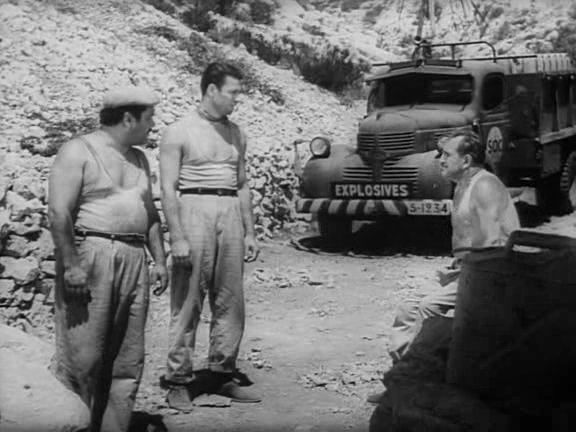
In order to survive, how far can you get to? You've better asked this question to the hopeless residents in Las Piedras, the fictional South American town in 'The Wages of Fear'. With their soulless existence, the 'odd man out' seemed to be the Southern Oil Company, an oil enterprise known for exploiting the workers in the town. There was a small airport to prevent this town from being a lonely island, too - yet do you think anyone will have the cash to get an air ticket, spread their wings and fly away? Among these desperate people were Mario, a Corsican playboy; Jo, a bully and ex-mobster from France; Bimba and Luigi, 2 other immigrants. Finally, a chance came for the underdogs. A massive fire happened at an oil field, and, absurd as it might seem, the only logical way to deal with this saga was to use nitroglycerine, an explosive chemical, to cause a big explosion, thereby consuming the oxygen source and capping the well. But no one is ready for this farce, right? So, without proper equipment, and with the town separated from the oil field through miles of mountain roads, the company decided that the explosive nitroglycerine had to be transported there anyway, with some second-rate jerrycans, on 2 trucks respectively. What does that mean? Well, that means the unstable nitroglycerine can explode with the lightest perturbation from the truck, and an explosion may just happen for absolutely no reason! It sounded dangerous, and of course the company knew it, so they were not willing to risk legal challenges from the unionized workers. Then who would do it? The desperados, of course! The company decided to recruit 4 men, and each would be paid for US$2000, if they could survive and come back. Honestly, this is not much, but this is more than enough to get an air ticket and escape the doomed hell in this small town. So, a lot of volunteers applied for this 'suicidal mission'. Eventually, Mario, Bimba, and Luigi were employed, and another German. Yet, the German never turned up, and Jo was substituted, leading to the suspicion that Jo might have killed him to take the job.

An iconic image from the film.

So, the trucks set out and began the suspenseful journey. Bimba and Luigi was on the first truck, followed by Mario and Jo in the second truck, within a reasonable distance to limit the possibility of collison or casualties. Yet the aggressive Mario and Jo drove a bit too fast, and also crashed into Bimba and Luigi's truck. Later, they had to cross a rough stretch of road, and also a rotten wooden platform. After these physical challenges, they came across a giant boulder blocking the way. The 'Old Jo', unlike the tough guy persona he has always been showing in town, started to be consumed by the stress and freaked himself out like a coward. They eventually solved the problem by doing a controlled explosion on the rock, after a tense preparation stage.


Explosion of the first truck.

Soon after the height of their achievement, the first truck exploded, and Bimba and Luigi perished for absolutely no reason. They were eliminated - from the game of life. Seeing this, Mario and Jo realized they were getting closer to their doom.  The explosion caused an extra obstacle for Mario and Jo, too - a large pool of viscous oil which blocked the way. Their truck was unfortunately stuck, and any instability could perturb the nitroglycerine to explode. Jo stepped down to the oil and helped to navigate, yet when desperately trying to free from the oil's clutch, Mario's truck ran over Jo and mortally wound him in the process. Eventually, the truck could continue, yet Jo was dying. They reached the destination, and the explosives successfully put out the fire. Mario was given the reward, and he drove the now empty truck back to the town. Happy ending? No, I haven't finished yet...


An elated Mario drove through the narrow mountain passages, knowing that now there were no explosives to burn him to hell. As he was proudly testing his driving skills, he made a careless turn, and lost control of the truck. As the truck fell down the mountain, Mario finally lost control of his life, and plunged to his death...

THE END. Literally.

*****Spoilers end*****

I have always been a strong believer for the following wise opinion - the truest side of the human nature will only emerge from the most extreme of situations. In The Wages of Fear, this is exactly what that means. The wisdom of the statement derives from the 'theatrical nature' of human relationships. We are all actors of our lives. We put on masks and facades, to present ourselves to the others in a way we desire. The motivation can be self-interest or empowerment. Yet when the challenges come, will you still be the same? Look at smart old Jo. He's a bully, harassing other people to prove himself strong all the time. He is smart indeed, as he knows how to get the power. But when flying rocks and furious explosives are marching towards him, he reduces to nothing more than a chicken. It is the extreme scenario that rips off his deceptive mask and reveals his true nature, and these are the cases that count.


The Wages of Fear is in no way a popcorn movie! While it looks like an adventure film, it is more fair to categorize it as a Film Noir. You may disagree - because unlike the claustrophobic environment in many of the Noir, 'The Wages of Fear' takes place at the exterior. Yet, it is the atmosphere and the paranoia that makes the film a Film Noir. The film captures the paranoid atmosphere evident in a number of films from the 1950s, such as 'Rififi', 'Le Trou', 'Touch of Evil', to name a few. The suspense, amoral characters, and the fatalistic bleakness also contributes to the Noir outlook of the film. And, sitting in a tiny component in the truck, with a burden of explosives at your back, is honestly the most claustrophobic experience I can imagine!


What is your motivation of life? For many, it is merely to 'get more'. Survival, in a sense, is about getting the best for oneself. At the opening minutes of 'The Wages of Fear', a kid was seen torturing some insects aimlessly on the muddy ground, which an ice-cream cart drove by. He had no money to get the ice-cream he wanted, and could just stare at the cart. Soon, the ice cream cart departed. This is a meticulous foreshadowing sequence by Clouzot, as it illustrates the underlying theme of the film.  This sequence has clearly inspired the opening scene of Peckinpah's 'The Wild Bunch', as both sequences succinctly establish  the bleak outlook of the directors. We desire and fight hard for whatever we want in our existence. When the chance has expired, it walks by. The hope for the child may have vaporized, but his desire has not. The question is, what is one willing to lose to get it eventually? In the case of our 4 protagonists, are they willing to struggle hard for the ultimate reward, even if that means they will reach their demises? Bleak as it may seem, it is the 'wage' you get for getting through the thrill of life.

One learns more as the journey continues. If that is the case, then 'The Wages of Fear' is a hell of an educational journey!

(1/2)

by Ed Law
5/9/2015

Film Analysis - 55


Monday, 31 August 2015

The Passion of Joan of Arc, Part 2


You cannot know the history of silent film unless you know the face of Renee Maria Falconetti.
- Roger Ebert

In Dreyer’s movie universe, his characters act in Dreyer’s way. Dreyer’s prime concern was never about any sort of the so-called psychological realism. He was more interested in the spiritual understanding and human relationships that his audience could identify with. Dreyer’s style was stark, ascetic and often minimalist. His detractors may call this ‘cold’ and ‘technical’, yet I suppose these are the qualities that appeal to me. Dreyer’s characters are often estranged from their surroundings, no matter it originates from rules, religion, norms, or an expressionistic vampire world. Their courage is derived from a firm commitment to what they truly believe in, even if the potential trade-offs will lead to their demises. With an unsentimental style like Bresson, Melville, or Ozu, Dreyer’s original style has been able to provoke emotion from his audience and also able to strike resonance among them.

Disruption of the classic D.W. Griffith horizontal line.

One of the most wonderful aspect of ‘The Passion of Joan of Arc’, belongs to the monumental performance of Maria Falconetti. She successfully captures the confusions, ambivalence and hardships in her quest to get closer to God. The film is about her ‘passion’, and it is her intense facial expressions that have casted a significant emotional power onto the audience. It is known that, in order to ‘prepare’ Falconetti for the role, Dreyer ordered her to kneel on the stone-paved set for hours before shooting started. This ‘Bressonian’ treatment was used to wipe her off any of the ‘performance’ (or sentimental) factor, and to make her portray the martyr ‘as she was’.  Of course, Dreyer and Bresson had rather different treatments on the theme of Joan of Arc, and I have compared them in the following table.

Dreyer's and Bresson's 'Joan of Arc'. Prepared by Ed Law.


The plight of Joan of Arc has been identified by many, including, famously, a fictional character known as ‘Nana’, the protagonist in Jean-Luc Godard’s film ‘Vivre Sa Vie’, where her misfortune would lead her to a tragic path of prostitution.

Nana (played by Anna Karina) weeping while watching 'The Passion of Joan of Arc' in Godard's 'Vivre Sa Vie'.


While the legacy of Joan of Arc has been firmly cemented, the interpretation of her case remains open. Over the course of history, many has switched to a more secular, or psychological interpretation of Joan’s situation. Some propose that her holy vision is merely paranoid delusions or the possible side-effects of some psychological or physiological illness. Whether her divine insights are spiritual or pathological, we should be open-minded and respect these viewpoints, as there really are not enough objective evidence to disprove any of these perspectives. And, I suppose this is what Ms. Falconetti has been able to deliver in her stunning performance. In the film, Dreyer has illustrated the challenge of transcending oneself, and the mental turmoil of believing in one’s faith. Others may call you crazy, marginalize you, and make you feel ‘out of joint’. Falconetti was more than able to portray all the conflicting feelings in her spiritual quest, her final moments of her human existence. She showed fright, frustration, paranoia, and most important, euphoria, during her tug-of-war with the corrupt judges. The judge attempted to bluff her by stating that she would be alone if she did not confess her crime, yet then she gleefully said, ‘Yes Alone... with God!’. What a verbal counter-attack!  Joan knew that she had to pass all the spiritual barriers in order to come closer to God, and when she could link to God, with her head slightly tilting up, her face showed a sense of ecstasy. I feel that Falconetti has nicely struck a balance in this iconic sense, as she could show both, rather conflictingly, a paranoid or hallucinatory feeling (like getting high on LSD), and also a euphoric and transcendental sentiment. To be capable of conveying such a multiplicity of emotions in a single frame, serves as a testament to Falconetti’s ingenious skills. Her face will linger in the audience’s mind for long...

Joan 'touring' around in the torture chamber, seeing the torture Ferris Wheel.

Joan thrilled by the potential damages from the torture

'You will be alone!'

Alone with God - the paranoia, the euphoria, the passion.


Joan of Arc will always be an icon of faith; Carl Theodor Dreyer’s ‘The Passion of Joan of Arc’, an icon of a masterpiece. 

(2/2)

By Ed Law
31/8/2015

Film Analysis - 53


Friday, 21 August 2015

The Passion of Joan of Arc, Part 1

I am going to Italy this weekend to attend a conference on Fluorine Chemistry, which will take place for the whole of the coming week. Therefore, I have been preparing for it these few weeks (a poster presentation) and did not write much in my science blog and film blog this month. I do want to get on with some films and therefore I will do a great classic here this time. We will continue with it when I come back next week!


Joan of Arc - the martyr


Joan of Arc (1412-1431) is a historical personality who has always fascinated me. The reason why I admire her is because of her authenticity. While I may not share the same religious belief with her, I am inspired by her courage to stand firm on what she truly believes in, even if that will lead to her death. Because of her magnificent cult status, Joan of Arc is a character that has been portrayed numerous times in different forms of art, notably in cinema.

While her leadership during the battles of the Hundred Years’ War is a subject that has been mentioned in many ‘commercial’ (and maybe CGI-driven) films regarding herself, two of the most outstanding  films about Joan of Arc are focused instead on the subsequent trials against her, by the masters Carl Theodor Dreyer and Robert Bresson. To me, it is not merely about being serious or arthouse-worthy. Because the courage, wisdom and resourcefulness of Joan of Arc was most evident in her ‘showdown’ against the corrupt priests and judges, who would resort to bluffs, tortures, deceptions, and even death threats, to push the young Joan to confess to all the guilty allegations against her.

Carl Theodor Dreyer
My focus this time is Dreyer’s masterpiece ‘The Passion of Joan of Arc’ (1928), a silent film back in 1928. This film is so wonderful that it has captivated generations of audience, and it has stood the test of time. It has featured on the Critics’ Top 10 list for 4 times in the ‘Sight and Sound’ magazine, coming out as the 9th greatest film in the 2012 poll. It is important to note that, while both Dreyer and Bresson have been categorized as ‘spiritual’ directors (akin to Schrader’s famous book), Dreyer’s ‘Joan of Arc’ is very different from that of Bresson. Even so, many will find that Dreyer’s masterpiece on Joan of Arc is rather different from the style he is usually identified with, like the long takes and mobile camera movements as seen in his later works like ‘Ordet’ and ‘Gertrud’. Schrader has provided wonderful insights on this issue, by stating that Dreyer’s style could be attributed to 3 distinct, and even conflicting influences – the naturalistic chamber plays, expressionism and of course transcendental ideas. It is in ‘The Passion of Joan of Arc’ that these 3 styles battled each other the most fiercely for artistic control, which resulted in a dramatic intensity that can still fascinate modern audience, and the film stands alone as an iconic piece. Maria Falconetti, merely using intense facial expressions, has delivered one of the most sublime and fantastic performance ever in the history of cinema. The great dramatist, Antonin Artaud, also starred in the film. Known for his faith on the ‘Theatre of Cruelty’, you get the idea! Indeed, this masterpiece was almost lost in the ashes of time, when a fire accident has likely damaged the negatives. Miraculously (is that what Dreyer’s film is all about?), an original copy was found in a mental hospital in Norway (the most suitable place for it to be found), and modern audience can thus appreciate this timeless masterpiece.

A frequent image - would Joan confess?


The plot was based on historical facts, and it focused on the trial of heresy against Joan of Arc. The priests and judges for the trials, which supported Britain at that time, were obviously biased and they could resort to all sort of dirty tactics in order to nail Joan of Arc. Using rhetoric and bullying tactics, they attempted to belittle the young Joan and tried to shake her belief that she had a God-given mission to chase the British away from France, and thus confessed to the allegations they have planned for her. Yet, the resourceful and strong-willed Joan would not easily succumb to these threats. When bluffs failed, the authorities decided to craft deceptions. They wrote a fake letter and dictated it to Joan, claiming it was from the French King. Of course, the clever Joan was not fooled by this. Sensing their carrot tricks were to no avail, they decided to show Joan the torture chamber, which consisted of various sharp objects, and a ferris wheel laden with sharp pins. Although disturbed by the possible thrill that could arise from these ‘fun rides’, Joan again stated she would not confess, before fainting and dropping onto the floor. The judges decided to give the calling card – if Joan would not co-operate she would be burnt at the stake. Joan eventually relented and signed the confession, and she was then imprisoned.  It was then Joan found that she was not faithful to God. She put into action, by asking to change back to men's clothes and retracted her confessions. The return to a tom-boy style, and the fact that God was calling back, were, rather ridiculously, the 2 heresy charges that would lead to Joan's demise. Nevertheless, believe in the power of human wisdom! More and more people could identify with Joan's devotion and therefore she was allowd for one final communion. More than ready to be a martyr for her country, Joan was brough outside and she was burnt to death. People felt bad for her, and a riot almost broke out. With her soul parting from her body, she was finally alone - with God!

Joan experiencing God

Dreyer has stated that he wanted to show a ‘landscape of men’ in ‘The Passion of Joan of Arc’. Natural landscape has been used as mental allegory in many films, including those of  John Ford, Anthony Mann, and Nicholas Ray. In order to achieve this, Dreyer employed stylized approaches. Many of these were expressionistic, including the extensive use of extreme close-ups, high contrast lighting, and low angle camera placement. This presented a threatening and confrontational atmosphere, as if Joan was being cruelly inspected under the microscope and was utterly alone in this battle against injustice. The emotional richness displayed by all the character’s faces was unprecedented in the history of film, and few subsequent films could capture such a plentitude of sentiments in such a lucid manner . Indeed, this style was extremely important for Dreyer’s end because his version of Joan of Arc was concentrated on the disparity / chaotic nature of the trial, and the outcome that followed. Unlike Bresson or Ozu, whose spiritual quests in their films would lead to a stasis stage – a kind of peace of mind at the end – Dreyer has chosen not to end that way. Thus, Bresson’s and Dreyer’s respective ‘Joans’ are different from each other.

Indeed, another high point of expressionism is the torture chamber sequence, which ironically can provide ‘guilty pleasures’ for modern audience (including myself) as the effects employed are certainly funny. With the canted angles, abstract images of sharp objects, and distorted perspective, this montage-style sequence was intercut with the elevating thrill displayed on Joan’s face. The priest turning the ‘ferris wheel’ with sharp blades is legend – he attempted a threatening stance by turning it slowly, and then faster and faster (certainly an expressionistic effect from Dreyer, as it became over the top at the end), thus while it could be fun to watch nowadays, it was certainly emotionally thrilling!

(1/2)

I have to stop here, as that is quite a lot to say about this great film. Falconetti’s monumental performance is so inspiring that there is no point to treat this subject lightly. I am getting ready for my trip to Italy, so I think I will continue with this next week when I am back. At the time, just go for this film on the internet (inc. the ferris wheel scene, see below link), it will leave a lasting impression. Anyway, see you next week!

https://www.youtube.com/watch?v=DY4M8WyIOrE

by Ed Law
21/8/2015

Film Analysis - 53


Sunday, 26 July 2015

A Trip To The Moon


At the dawn of an art, even the smallest achievements represent the greatest leap forward. And if these achievements can survive the test of time, they certainly can be seen as magical. If this is the case, then Georges Méliès (1861-1938) deserves to be one of the most wonderful filmmakers of all time. A magician and illusionist by trade, he had such an insightful imagination that modern artists could in no way get close. His story has inspired the novel ‘The Invention of Hugo Cabret’ and also Hugo by Scorsese. After watching some of the pioneering motion picture work by the Lumiere brothers, Georges decided to take a shot at filmmaking himself, and started making hundreds of short films, many of them survived and was still accessible on the internet. One of them proudly stands out, and that iconic film is the subject of this article – ‘A Trip To The Moon’ (1902)!


Though the length of ‘A Trip To The Moon’ was no longer than 13 minutes,  Méliès’ wisdom was evident in every single frame of this masterpiece. With an unlimited imagination and deep understanding of the burgeoning film art, Méliès’ masterpiece served as a model for many future films, and one of the most wonderful pioneering film.


The story started in an astronomy club in France, when the members discussed about the possibility of interstellar travel. The professor, who was the chairman of the club, proposed a daring, yet deceptively simple approach – by shooting a capsule, which was their ‘spaceship’, through cannon onto space. After lots of quarrels and paper-throwing, they decided to give this a try.


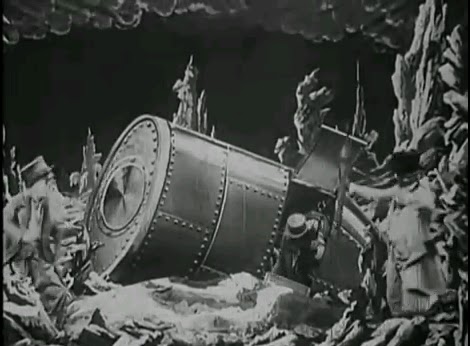
A capsule, which resembled the shape of a giant bullet, was built. Then the Frenchmen sat inside the capsule, and the capsule was fired into the space. There seemed to have a luna-god on the moon, as he was smiling and lazing around. Unfortunately, he got a ‘shot-in-the-eye’ when the capsule hit on the moon’s ground. This is the one of the most iconic images in the history of cinema, and I suppose many have seen this before even if they are not aware of this film!


The Frenchmen arrived safely on the moon. They explored around and saw their beloved Earth at a distance. The goddess and spirits of the stars shone in the beautiful star. After a brief rest, they started to investigate the peculiar plants and organisms around, when they encountered some moon aliens. Panicked, they fought the moon aliens and killed them by making them ‘explode’! The men were soon subdued and were brought to the king of the moon aliens. It was there the Frenchmen suddenly revolted and killed the king (and he exploded of course), and they ran away, with the aliens in hot pursuit. They got into the capsule and it set off back to Earth. Arriving back to Earth safely, the civilians celebrated such an impressive and imaginative (though non-scientific) feat.


Méliès, who was a magician, understood how to stage a performance and captivate the audience’s attention. His imagination was so profound that it could only do justice by instilling his style into his many short films. A 113-year-old film, ‘A Trip To The Moon’ was likely the very first science fiction film (though the ‘fiction’ factor certainly predominated). Though the idea behind the story sounds silly by today’s standard, this film has far more substance and imagination than many of the CGI-riddled, so-called entertaining films nowadays. If the images in Méliès’ film are not iconic, why can it still inspire so many after all these time?


‘A Trip To The Moon’ is important in the history of cinema for 2 key reasons. First, it was likely the first narrative film. A narrative film is a fictionalized film, that tells a story. At the start of cinema, most of the short films were instrumental in showcasing the technology of film projection. Thus, those short films only showed short clips of moving images, without an intention to show a plot and tell a story. For ‘A Trip To The Moon’, it had a clear and simple plot. The story was played out simply by action, without the needs of any dialogue. This served as a testament to Méliès’ story-telling power, and his meticulous use of filmic images to impact and influence audience.


Second, ‘A Trip To The Moon’ showed Méliès’ mastery of the application of mise-en-scene. The word ‘mise-en-scene’ is French for ‘putting into the scene’, and it has a theatrical origin. Mise-en-scene signifies the film director's control over what will appear in the film frame. By staging the event in the frame, the director passes on a feeling, and a meaning, to his audience. Through an artistic application of mise-en-scene, Melies constructed an imaginary and creative world in his masterpiece.


In an era without CGI and special effects,  Méliès had to rely on rather primitive techniques to stage the wonderful effects in the film, and these techniques originated from his magic and theatre experiences. A couple of these were worth mentioning, and they indeed inspired later filmmaking techniques. For example, Méliès often employed superimposition techniques to stage depth in his short films, and it could be seen as a sort of early composition in depth. When motion picture cameras became more sophisticated, these techniques became easier to operate and avoided laborious hardships.

The capsule projection scene is one I am particularly impressed. The staging of this scene foreshadows the future anamorphic-style composition, with the extensive use of widescreen camera lens. This represents an aesthetic that are evident in so many of the widescreen films. That is when a figure, in close view, is situated on one side of the horizontal plane; with the other figure, in far view, is situated on the other side, as if a projection action is taking place. Méliès’ foresight and wisdom pass through generations of artists and filmmakers, and the trail is evident on the numbers of films that are influenced by ‘A Trip To The Moon’. 

Filmmakers have to stand on the shoulder of a giant to look further and move forward. If that giant exists, he must be Georges Méliès.

Sweet dreams, papa Méliès!

by Ed Law
26/7/2015

Film Analysis - 51 


Saturday, 18 July 2015

Terminator and Postmodernism


Terminator is in no way a popcorn film. It is a film that has stood out from the waves of shallow, ephemeral commercial films and has established itself as a cultural icon. Along with films like ‘Blade Runner’ and ‘Pulp Fiction’, Terminator films become one of the epitomes of Postmodern cinema, and through a fictional plot, it facilitates us to philosophize about the modern condition. In a world defined by superficial images, Terminator helps us to confront our intellectual depths.

The postmodern condition does not come out from nowhere. It is a continuation of Modernism, an artistic engagement that was originated from the dawn of the 20th century. Modernism takes a critical stance, and asks questions about our established beliefs and core values since the Enlightenment. To coin a term highly related to Postmodernism, Modernist art poses challenges to the metanarratives – the values that we believe to be normal and thus govern our thinking in a given era. Some examples are reason (rationality), progress and liberal humanism. From philosophers like Descartes, Kant, and Hegel, we arrive at a position to be so confident about what it is to be human – we exercise reason, time is a linear flow towards the Absolute, and a person has a unique identity. Yet as time goes away, our experiences start to question about many of these ideals. Modernism allows a creative freedom to go against the grains that allows non-linear narratives, stream of consciousness, and non-rational philosophizing. Indeed, with the cutting-edge uses of filmic techniques, cinema can be seen as a modernist art, and our perceptions about difference possible experiences have been broadened since the advent of motion pictures. Indeed, another reason why Modernism is so associated with cinematic art is due to cinema’s emphasis on movement. Through movement, the static images on the film stock contribute to the dynamic sequence in the final film.


At the second half of the 20th century, Modernist thinkings have been evolved into Postmodernism, due to an explosive development in technology, entertainment and consumer products. We no longer need definite answers, we just need open-end questions! Indeed, there are a number of key themes to characterize Postmodernism, and here I summarize it.

1. Denial of metanarratives. In the philosopher Lyotard’s wording, it is a denial of grand narratives. The so-called normal major ideas are challenged, and every individual has his own opinions on what is most important for him, no matter how minor or low-culture it may seem.

2. Surface. Things are superficial in the Postmodern condition. No one asks for meanings or understandings, they just ask for superficial representations. A famous painting by Picasso, after making into millions of copies, becomes ‘post-modernized’ as a result.

3. Identity. Postmodern identity is not stable, and it is always subject to change. Form Saussure’s classical theory, a signifier, which is a defined word, should point to a definite thing it represents, the signified. In a post-modern world, this is no longer important. As the signifiers never have a stable meaning or representation, the meaning of a signifier can change from time to time, it ‘just depends’. The meaning is always sliding, and also slippery.  Postmodern era is the age of ‘signifiers’.

4. Simulation. This is Baudillard’s idea. The postmodern condition is a bit like inside an imaginary world, exploring inside a computer game. We cannot live without the cyberspace, a rhizomatic zone as Deleuze would have put it. We are all connected – to the computer world, and we are literally like the ‘SIMS’ – we are like components in a simulated, virtual world. Humanity, tragically, is now more subject to machine control.

5. Illusion vs. Reality. This is no cliché here, the question of reality is the key theme of Metaphysics, and for thousands of years philosophers asked for valid arguments to establish an objective reality. Postmodernists take the ‘Anti-Metaphycis’ stance, and they believe the boundary between illusion and reality is more blurred than ever. They are not alone – indeed throughout the history of humanity there are maverick Postmodernists – Zhuang Tzu (with his famous Qi Wu Lun), Nietzsche, Heidegger were all against the possibility of Metaphysics.

6. Juxtaposition. Postmodernism is all about mixing news and olds, and someone will see it as ‘retro’ or showing a nostalgic sentiment. This characteristic is more relevant to the cases of ‘Blade Runner’ and ‘Akira’, which I will discuss in the future.

I have talked loads about what it is to be postmodernism, yet with all these information, we will start to appreciate why ‘The Terminator’, the exemplary Postmodern film, is such a cultural phenomenon.


High tech, low life – Terminator as Cyberpunk

As I have mentioned in the first article, Terminator films belong to the Cyberpunk genre, which is a sub-genre of science fiction. Cyberpunk movies can be succinctly stated under the slogan of  ‘High Tech, Low Life’. These films take a bleak view of our future times, and often take place in a washed-up, dystopian future. Ironically, this is often realistic and foreseeable, and movie audiences can therefore easily project to these. Cyberpunk movies do not adhere to the sort of ‘This-is-not-Kansas-anymore’ fairy tale world, yet there are still wicked witches in these films. Very often, some sort of conspiracy is evident in a cyberpunk film, and it is often responsible for the nasty conditions in the film.


Why is ‘The Terminator’ so relevant to our experiences? Because, like ‘Blade Runner’, Terminator films challenge the delicate boundary between human and machines, if there really exists one. Terminators are cyborgs, which is ‘cybernetic organisms’ for short. While this type of species is controlled by computers, after all there may be NO difference between a human and a terminator. That is certainly a sweeping statement, so let me explain. First, cyborg is a term hard to arrive at a clear definition. In short, ‘cyborg’ implies something in-between, a ‘cyb’ and an ‘org’. It is standing at the thin line between an organic whole and a mechanical machine. While the word cyborg can mean Arnold-like robots, it seems to take further meanings. In feminism, the philosopher Donna Harraway has provided a more culturally-oriented meaning for the word. She sees the ‘cyborg’ as a creature of the postgender world, for which the established meanings of gender have been shaken in a more diverse and gender-equal society. We even have female Terminators now! In short, a cyborg is something in between human and non-human, it is the ultimate  product of postmodernism.


So how do we all become Terminators?! Well, Terminator films illustrate the idea of post-humanism, as it challenges the whole conception of being human. A terminator is a humanoid robot, with human-like flesh and skin outside, yet a computer and metal-endoskeletons inside (with a monotone Arnold voice too...). It is the most explicit example of a trans-human, and indeed, it is the plot in ‘Terminator: Salvation’, where the Sam Worthington character is the proto-type of future terminators! Of course, a similar idea is also present in the ‘RoboCop’ movies. If you are into cult movies, films by Shinya Tsukamoto (such as Tetsuo: Body Hammer) and the body horrors by David Cronenberg share similar themes.

Let’s expand ourselves further on the cultural perspective of ‘cyborg’. As I have mentioned, we are all connected to machines somehow, and it is not too far away from the case of ‘The Matrix’ (don’t even day-dream on brawling with a hundred Agent Smiths!).  Isn’t it the case? We rely on tools to complement with our lack and human limitations.  When we are not strong enough to lift a 100-tonne weight, we use our intelligence to develop a machine to help us. We can wash 10 kg of dirty laundry in 20 minutes, we invent washing machines. We wear spectacles, and medical robots, or even in the future, ‘nano-bots’ may help us to clear the cholesterol that blocks our blood vessels! And you are now online when you are reading this, right? Since our lives have become so connected to machines, it can be argued (at lease in a rhetorical sense) we are all ‘cyborg’. In the modern era, our human existences cannot be disconnected from the influence of machines, and that is what makes our experiences so postmodern.

This sentiment is something that James Cameron has carefully shared in all the Terminator films. In almost every key sequence throughout the series, it is almost always about interactions between humans and machines or tools. Be it cars, computer decoders, Gatling minigun, steel mills, or ‘plastiques’, which are likely to be Sarah and Reese’s supper. In a postmodern universe, every facet of life is related to, or intertwined with machines. Our direction is driven by the advancement in technology. When we become more like a machine, will the most fundamental human qualities be gone?

Sarah Connor, Mother of the Future


I know the last paragraph belongs to my appreciation of Sarah Connor, a female character I like very much. Indeed, I have discussed about this in an earlier article, ‘Films And Feminism’. I suppose one of the reasons why some many female audience are driven to such a masculine film like Terminator is due to an identification with Sarah’s character. ‘Terminator’ is literally a Bildungsroman of Sarah. How this lady changes from a vulnerable young lady, who cannot even hold your chequebook tightly, to a mature, driven feminine warrior, ready to take on the dark sides of the future. Through the education and encouragement, and the ‘No Fate’ motto she has given to John, she gives John inspirations and channels up his confidence to stand up to the powerful robots. She may still not able to balance out her monetary issue, but now with a sniper rifle on one hand and a wasted robot skull on the other,  what else does she need?


Final words

Terminator is a dark film. It is not like some sentimental, blindly optimistic, and pretentious wanna-be movies that makes you feel good afterwards. The film gives us thrills, and makes us conscious of a potential future we are marching towards. After all the pains, it offers us hopes, the humanistic values that we treasure all along. While it is a supposedly Postmodern film, there are so much depths and meanings that I have been inspired by. It certainly is one of the most important films I have ever watched, and it will always be my favorite film of all time.

Stay here... I'll be back!


-END-

(3/3)

by Ed Law
18/7/2015

Film Analysis - 50