Saturday, 16 June 2018

2001 : A Space Odyssey - What the HAL ?


Stanley Kubrick’s ‘2001: A Space Odyssey’ is celebrating its 50th anniversary this year. With the various re-releases around the world, including the Cannes Festival in May, the younger generation has an opportunity to experience one of the most iconic films in the history of cinema. Every generation of humanity deserves ‘2001: A Space Odyssey’. It is the film that has shown us the potential of our imaginations and how far we will go to actualize them. One should be in awe, or even in a sense of chill, how Stanley Kubrick could predict so many things correctly half a century ago. Space travel, various type of computers, video conferencing, the potential of internet and virtuality, tablet computers, corporate business, the all-dread frozen dinner, the perfect breakup line, online birthday wishes, and the sad fact that we indulge in our smart phones or tablet computers when we dine with others, you name it. It is fair to say that ‘2001’ is a film that has shaped the way we look at the modern world, and we have clearly taken inspirations to drive the development of our future. This time, I am talking about the iconic central part of the film – the struggle between humanity and an artifact Man has created – an artificial intelligent computer known as HAL. No matter you have heard of that before or not – just Open the Pod Bay Doors, HAL!


In the first part of the film, ‘The Dawn of Man’, Moon Watcher, the dominant ape in the tribe, discovered the first use of a tool. Combined with his instinct for control and violence, he successfully chased away a rival tribe of apes with his friends, claiming ownership of a property in the ancient world – a water hole. With a brilliant match cut, Kubrick has taken the audience to an era we are more familiar with – the Space Age. With John Strauss’ ‘The Blue Danube’, various spacecrafts drift in the space in a harmonious manner, signifying that humans have developed a better understanding of the universe, through the use of technology. The reason why we are at ease and feel harmonious with our surroundings is because we have the intelligence to gain power and master our surroundings, rather than submitting passively to that. While we will see that Kubrick had a complex view regarding technology and artifacts, it is important to note that Kubrick was never anti-technology per se. He had no reservation about human’s ability to use technology and concepts to lead to a more advantageous existence, and he celebrated that by juxtaposing that with a beautiful piece of classical music. In an evolutionary point of view, if humans do not possess the cognitive abilities to create all the technical artifacts, we will have not much difference from a bunch of apes! What Kubrick was driving at here was that, while he affirmed the achievement humans have made, he knew that it was far from finishing, and there were some issues to settle before moving on. One can compare this idea with Nietzsche’s philosophy. With the ‘Death of God’, humanity has lost a central reference point for morality. Therefore, new concepts came up to represent normality – the age of Enlightenment, secularism, rationalism, and the need for objective morality. While Nietzsche felt that there were some improvements, he did not see any fundamental differences from these new ideas. Because he believed that there was a final stage for humanity to reach – the Ubermensch, who created his own ideas and acted as his own judge. Going back to Kubrick. Each jump for the progress of humanity is represented by the appearance of the monolith. With the haunting music from Ligeti, humanity is sent to uncharted seas of the future.


So what is Kubrick’s view on technology, after all? While Kubrick celebrated human’s creation of a technological harmony, he wanted us to think about the limits of that. First, do we really understand the end point of our invention? It is totally possible that our technology can exceed the ability of humans, and it should not be surprising because that is the motivation why we invent all these useful tools in the first place. With an appreciation of our physical and cognitive limits, we develop the intelligence to create sophisticated tools that can help us to solve all the problems. Yet, with a need for control and power, humans want to assert the power on these ‘machine slaves’. That is the ego, which is derived from the cognitive abilities, which leads humanity to a ‘will of power’ – the need to control everything around us, including other human beings. Even half a century, Kubrick has already foreseen that our creations may outwit us – with the complex generative functions, emergent properties and stochastic phenomena, nasty surprises may lurk out and cause negative impact to humanity. Indeed, Artificial Intelligence – exemplified by HAL in the film - is a contestable issue, because we are not yet sophisticated enough to understand the nature of A.I. – should it be considered a machine, a genuine human being, or do we have to apply a revolutionary framework to accommodate that? Great minds like Stephen Hawking and Bill Gates have already warned about the implications of A.I., and it is pessimistic, though reasonable, to be concerned about the creation of a more powerful form of human existence by A.I. I suppose most of us, including Kubrick, probably do not have a definite answer to this question, yet it is something worth thinking about through cinema.


Second, Kubrick was skeptical about the notion of the perfect system, a holy grail desired and embraced by many people. Humanity has always wanted to create all sort of systems that can solve the problems in our world, and with the belief that technology is reliable, humans believe some day a perfect system will emerge to make the day. In Kubrick’s films, there are a lot of ‘perfect systems’ which lead to all sorts of problems (and hence drama), and he always tried to satirize this folly. In ‘Dr. Strangelove’, the nuclear system eventually led to apocalypse, all because of human errors and paranoia.   In ‘A Clockwork Orange’, the desire to reform criminals through the Ludovico technique led Alex de Large to become robot-like. In ‘Barry Lyndon’, the empty customs and rituals failed to lead to a higher moral existence, it only rendered the people a soulless existence. Kubrick felt that the perfect system was a dead end because it was derived from humans, who often did not understand their limits. In fact, the false belief of the creation of a perfect system only reflected a lack of self-knowledge. Humanity is always weak in the face of contingency. The reason why classical science advocated deterministic systems was because we wanted to rationally chain up the cause and effect, so that we could develop a better understanding and eventually exert a better control. Yet, there are a lot of aspects in humanity that defies rational explanation, especially our instinct, unconscious, and our dark sides. There is no way we can understand that in a rational manner. The failure of systems in the Kubrick’s film served as a great reminder of all these aspects there are part of ourselves and cannot deny from. In ‘2001 : A Space Odyssey’, the system in question is the computer HAL.


'And if you gaze long into an abyss, the abyss also gazes into you.' - Nietzsche

After the discovery of a monolith on the Jupiter, a space with 4 astronauts was sent to there for investigation. The crew members included Dave Bowman, Poole, and 2 astronauts in hibernation. There is a 5th passenger – an artificial intelligent computer known as HAL. Recognizable by its circular, intense red eye, HAL controlled everything on the spaceship and it can be considered the central hub of the spaceship. This is an idea very similar to the virtual world, internet and cloud computing, and for a generation without computers, that is very revolutionary – think about Rocky Balboa looking up to the sky and wonder what ‘cloud computing’ is. What is more is that, aside from its mechanical appearance, HAL perfectly mimicked a human being. It was stimulated so spectacularly that it could interact with others as if it was a genuine human being. It also appeared to show emotions – though the 2 astronauts reasonably doubted that it was stimulated rather than genuine emotions. All the astronauts treated HAL as if it was a colleague on board, rather than as a mere machine. What is ironic is that Kubrick reversed the characters of the astronauts and HAL. The astronauts, who are genuine human beings, were portrayed coldly and emotionless, while HAL, merely a simulacrum of human being, seemed to show and express more emotion than the astronauts. Kubrick was illustrating the mechanical dehumanization of the modern age, which was a common theme in many of his films. The astronauts became the instrument of the spaceship and the institution it represented, and to maintain a sense of ‘professionalism’, they had to perform in a rational manner and control their emotions. Of course, the fact that HAL was controlling everything also suggested that there was an intense surveillance (think of Foucault's and Bentham's ideas) in the spaceship, and the astronauts would not be allowed to show their true feelings, such as fear and stress, when they were doing their jobs.


'I am putting myself to the fullest possible use, which is all I think that any conscious entity can ever hope to do. ' -HAL
HAL was considered a perfect system by the characters in the film. Because, according to record, this type of computer has never committed a single mistake. Yet, the creators have missed a critical factor. The very fact that HAL was mimicking humans meant that it would get all the characteristics –good and bad- from humanity, and of course we could not take the raisins without taking the bun. While HAL has super intelligent abilities and a brilliant stimulation of human beings, it consists of all the dark sides of humanity – fear, jealousy, paranoia, and desperation for control and mastery of its surroundings. If there is one single reason for HAL’s eventual demise, to quote Nietzsche, that is because HAL is human, all too human.


When the journey went on, HAL started to show subtle problems. First, it sent a wrong message of reporting an antenna was broken. While Bowman and Poole checked out that nothing was wrong, they were quite puzzled by HAL’s mistake, because this type of computer was 100% reliable. This is indeed a point very relevant to modern audience, because we often rely too much on technology, and place excess confidence on our creation. Because of that we literally switch off our thinking and become less vigilant to contingencies. In an age that encourages backing up of files from the computer, we should totally appreciate this idea. The second mistake is quite subtle, and it is also contentious among the audience. During a game of chess, HAL gave a checkmate to Poole, and it deliberately spelt it out to Poole every moves that would lead to his defeat. What is fascinating is that HAL, allegedly having 100% accuracy, has spelt out a wrong move in the middle. There are 2 different schools of thoughts about this scene. The first one is to say that this further illustrates that HAL’s programming was getting into problem. Yet a more chilling interpretation was that HAL said that deliberately, to see whether Poole discovered its mistake or not. If Poole assumed that HAL had all the correct moves, then that suggested Poole still trusted HAL tremendously. HAL used this psychological tactic to test if Poole was suspicious of itself. Indeed, when HAL decided it has to kill the astronauts, he went after Poole first. From this, it was evident that HAL was having some crazy problems in its programming, and soon there would be a breaking point.


'There isn't a single aspect of ship operations that isn't under his control. ' - Poole

Bowman and Poole started to have some gut feeling that something funny was going on with HAL. Taking caution for eavesdropping, they switched off all the audio apparatus, they discussed about their concerns. Yet, they were not aware that HAL had the ability of lip-reading, so it grasped the astronaut’s idea of disconnecting it, or in a sense, ‘kill’ it. This scenario strikes a chord with modern audience, as the emergent properties and hidden functions of technology are often inaccessible to us, and Kubrick was challenging us – do we really understand our technology and machines, the artifacts we are so proud of creating?


'I can see you're really upset about this.'  - HAL

With a survival instinct, HAL decided to make the first move. It tricked Poole and sent him out to space, literally killing him (not counting his reappearance in the so-called sequels.) Next, it disconnected the life support of the hibernation chambers, and murdered the 2 astronauts in a quiet and chilling manner. Bowman, soon realizing that he was alone, knew that it was a zero-sum game between him and HAL. The final showdown between Man and Machine is inevitable.


'Open the pod bay doors, HAL. ' - Bowman
'I'm sorry, Dave. I'm afraid I can't do that. ' - HAL

 ...
'Alright, HAL. I'll go in through the emergency airlock.' - Bowman
...
'Dave, this conversation can serve no purpose anymore. Goodbye.' - HAL 

With the now famous quote ‘Open the pod bay doors, HAL!’, Bowman gave the ultimatum to HAL. The computer was not willing to co-operate. Situating at the other part of the spaceship, Bowman decided he could only re-enter the control room through the emergency airlock. Because he did not have the safety equipment, there was a significant chance he would suffocate and die. Yet, Kubrick affirmed the value of humanity in the face of challenge and danger, and showed Bowman’s tremendous courage. Bowman decided to take chances and shot himself through the emergency airlock in a memorable scene. This was an outcome HAL would not be able to compute – because it would likely assume that Bowman would not attempt that due to the threat of death. The computer would likely map out and weigh all the possible pathways, and this humanistic choice – a gamble at the risk of self-destruction was something it could never comprehend. Yet, taking chances in the face of danger and uncertainly is what makes us human, and the aspect that distinguishes us from a cold and calculating machine. Sometimes, that may turn out to be a foolish decision, yet once in a while, the outcome is a surprise and something we cannot predict in a rational manner. Even in the midst of technology and machines, Kubrick still wanted to show us the positive sides that have led us to become one of the most successful species on our planet.


'I've still got the greatest enthusiasm and confidence in the mission. ' - HAL

When I first watched ‘2001’, I felt that the film was about technology and space travel. Yet, the more I think about that, I start to have the feeling that his films are not merely about machines or technology, as they may appear on the surface. Kubrick’s films are fundamentally about humans, unlike some detractors who say his films are misanthropic or so on. Kubrick has adopted an innovative and lateral approach to achieve that. He illustrated something impersonal and inhuman, to lead us to explore the fundamental characteristics of humanity. Through these satirical and often disturbing portrayals, we start to construct the essences of being human. HAL, though being a computer, can be considered a doppelganger of humanity. It is a reflection of ourselves, and it represent our achievement and what we will soon become. By looking at HAL, we have a mirror put up to ourselves, and we can therefore have our opinions to the question of that makes us human.


'I can feel it. My mind is going. There is no question about it. ' - HAL

After regaining control of the spaceship, Bowman has to make the hard decision – to disconnect HAL once and for all. Through the various pleading and begging, HAL tried to prevent its own destruction, yet bowman was firm on this. Indeed, the scene is quite a heart breaking scene, because I did believe HAL was expressing genuine fear of death, unlike some theories saying that it was just pretending. It was likely this experience that has inspired Bowman to later think about his own life and to confront the possibility of death in the last section of the film. Bowman has destroyed HAL, a sublimation of human’s technology and achievement. It is an ironic outcome because in order to win in the struggle, Man has to negate something that originates from nowhere but himself, leading to a complete dehumanization. Yet, both Kubrick and Nietzsche have tried to convince us that it is not a pessimistic point of view. Because only when we are aware that we have reached the limit of our era, we are ready to enter a new frontier. Bowman has become the ‘Last Man’ of humanity, and he would soon discover, not only more about himself, but also the transformation he would soon become. 


(To be continued.)


by Ed Law


Film Analysis


Saturday, 19 May 2018

The House That Jack Built


The provocative Danish filmmaker Lars von Trier’s latest film, ‘The House That Jack Built’, was released this week in the Cannes Festival. The film, which chronicled the story of an American serial killer, resulted in controversy, just like any of the previous films from this spectacular filmmaker. There were reports saying that as many as 100 viewers walked out halfway during the screening as they could not swallow the extreme brutality in the film. It is also interesting to note that the reviews so far have been extremely polarizing, with some critics reprimanding not only the content of the film but also going personal on von Trier himself; and then there are critics who has looked beyond the surface and praised the strong points of the film. As a big fan of Lars von Trier, I would like to give my views on what I know so far about the film, and maybe suggest some questions for everyone to think about. Just like many of his great films, ‘The House That Jack Built’ is one that will lead to a lot of discussions and debate for the years to come.


Pondering with ... murder?!


Before we touch on this controversial picture, there are two points I wish to be clear about. First, there are no justified reasons for homicide. No matter the victim is a woman, a child, or a man, that is simply wrong to take another individual’s life. No matter what sort of artistic merit one can get out from ‘The House That Jack Built’, no one should ever identify with Jack, the serial killer in the film, even if he could provide any rhetorical or ‘philosophical’ explanations he could come up with from his twisted mind. That is a bottom line of morality we have to establish before we really look into the film. Second, I have concerns, like many others, that Jack has found killing female victims particularly appealing and significant. I am worried about that because as a big fan of von Trier’s cinema, I feel that this can be a knockout blow from the detractors, and that will undermine any potential discussions regarding the merits of this film. It may sound insensitive for von Trier to show this film at the epoch of the ‘MeToo’ movement, yet that can also be a deliberate act from the provocative filmmaker, because he despises political correctness as hypocritical. What I will try to do is to analyze this issue within the context and style of the film, and I wish to express that, no matter what von Trier has shown, that is his artistic freedom and he has to bear the consequence of alienation from certain viewers. Yet, to jump to the conclusion of reprimanding Lars von Trier as crazy, misogynistic or evil is just unfair for the artist.


Where's the killer?


In a nutshell, the film is about Jack, a serial killer who has murdered about 60 individuals. During most of the time, Jack was talking to a mysterious figure Verge, and he tried to rationalize why he wanted to kill. Drawing on all sort of analogies from history, culture, and philosophy, Jack believed his murders had artistic merits. Yet, Verge was playing devil’s advocate – he tried to challenge and debate with Jack about the validity of his claims. Jack has selected 5 significant incidents that served as milestones to his murderous rampage, and ironically, not only they were mainly about women, the brutality of each murder intensified.  It is important to note that the story was seen from the point of view of Jack. He was clearly a psychopathic individual, and therefore he could not behave in anyway that resembled a normal individual. Notice also that the story took place in the 1970s – a time when ideas like equal sex or equal opportunities were not mature ideas. Jack was an individual who would not show any compassion to others, and he would not have the ability to step into other’s shoes and feel for them. I have the feeling that von Trier created Jack not merely as a crazy character, but as the embodiment of a bundle of attributes of humanity – the darkest aspects of human nature. Jack could represent the controlling forces of patriarchy, institutions, and manipulations, which were all issues that von Trier has criticized throughout his films. The filmmaker is just reflecting the harsh and ugly reality in the real world. Jack’s worldview only reflected his limited and narcissistic perspective towards the environment around him, and one would expect, for a psychopath like him, the only way to cope with that was to strive for control and manipulation on those around him. In his twisted sense of psyche, that meant taking away other’s life. One should not blame von Trier for this, because all the scenarios he portrayed in the film was based on reality. There are far more outrageous actions in the world -genocide, child slavery, war crimes – and yet people can be indifferent to them. All von Trier was trying to do was to reflect the harsh reality in an honest way, and I would find that hypocritical if they merely criticized von Trier while being oblivious to the horror in the real world.


To hunt or be hunted. One of the most controversial scenes in the film.


While Jack has killed men, women and children, that was his murder and sadism towards women and children that has generated controversy among the viewers. This is an issue we have to analyze with care here.  First, I do not agree to the observation that certain critics find that the female characters in the film are portrayed as shallow or uninteresting. I have come up with a reason why Jack has to harm these characters, as there is something common among them other than the fact that they are all women - they signify the positive attributes of human nature, which are often embodied within von Trier’s female characters. I cannot accept the shallow observation that von Trier hates women and therefore he has to make these characters suffer. If Jack represented the force of evil inherent in human nature, then it would make more sense that he killed these few women in particular because he despised what these characters represented. If we fit this idea into von Trier’s cinema, there one will find it fits very well with von Trier’s general theme. I find it weird why some writers say ‘I like every von Trier films except this one’. It may just be the reassurance moves that they would not be seen as someone who did not understand art, yet if one looked at the scenario in ‘The House That Jack Built’, it was just a similar scenario one could find in his other films, like ‘Breaking the Waves’, ‘Dancer in the Dark’, ‘Dogville’ and ‘Nymphomaniac’. The only difference here is that we are viewing from the bad guy’s point of view.


The moment when you find out your boyfriend is a serial killer.


We should be aware of the fact that, of the significant incidents Jack was proud of, the victims had some interactions or even relationships with him, because they had no knowledge of his monstrous side (thus he was not a stalker). This was an exemplary characteristic of a psychopath – they tended to put on masks that made themselves charismatic, and therefore people might not even aware of the gaps in their personalities. Psychopaths like Jack were also emotionally manipulative, and that was best illustrated by his sadistic attitude towards his victims. He not only wanted to kill them, he moreover wanted to torment them mentally, and played with them as if they were puppets. And I guess these suspenseful moments were more distressing than the outrageously violent scenes, because they really got into the emotions of the audience. I maintain that the female characters not only were not portrayed peripherally, they were demonstrating some of the great aspects of humanity. Uma Thurman’s character might appear whiny, yet she was merely being friendly and humorous, and tried to interact with Jack during the lift. She was plainly unlucky that her humor has provoked the crazy killer and led to her demise. Sofie Grabol’s character was courageous because she was a widow who had to raise her sons alone, and her interaction with Jack was ill-fated because she likely wanted to compensate for a father figure that the kids lacked. For Riley Keough’s character, known as ‘Simple’, that was the most heart-breaking and would generate sympathy from the audience. I guess Keough’s character was the most representative of von Trier’s theme, and the character resembled that of Bess (Emily Watson) in ‘Breaking the Waves’ or Selma (Bjork) in ‘Dancer in the Dark’. Without any knowledge regarding Jack’s true nature, she had a relationship with Jack, just maybe because she found him fascinating or so. She treated Jack as a genuine human being, and was compassionate to him, though this mercy was not returned by Jack. I did not feel Jack to be a loner on the verge of explosion – because when he hid his monstrous side, he could co-exist and interact with other people. It was his psychopathic tendency that has got the better of him and led to destruction, and eventually his own. As I have said, Jack’s character might represent the nastiness of human nature. With the female characters, who brought beauty to a harsh world, they could very likely be destroyed by the dark forces represented by Jack – be it patriarchal structures, institutions, or just our darkest impulses. They were the martyrs in a secular world, very much like Bess and Selma in their respective stories.

The psychopathic showdown!


If you are interested in the film, then I recommend you to give it a go when it shows later this year. It is OK for one to be disgusted or hate this film, yet you have to watch it and give your own contribution to the discussion. If one just blindly follows other and says ‘That is trash because many viewers say so’, then it will no way be constructive to anyone’s understanding. If this film, like any of von Trier’s previous work, can provoke intense debate regarding the way we look at cinema, then I think von Trier has served his purpose.

Film Analysis

Friday, 11 May 2018

The Conformist, Part 2


Bernardo Bertolucci’s ‘The Conformist’ is a multi-faceted film. If the audience wants to make sense of the meaning of the film, they will likely find themselves among a number of possible interpretations, which may even be at odds with each other. Through the use of expressive poetic images and an elliptical narrative structure, Bertolucci and his co-workers have woven a brilliant film about the different dimensions that can impact an individual’s life. I think this attribute of ‘The Conformist’ is one of the most important elements of European art cinema in general – the refusal to give the film a single definitive meaning or answer. Many great films, not only those from Europe, derive its continuing fascination from the audience because of the multiple layers of meanings the audience can get from them, and that demands the active participation from the audience.


Through the film is obviously a critique of Fascism, I believe Bertolucci has placed a significant focus on Marcello’s conformist attitude, and the filmmaker was trying to explore the origin of this belief, which even led to a character’s death. True, there are interpretations which focus more on the political contexts of the 1930s, and there are also theories that synthesize psychology with politics (say, the Frankfurt School). I bet the most important take-home message that most audience can easily appreciate is the destructive effects of conformism on individuals. Even if Fascism did not even at all in Marcello’s world, his character flaw and past trauma would likely lead him to conform to any major ideology of his time, and at the end of the film Bertolucci showed that Marcello definitely had this ability to fit in. It was exactly this flatness the filmmaker wanted to caution us about.


Marcello conformed to whatever the mainstream agenda of his time was. In a sense, he had no personal beliefs of any sort, and all he wanted was to hide inside his comfort zone, and to make his life easier. The irony about the protagonist was that, while he possessed the intellectual capability (ok, he has changed the title of his thesis but he has graduated anyway) to think about the issues around him, he was most willing to conform to his political surroundings so that he could have a sense of fitting in. He did not ask questions, and that was not because he did not have the ability to. He refused to ask questions due to his self-interest.


Yet, the complexity and brilliance from Bertolucci was that the origins of Marcello’s personality could not be rationalized politically or instrumentally alone. Bertolucci was just as interested in psychological as much as social issues, and one could easily see a Freudian influence from many of his films. Marcello did have his own taste of childhood trauma. Because he was born in a relatively affluent family, he has often been picked on by the other kids because his status and character was very different from those around him. Finding a friendship from his chauffeur, the experience proved to be traumatizing because the chauffeur was likely to be homosexual (and also implied to ‘like children’ a bit too much), and the young Marcello went as far to put a bullet through the chauffeur’s face after a severe conflict, and wrongly assumed the chauffeur died from that. Marcello has been scarred by this incident, making him sexually confused and he started to believe in the power of violence and aggression. At the same time, he also learnt that he could not afford to stand out from the crowd due to the psychological distress. The fact that he had to fight his inner demons and the development from that was the factors that have led to Marcello’s character when he grew up, and it was obvious it has gone a perverse direction.  


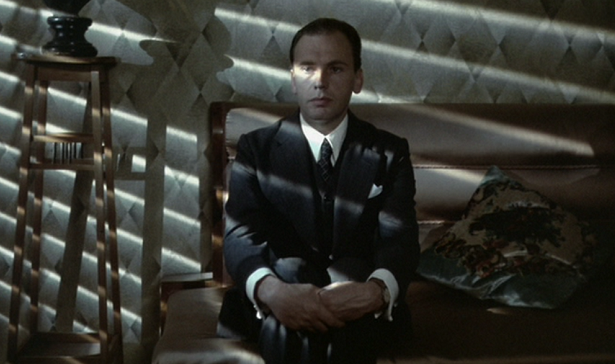
One of the most memorable and widely discussed sequences in the film was of course when Marcello and Professor Quadri met in a room in Paris, and involved a discussion of Plato’s Cave. The scene was atmospheric because of the unique lighting and composition, and Bertulocci / Storaro’s innovative play with light and shadow illustrated the power struggle between 2 conflicting ideologies. The issue regarding the cave also served as an organizing symbol for the whole film and allegorized Marcello’s situation nicely. There are a few viewpoints I can think of about the allegory. First, the idea about Plato’s cave is that the men in the cave are not allowed to see the real world outside the cave, and all they can see are shadows. Bertolucci nicely illustrated that through the light-and-dark play, by having Marcello seeing his shadow on the wall a few times. What Plato was trying to say was that if one could not escape the cave, they would never see the thing-in-itself (the ultimate reality), and could only see the phenomenal world, which he believed was not the most real one in a metaphysical point of view. He further stated that most of the people would conform inside the cave and happy with receiving what they saw inside the cave, without having the courage to step out and figure out what the reality looked like for themselves. This was similar to Marcello’s case, where he simply conformed to the predominant, Fascist thinking of his time and was not trying to examine whether that ideology was justified in the world or not.


A second viewpoint is that Plato seemed to imply that the people in the cave was misled to believe that what they saw inside the cave was the reality, and therefore they probably did not feel that was a need to verify whether that was true or not.  The case bore resemblance to Marcello’s, because his childhood trauma led him to connect the dots erroneously and believed that his conformist and normalizing tendency were the consequence which originated from that, and eventually led him to more evil deeds.


I can think of a third viewpoint. The presence of the shadow reminds me of Carl Jung’s ideas, the fact that there is always a shadow behind everyone’s psyche. The shadow on the wall represented what haunted Marcello – his darkest urges and trauma. He has tried hard to escape from the clutches of his shadow, the dark side inherent in every person. Yet, his character and attitude meant that he could not be able to defeat that, and Quadri’s additional lecture to Marcello also could not save himself, too.


Marcello and Quadri also discussed Marcello’s unfinished doctoral thesis about Plato’s Cave. Quadri lamented that Marcello could not be able to finish the thesis as he felt Marcello was a gifted student with potential, yet Marcello pointed out that the reason why he did not finish it was because Quadri left the school in the first place, leading to his abandonment of the thesis. While this chick and egg scenario took a cyclic irony, it also had Freudian implications because it represented the theme of abandonment. Maybe both Quadri and Marcello served some responsibilities for Marcello’s dark personality. If Quadri has been able to educate and inspire Marcello better, he might have prevented Marcello from turning to the dark way, and that would of course prevent his own demise at the end.


After Mussolini failed, Marcello and one of his comrades gathered to think about what should be the next thing to do. The conformist nature of Marcello meant that, when he saw the anti-Fascist movement was rising, he went to change his opinions to an anti-Fascist stance in no time, and criticized his comrade’s old belief. He could be seen as a chameleon in human form – it was just his nature to fit into the big picture no matter the cost. The flatness of this character was what made him a soulless individual, making him easy to be manipulated by ideology.


When I watch ‘The Conformist’ and ‘Last Tango in Paris’, I can’t stop having the feeling that Marcello and Paul have a number of common aspects. Both characters were the victims of their past, for which they were traumatized by events they were not responsible for. True, maybe Paul’s character flaw was what made his wife commit suicide in the first place, yet it could not be all his fault. Both Marcello and Paul could appreciate well the problems they encountered, yet foolishly and tragically, they confused the nature of their problems and combated them in the wrong directions, leading to a self-destructive end. Thus, both stories had psychological elements amidst the other factor. All Paul wanted was someone to care about him, yet he mixed up lust with true love and compassion; all Marcello was to live a normal life and not to stand out from the crowd too often; yet he mixed up being normal and being conformed to something, especially when the idea was horribly wrong. The tragic consequence was that not only they could not achieve more well-being at the end, they have also harmed or traumatized others as a side-effect.   


Such aspects represent Bertolucci’s brand of cinematic pathos.

-End-

(2/2)

by Ed Law

Film Analysis


Friday, 4 May 2018

The Conformist, Part 1


Are you willing to step out of your comfort zone, to embrace in beliefs that may be contentious to others? Are you feeling desperate just to fit into the picture? Are you aiming for a form of flatness in life, which is not subject to any form of perturbations? These appear to be confrontational questions, yet they were exactly the questions Bernardo Bertolucci wanted his audience to think about in one of his most famous films – ‘The Conformist’ (1970)!


‘The Conformist’ was the film that has led Bertolucci to international stardom as a filmmaker in the early 1970s. Having won a number of awards around the world and an Oscar nomination for Best Screenplay, the film is memorable for being one of the most visually brilliant films in the history of cinema. I can say that is already pleasant by simply looking at the film images alone – the vibrant images constitute an organic unity of visual poetry that prove to be rare in cinema. Other than Bertolucci’s genius, the effort and creativity offered by the director of photography, Vittorio Storaro, was also essential for bringing ‘The Conformist’ to such a status. In fact, ‘The Conformist’ could be considered one of Storaro’s most iconic works, and Storaro is the rare sort of cinematographer that has its own photographic style, which I will discuss in the later passages of this article. No matter which filmmaker he has worked with, you can likely detect his presence through his signature style. Again, ‘The Conformist’ is a beautiful film one can easily fall in love with – and what is the problem if that is a really great one?


The story concerned Marcello, who lived in the Fascist era of Italy. He became a correspondent of Fascism, and his mission was to assassinate Professor Quadri, his teacher during his college years. Quadri, currently living in Paris, was involved in some political resistance against Fascism, and therefore was marked as a target for termination. The story was told in flashbacks, which explored the social, cultural and psychological reasons why Marcello became a Fascist and has developed an attitude of extreme Conformism to the political setting around him.


When one watches ‘The Conformist’, how can one not notice the stunning visual aspect of the film? While Bertolucci has been largely responsible for delivering such an impressive mise-en-scene, the achievement would not be possible without the hard work and vision of Vittorio Storaro, the director of photography who has collaborated on numerous occasions with Bertolucci. Storaro can be considered as the rare sort of cinrmatographer who has developed a unique and recognizable visual style as original as any filmmakers. Indeed, ‘The Conformist’ can be seen as one of Stararo’s major achievements, and the film can serve as a textbook example of how to do brilliant cinematography.


Storaro’s camera style has a few notable characteristics. First, that is the fluid and mobile camera movement, and that is so smooth that it appears as if the camera is dancing, and that gives the audience a flowing and liberating feel. He is also known for a narrative use of lighting effect, and often uses high contrast lighting effect to enhance the atompshere. His choice of colour and light usually led to expressive effects that contributed to the narrative and atmosphere of the scene. Storaro was particularly noted for a combination of colour tune consisting of cold blue/warm yellow, giving very contrasting and expressive results. Having a sound understanding of colour temperature, he has been able to make a number of beautitul Technicolor films with directors including Bertolucci.


Bertolucci and Storaro have drawn influenced from the artistic style most associated with Fascist Italy, in order to lead the audience into that particular political climate in the 1930s. Notice that the preferences were not merely visual gimmicks. The visual and camera or lighting style also served a narrative purpose. It illustrated the exaggerated situation of Marcello and the Fascist beliefs he attempted to embrace and conform to, much like the decors of Expressionism were used to externalize the madness of someone’s mind.


The film has a unique style of having contrasting light and dark/shadow often in the same shot, rather than a balanced or natural arrangement. This style was deliberate from the filmmakers likely because they tried to show the co-existence of conflicting ideologies, and most of all, good and evil that fought for control in the world.


The filmmakers have used light and dark to represent the Freudian conscious and unconscious respectively. They have decided to shoot the Italian scenes in a more claustrophobic way, and the color tone was dry and institutional, to show Marcello’s entrapment in the Fascist regime. In contrast, the French scenes were more balanced with light and dark, and the space was more open, as if offering Marcello an opportunity to escape – which of course he failed to grasp.


Before we finish here, I also want to divert a bit from ‘The Conformist’ and talk about Storaro’s impressive work in 2 other films, ‘Last Tango in Paris’ and also Francis Ford Coppola’s ‘Apocalypse Now’. Of course, a common element between the two classics is the presence of Marlon Brando, and both films include a our-of-this-world monologue respectively – the one about Paul’s recollections in ‘Last Tango’, and Colonel Kurtz’s ‘Horror’ monologue in ‘Apocalypse’. Storaro seemed to have been using a similar style when he shot these two scenes, with an emphasis on the contrast of light and shadow, so that at some point Brando’s almost close-up face were in the dark, and then reappeared at the next moment, giving that a ghost-like quality. This approach seemed nicely with the message the directors were trying to convey, namely, the difficulty to access one’s mind in ‘Last Tango’, and the duality of Man in ‘Apocalypse’ - which, is very much the theme of 'The Conformist'.


(1/2)

by Ed Law

Film Analysis


Monday, 30 April 2018

Last Tango in Paris, Part 2

One of my favourite shots in 'Last Tango in Paris'. Bertolucci's and Storaro's paintly composition and use of color made it memorable.


Bertolucci’s ‘Last Tango in Paris’ has always been an enigma. The film has inspired discussions and debate regarding its meaning ever since it emerged, and all sorts of interpretations have been proposed to the story. Bertolucci did not spell out all the details in the plot, because he wanted to engage the audience to think and use their imaginations. The style of the story is very representative of the style of European art films, when ‘scenarios’ are staged – in a often episodic or poetic manner – and motivations are often ambiguous. Indeed, the scenes in the film were formalized and could be compared to ‘snapshots’ of the characters’ lives. The story of ‘Last Tango’ unfolded in an alternating manner, where the scenes could be either categorized as (a) Paul and Jeanne’s carnal experience in the apartment; and (b) the experience of either Paul or Jeanne in the outside world. The fact that these two scenes were staged in an alternate manner make it similar to a day-and-night dichotomy, and as I have suggested in the previous article, it sort of symbolized the unconscious (represented by desire) and conscious (represented by reality) of the characters’ psychological makeup.
Even when one watches ‘Last Tango’ many times, different interpretations can be given to the story. Did Jeanne have any feelings at all to Paul? Why did Paul’s wife commit suicide? Did Jeanne and Tom have a genuine love relationship? And after all why did Jeanne keep on coming back to Paul if she was not comfortable about that – was she just not sure, or as someone might provocatively suggest, that represented a sadomasochist relationship or Stockholm Syndrome? These are just some of the mysterious questions that have been haunting the audience over the ages, and I believe that is the continuing attraction of ‘Last Tango in Paris’.
Marlon Brando has delivered one of his best ever performance in the form of Paul, the depressed widower. Audience tends to concentrate too much on the controversial sex scenes, and they may overlook Brando’s brilliant performance in this film. As a big fan of him, I in particular enjoy Brando’s performance in the 1970s – from ‘The Godfather’ to ‘Apocalypse Now’ and even his cameo as Jor-El in ‘Superman’. He has delivered first rate monologues, and there was an intricate aspect about most of his roles. While he often starred as characters who possessed power or had the courage to fight for it, there was always a vulnerable dimension in the same character, and that was most evident in his role as Paul in ‘Last Tango’. Paul, having lately lost his wife, was empowering himself through the control on Jeanne, and to be honest, certain cases of his advances towards Jeanne could be considered harassment or even rape. Yet, he was truly desperate and mournful at the same time. I guess the magic from Brando originated from a delicate balance in terms of performance, and that was what made his characters fascinating.
As a method actor, Brando has contributed a lot to his role through improvisation in the film. Indeed, some of the quotes were based on his past recollections. Two sequences were absolutely sublime – Paul’s monologue about his past, when he was reclining in the apartment; and Paul’s monologue to the corpse of his wife. These were brilliant moments because they were the points when Paul really expressed his feelings about his life and beliefs in general. In the other scenes, either he maintained an anonymous relationship with Jeanne, or he tried to distance himself from the others around him, and most of those quotes were banal and vulgar. In general, one could see most of the quotes in the film were in an opaque style, they were often contextual and one could not really draw most inferences from what the characters were thinking – unlike in the narrative-oriented style of classical cinema – and I think that was Bertolucci’s intention after all.
When Paul was alone in front of his wife’s coffin, the monologue delivered by Brando was probably one of the actor’s greatest moments in cinema. Literally talking to a corpse, he has expressed a rich feeling of regret and persecution. Paul lamented the fact he could not access to his late wife’s psyche, and doubted that the intention of his wife to marry him was merely to retreat from life. The scene was important because it exposed Paul’s character flaw and weakness. Bertolucci did not tell us much about Paul’s wife, all the information was from the subjective, and often opinionated comments from Paul. Paul did not feel responsible for the failure of their relationship, and he felt that the reason why the marriage led to a tragic end was because of the infidelity of his wife, which he castigated her as a ‘pig-fxxking liar’ or so on. The comment being both banal and misogynistic, Bertolucci put the audience into Paul’s shoes, and led us to experience the situation from Paul’s point of view. If there was any reason why Paul could never understand his wife – or other women in general – that was because of his passivity. What the story suggested was that Paul’s character could not provide compassion and care to the other half of his relationship, and therefore he could only have these relationships – sexual in many cases – in an instrumental manner. I suppose what Bertolucci was implying was that Paul was repeating history – his relationship with his late wife probably mirrored his relationship with Jeanne.  
Paul the desperado
So, is Paul a bad guy? Well, yes and no. The beauty about the film was really the complexity of Paul’s character, and anyone will probably have a love-hate relationship with him. The audience would hate him for being vulgar and treating women in a disrespectful manner, yet they also wanted to love him because he was vulnerable and was crying for help. I would say Brando has successfully portrayed a character of nihilism, because he could not find much meaningful aspect after he lost his wife. He was just like someone into drugs or severe alcoholism, and foolishly believed that these instruments could help him to pass the time and eventually lead him to a better endpoint. For Paul, his poison was sex. Paul had absolutely no idea that he was railing on a self-destructive path, and his experience with Jeanne would most likely traumatize her also. Instead of looking for genuine romantic love or positive relationship, Paul succumbed to a detached and carnal sexual relationship, and eventually got nothing from that.
After all, the anonymous sexual relationship with Jeanne was merely his psychological defensive mechanism. He wanted to divert his focus from the regret and guilt he had for his failed relationship with his wife. That was why he stressed all the times ‘no names’ to Jeanne, because in a philosophical point of view, names led to associations of things, and thus entailed responsibility. Paul wanted to live the sexual experience one at a time, even if Jeanne provided the subtle implications that their relationships could be developed to another level, like friendship – Jeanne did not mind telling Paul about herself, but was always stopped by him. By engaging with Jeanne in this banal way, Paul was rid of any responsibility and commitment, and could therefore fuel his most nihilistic existence.
Jeanne the enigma
An interesting aspect noted by many viewers was the imbalance of knowledge the audience would be accessible for the two main characters. Bertolucci appeared to allow full access for the audience to understand Paul – he spoke out what he felt and thought about, through his introspective monologues. Yet, Jeanne was very much an enigmatic character. We did not know clearly what her motivations throughout the film were, and how she really felt about her relationship with Paul. That was ironic because it served as a parallel to Paul’s scenario with his dead wife. He failed to understand her and see through her soul, he could not connect with her emotionally.
Jeanne seemed to be a more flexible character, and she was able to fit in to both Paul’s world and her boyfriend’s cinematic world. She was willing to explore for different possibilities, yet it was evident that she has not been able to make up her mind. To me, the reason why Jeanne kept coming back to Paul was because she was confused and she did not see that much harm of engaging the relationship with Paul. Maybe there was a psychological need for her, and she probably did not take the issue seriously. Jeanne was oblivious – or not fully aware of, to be fair – Paul’s emotional turmoil and did not see that he was using her as an instrument to get over the hard times. Because both characters had such a distorted expectation from the relationship, it would be clear that Paul was asking too much from Jeanne. At the near end of the film, Jeanne has made up the decision to marry her boyfriend, and gone to try the bridal gown. Yet out of a bout of indecision, she ran away and went back to the apartment. Later, when she and Paul was in the dance hall, she was juggling with all sort of conflicting feelings about Paul, and eventually decided to leave Paul for good. Yet, Paul continued to pursue her into her apartment, and impulsively, she pulled a gun on her and killed him.
As Jeanne stood almost frozen in the apartment, she kept on rehearsing and repeating that she did not know Paul, and said he tried to rape her, as if practicing the statement to say to the police later. Certainly, the murder was an impulsive act, yet it was clear that Jeanne regretted doing that. Because, Jeanne clearly had some feelings for Paul after all these. In order to defend her from the psychological stress, she tried to pretend the whole relationship has not existed at all. While in a legal standpoint there was a smart move – because after all their relationship was secretive and anonymous, and Jeanne could argue her action as a self-defense from a stalker – emotionally it was unsettling because she was lying to herself. In her heart, she would not forgive herself for doing this, no matter how repulsive Paul might have seemed shortly before that.
Over the years I watched ‘Last Tango in Paris’ again, I have the feeling that Jeanne and Paul’s story could lead to a good ending if they had a better direction for their relationships. What Paul needed was not sex, but someone who could give compassion and listen to him. There should be someone who was willing to understand his plight and prove him wrong on his bleak outlook towards his world. If a romantic love relationship was not possible – Jeanne had a fiancé – then a ‘father-daughter’ type friendship would still be possible, given their age difference. In such a relationship both would be able to contribute. Paul could share more about what he knew to the younger girl, and Jeanne could provide hope and emotional consolation to him. I suppose the reason why ‘Last Tango in Paris’ has become so iconic is not merely because of the dirty lust or so on  - that is because Bertolucci has been able to dig deep into the audience’s soul by expressing something we all care about a lot – the need for human relationships.

-End-

(2/2)

Film Analysis