Showing posts with label Cine Fan. Show all posts

Friday, 21 December 2018

Possession


Recently, a number of films with the great French actress Isabelle Adjani has been released again. Adjani is the rare kind of actress who has demonstrated that ability and beauty can fit so well together. Other than possessing a great look that anyone will never forget, Adjani has demonstrated tremendous talent through her performance, in particular very psychologically driven characters. Be it Camille Claudel, Adele Hugo, or Queen Margot, an Adjani character will leave a lasting impression in the audience's memory, due to her judicious choice of choosing roles and her intense drive and focus as an actress. As the only actress who has ever received 5 Cesar Awards, Adjani has an impressive portfolio that anyone who is passionate in cinema should go after. Yet, her most iconic performance is probably in a cult film , which is also very well known from mainstream audience - Possession (1981) !


Possession is a film full of surprise. While the film is certainly intended for arthouse cinema, it has achieved a cult status among mainstream audience. While the film appears to be a horror film, it is a cerebral film , and very rarely a performance from a horror film Adjani's memorable performance has been recognized by Cannes festival and other award for art films. I personally do not find Possession scary, though there are some genuinely gross out and disturbing moments, and the film has been banned in certain countries for 20 years ! Possession is the introduction to the cinema  of  Isabelle Adjani - once you are 'possessed'  by this cult classic, you will find yourself in an obsession with Adjani's gift for acting and watch her films one after and another !


The name of the film has two layers of related meanings. From the context of the film, it means possessed by the evil. Yet, we can also understand the meaning in a more common meaning of the word - that of ownership. The tragic consequence is due to the fatc that the two main characters see each other as a 'possession'- with an obsession and desire to 'own' the other and control the other. Obsession is different from love, because love is based on respect and a consideration of the other's feelings, while obsession is more one-sided and merely served to fuel one's desire for control and satisfaction. Even the plot of a satanic intervention can provide much sensation and macabre for the story, I feel that it is the psychological aspect of the story that makes it terrifying...

(To be continued)

by Ed Law
Film Analysis


Sunday, 16 December 2018

Cries and Whispers


Can the serenity of everyday life undermine the darkness that threatens to haunt all of us? Can the institution of family control the rawest desire and emotions that are inherent to any human beings? When you are faced with the bleakest and most inhuman moments that is nonetheless fundamental to our existence, would you choose to turn away from those, or have the courage to admit our weaknesses? As I have always maintained, the truths of humanity will only emerge at the most extreme situations, when the instinct for self-preservation rules over any notions of the polite society and cultural machine. That is indeed the wonderful aspect about cinema, which represents a chance to provide all these hypothetical scenarios to provoke our thoughts. All these themes are brilliantly explored in my favorite European film of all time - Ingmar Bergman's 'Cries And Whispers'!

If you have read my previous articles, you would probably have noticed ‘Cries and Whispers’ has already been mentioned many times. Now is the time to have a formal introduction of this film. It is fair to say that I have fallen in love with the film since I first watched it many years ago, because the film is so one-of-a-kind and fantastic in many aspects. Not only it deals with and presents the issues of human nature in an inspiring manner, it also presents some of the most memorable visual images ever in film. Be warned that while the film appears like a ‘chick flick’ about 4 women, it is probably one of the most emotionally intense films in cinema history, and the images in the film will imprint and haunt your minds even a long time you have watched it. I think ‘Cries and Whispers’ is kind of a chilling film, because the more you think about that, the more you can identify with the film and it is totally possible that the scenarios in the story can take place in real life. Though it is in no way a horror film, the darkness of humanity portrayed in ‘Cries And Whispers’ will make your heart pound more than any of those ‘cheap-scare’ movies nowadays. The beauty of ‘Cries and Whispers’, as one may appreciate from the title, lies in its inherent contrast – while it is a very stylized film in terms of form and narrative, it also bears relevance to the audience because of its stark realism.

The story took place in a mansion in the 19th century, and concerned 4 women, Karin, Maria, Agnes, who were siblings; and Anna, their maid. Agnes, due to a weak health, was dying from cancer. Did this crisis draw the family closer together? Unfortunately, no. Karin and Maria, while having contrasting characters, were emotionally distant to Agnes and reluctantly came back to the mansion to take care of her. While bearing with the negative aspect of death and decay, they also had to confront their own personal problems, and the relationships between each other. Only Anna, who had a religious faith, was emphatic and could be able to console Agnes, who was already bombarded with tremendous physical pain and mental anguish (which is pretty nasty to see on screen). Bergman presented the story in a very stylized and formalized way. He divided the story into parts, and each part was concerned with one of the characters,  and provided insights on that character and how she has come to possess such a personality. Though the most memorable moments of the film were often concerned with the darkness of human nature –   be it emotional coldness, self-mutilation and meanness to others, Bergman also celebrated the noble nature of humanity – selflessness, redemption, and the consolation achieved from imaginations and dreams.

Ever since my childhood, I have pictured inside of the soul as a moist membrane in shades of red. 
– Ingmar Bergman , 1972

(To be continued.)

by Ed Law

Film Analysis


Sunday, 8 March 2015

Children of Paradise


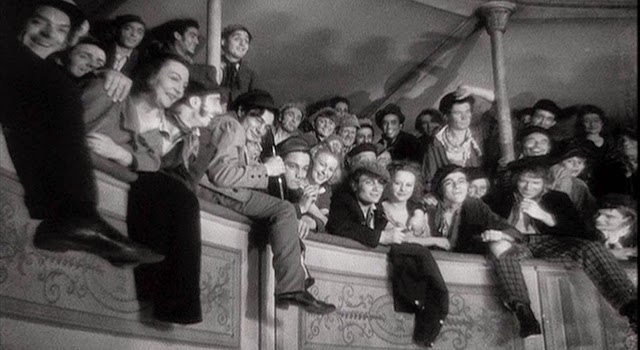
Children of Paradise was a highly-regarded film in French cinema.  Marcel Carné has provided a grand finale to the style of Poetic Realism in this epic love story. The paradise, in a sense, is where the gods reside - but not in a religious sense. ‘Paradis’ in French refer to the highest positioned - and hence the cheapest seats - in a theatre (in English we call those ‘the gods’). So, the children of the paradise were the common everyone that Poetic Realists were most interested in.


The story concerned some sort of a goddess in the name of Garance who has caught attention of no less than 4 male contenders, of various antic dispositions. She was likely to be in true love with Baptiste the pantomime artist, yet their relationships were almost Platonic.  The other 3 men could not afford sincere love, their intentions were far more instrumental and the facades they possessed would p only prevent Garance from a closer bond to any of them. Indeed, bad blood was stirred up among this trio.  Eventually, mademoiselle Garance would be inaccessible to any one of these, and she disappeared amidst a bunch of pale Pierrots.


‘Shut up! We can’t hear the mime!’

The theater scene in ‘Les Enfants du Paradis’ was a portrait of the real world we situated in, and the realism was achieved by illustrating its carnival-esque side. This was spectacularly executed by a deep focus shot that showed the mass of audience at the paradise section. Garance’s odyssey represents a flow between truth and deceptions, real and theatrical, authenticity and pretentiousness. Carné was capable to reconcile all these opposites, as signified by the smoothness of the sequence, and that led to the blurring of reality and fiction.


Garance’s tool of trade involved a 360° round-a-bout in a bathtub when she was inspecting herself in the mirror. To me, this famous scene represented a deconstruction, a breakdown of dialectics. Garance, in a sense, was asking ‘am I watching or am I being watched’, and her introspection with the mirror suggested she was pondering her being. Indeed, some critics believed that Garance was a symbol for ‘cinema’, and there were some truths to it. The deconstruction of ‘subject’ and ‘object’ was complimented by a shift of focus from a more traditional film theory (i.e. the gaze theory) to a more reader-oriented / hermeneutical theory. The focus was not about what the director wanted the viewer to see, but rather the audience took the liberty to draw their own conclusions from their viewing experience.


A key theme in ‘Les Enfants du Paradis’ is that of ‘displacement’. Things are misplaced and conceptions are faultily designated throughout the film. Baptiste would be able to acquaint with Garance on numerous occasions, but their romance could never flourish. Baptiste’s real wife, as a result, suffered because he could not afford any real love to her. Too many times, Garance was accused of crime she didn’t even commit. Frederick, the actor, could completely distort a script he tried to adapt, switching a melodrama into some sort of a farce, which insulted the original authors gravely. When Baptiste learnt of the fact that Garance has been watching him perform so many nights, he rushed to her box, only to find she has already departed. When the three men verbally sparred with each other to determine who deserved Garance the most, the unveiling of a curtain only showed the truth that Baptiste and Garance deserved each other. In the film, this paradise was in no way a heaven that granted wishes. All forms of displacement became almost prevalent in such a real, brutal and chaotic world.


Too often, poetic realism is about the reconciliation of the 2 ends of the dialectics, namely the truth and the fiction. Transcendence was another key theme in ‘Les Enfants du Paradis’, because a lot of thin lines have been crossed. We could see actors in the play mingling in the audience, and a talking mime around. All these rules have shown artificialities, which suggested the oppositions were futile. When Garance was accused of stealing, Baptiste stood up for her. But instead of giving descriptions verbally, he literally acted out the whole situation using pantomime techniques. Not only the act was fascinating (that’s what we call ‘cool’), I believe Baptiste’s style was emblematic of the spirit of Poetic Realism – what he did was to ‘represent’ the theft. Based on a careful observation of an objective truth, he used an art form to illustrate that and resulted in a significant realism. The motivation behind this was that of justice, rather than the various nefarious motives the other 3 men had when they approached a goddess like Garance. Yet the end was bittersweet, as none of the men would sustain any relationships with her, and she would lose herself again in a word of masks. This really gave Poetic Realism a rather tragic finale.

Poetic Realism (2/3)

by Ed Law
8/3/2015

Film Analysis - 36